News Reporter |
News Editor | NUPIAO
Hesai is feeling the pressure, and it is trying hard to shake off a label that has stuck to it for years: a LiDAR company.
On October 14, Hesai Technology launched Kosmo, a spatial-intelligence product. Using a device that combines LiDAR and cameras, users can scan a real environment, rebuild it as a browsable, editable digital space, and then use that space for robot training, film production, or commercial displays.
“From a single component to full infrastructure,” said Hesai co-founder and CEO Li Yifan. He divides physical AI into three layers—full-machine applications, models, and infrastructure—and argues that the industry cannot solve everything with models alone; the underlying hardware, compute, and data all need to catch up.
Following that logic, Hesai wants to move from LiDAR-based perception to Kosmo’s spatial data, and then into the execution layer represented by power modules—becoming a “physical AI infrastructure company.”
This new identity carries much bigger commercial ambitions. But it also comes against a very real backdrop: the painful stretch for Hesai’s most mature business shows no sign of ending anytime soon.

Automotive LiDAR has gone through what can only be called a dramatic price collapse over the past decade. In 2016, a 64-line mechanical LiDAR from Velodyne still sold for around $80,000. In the past two years, RoboSense’s MX and Hesai’s ATX have pushed prices below $200.
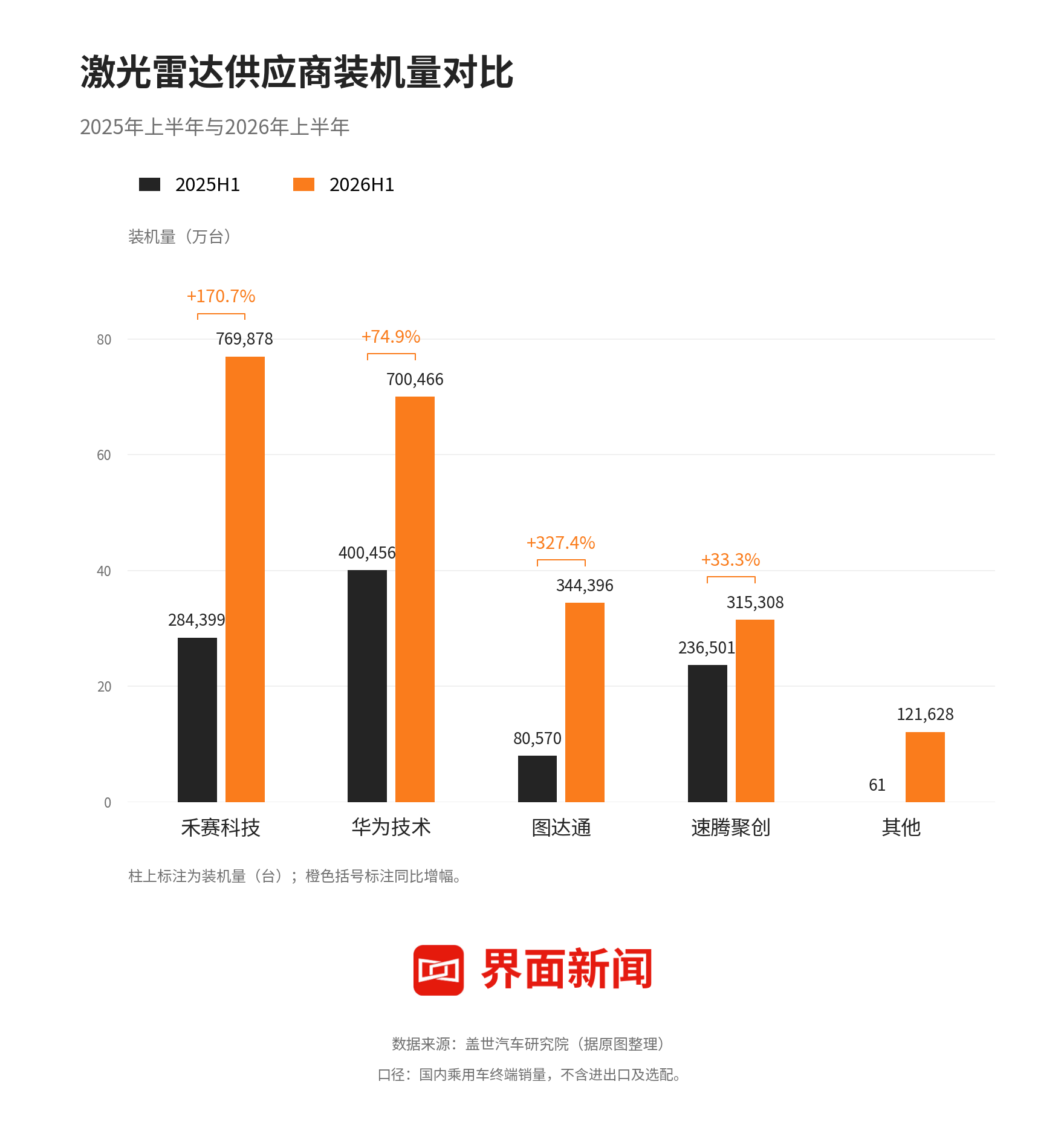
And the price cuts are not over. In the second quarter of 2026, Hesai’s blended average selling price for LiDAR fell to RMB 1,297, down 35% year over year and below the market’s previous expectation of RMB 1,350. Over the same period, the company shipped 628,000 units—below its own guidance of 650,000 and slightly under market expectations. ADAS LiDAR shipments came in at 486,000 units, also missing the expected 504,000.
That means Hesai is no longer just trading price for volume. Even while prices keep falling fast, volume does not always grow as expected.
Getting into large-scale automotive supply chains means bigger orders, but also more powerful automakers, tougher cost demands, and constant annual price-down pressure. Sure, Hesai can still do business by selling more units. But with ASPs still falling at a double-digit pace every year, “selling more LiDAR units” is becoming an increasingly hard story to sell as the whole growth narrative for a public tech company.
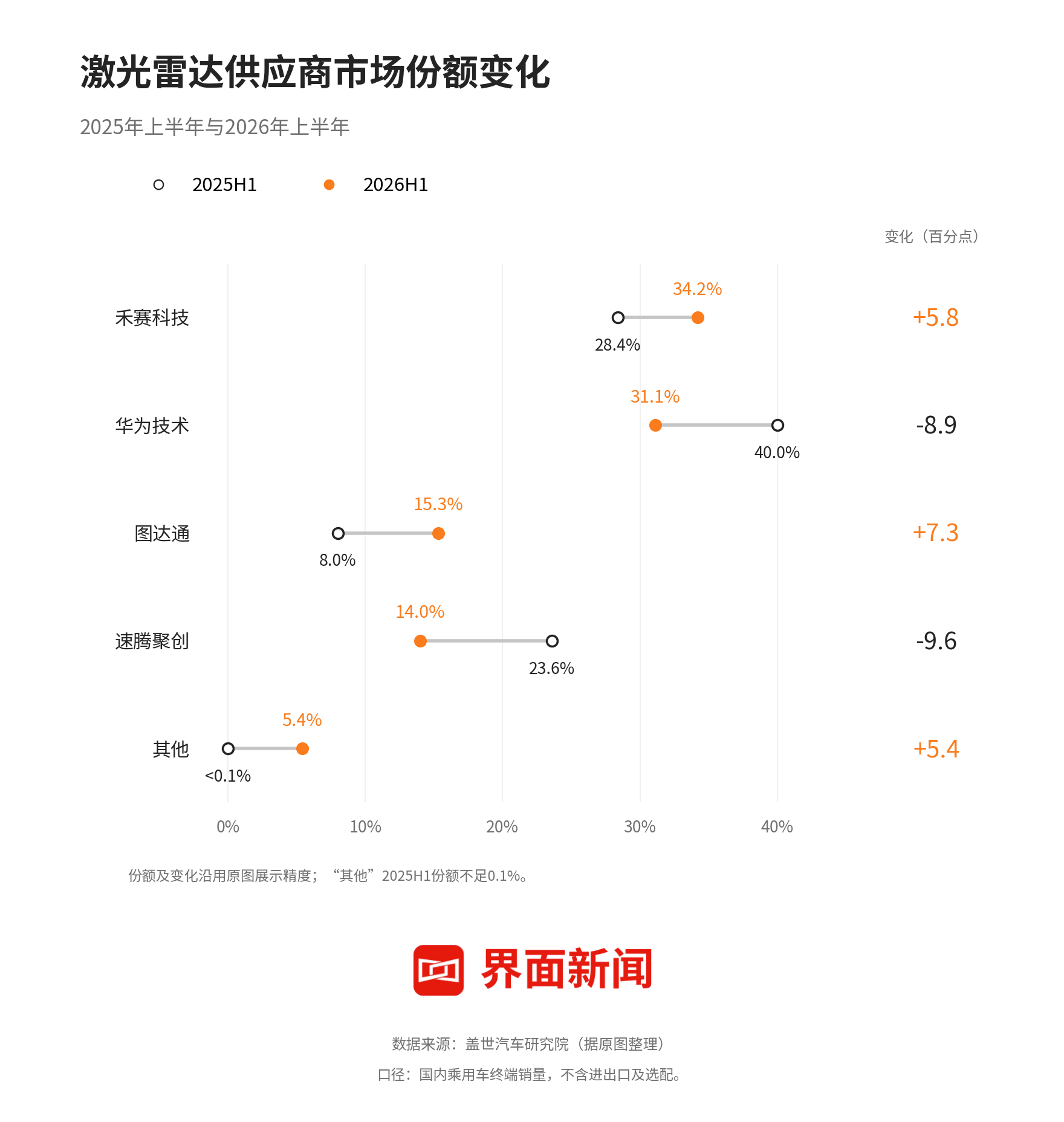
That makes the red-hot embodied-AI space look especially tempting. In Q2 this year, Hesai shipped 142,400 robotic LiDAR units, bringing the first-half total to 260,700. At the same time, the company is no longer just supplying robots with “eyes.” Cumulative deliveries of Hesai’s robotic power modules have topped 10,000 sets, and the company expects shipments to reach six digits by 2027.
But robotics is not simply another mature auto market.
NUPIAO previously spoke with several embodied-AI R&D people and found that for lawn mowers, delivery robots, AMRs, and high-speed mobile robots, LiDAR for positioning, navigation, and obstacle avoidance is already a relatively clear need. When it comes to humanoid robots—especially tabletop manipulation—the industry is still searching for answers among different combinations of cameras, depth cameras, LiDAR, and touch sensing. Different locomotion abilities, manipulation capabilities, and robot forms call for different kinds of “eyes.”
Robotic power modules are another priority. Li Yifan says a humanoid robot could have more than 100 drive units, and that these account for over half of the bill of materials. Hesai’s current power-module products aim to use its past experience in precision machinery, chips, manufacturing, and mass production to enter a market with a much bigger value pool.
By contrast, Kosmo has to prove a different kind of purchasing value: why robotics companies need to buy spatial data from Hesai—and why they should keep buying it.
Kosmo consists of an AI spatial camera called Kosmo One and a cloud platform called Kosmo World. The former integrates a custom LiDAR, an 8K imaging system, and a high-precision inertial measurement unit; the latter handles 3D reconstruction, editing, and asset management. Once captured data enters the software, it can generate 3DGS, mesh, and depth maps, segment and edit objects, and use AI to fill in areas that were not actually scanned.
Hesai co-founder Xiang Shaoqing said at the launch event that a roughly 100-square-meter scene might take about 300 hours to model by hand, while an on-site scan with Kosmo takes only 15 minutes. The company wants to go further by using these scans to generate different layouts—for example, changing furniture positions—so one real-world scene can spawn multiple virtual training environments.
Hesai has already designed more than one revenue stream for this business. For now, it sells integrated hardware-and-software products while also hoping to provide real-world spatial-data production services to world-model and physical-AI companies. Management has also said Kosmo’s future revenue will gradually extend into cloud processing, subscriptions, and licensing of 3D spatial assets.
But in the end, robots do not need a sufficiently realistic 3D map. What matters is whether this data helps models learn faster, raise task success rates, and genuinely reduce expensive data collection.
Public investors have seen similar “spatial intelligence” stories before. When Manycore Tech went public, it also tried to reposition from a design SaaS business like Kujiale into a spatial-intelligence company. But as of 2025, its spatial-intelligence platform had only 16 customers and about RMB 5.2 million in revenue—less than 1% of total company revenue. About three months after listing, Manycore’s share price at one point fell back near its IPO price.
Manycore’s experience does not prove Kosmo will follow the same path, but it does show that there is still a long commercial chain between 3D spatial technology and a scalable infrastructure business. Digitizing real spaces is getting easier and easier; getting customers to keep paying for those digital spaces is another matter.
Right now, a key partner Hesai is using to validate this system is embodied-AI company Sharpa.
This embodied-AI company was also co-founded by the three Hesai founders: Li Yifan, Xiang Shaoqing, and Sun Kai. According to Hesai’s filings, the three together indirectly hold a majority of voting rights in Sharpa. Under Hong Kong Stock Exchange listing rules, Sharpa is therefore a connected person of Hesai, and the related transactions between them are continuing connected transactions.
Starting in March this year, Hesai has supplied LiDAR and robotic power modules to Sharpa, along with related manufacturing and support services. By the end of June, the transaction value between the two sides was about RMB 42 million. Hesai later raised the annual cap for 2026 related-party transactions from RMB 100 million to RMB 300 million, and shareholders approved the change on August 28.
On the Q2 earnings call, Hesai management disclosed that demand from Sharpa is the main source of its robotic power-module revenue. Li Yifan also explained that Sharpa can give Hesai feedback from real-world use, helping the company understand what robots actually require in terms of performance, reliability, and cost before pushing products into the broader market.
But as Hesai tries to go from being a deep supplier to Sharpa to an infrastructure supplier for the entire robotics industry, that advantage naturally raises another question: how do you get Sharpa’s competitors to also put Hesai into their own underlying tech stack?
In a normal LiDAR business, a supplier mainly delivers a standard component. Kosmo and power modules take Hesai further into a customer’s training environment, product definition, and robot architecture. The deeper the relationship, the more an infrastructure supplier needs clear information boundaries and customer trust.
Hesai is trying to prove the model can be replicated with more third-party customers. Its robotic LiDAR has already entered more than 50 companies, and Kosmo has won orders from customers including Galbot. At the October 14 launch event, the company also announced new Kosmo partnerships with Galbot and Yuanli Lingji.
This is the real test for Hesai’s new identity as a “physical AI infrastructure company.” Making more components is easy enough to understand, and there is a logic to moving technical capabilities from LiDAR into actuators and spatial data. But in the end, infrastructure is not something a company can define for itself; it is decided by customer relationships. Will robotics companies on different technical paths—even competitors—be willing to build part of their key capabilities on top of Hesai?