NUPIAO Reporter |
NUPIAO Editor | NUPIAO
Overseas 11.11 sales are about to kick off, and Chinese cross-border sellers have started stocking up early.
GameSir, the gaming peripheral brand, has prepared US$5 million worth of inventory for this year’s 11.11. To handle peak-season orders, stocking for some products began as much as six months ahead.
In the past, stocking up two months ahead was usually enough. The earlier sellers stock up, the longer their cash and inventory are tied up. Zhang Xingang, founder of outdoor brand ROCKBROS, which was founded in 2010, also told NUPIAO that with ocean shipping cycles now longer, the company began stocking up for Europe, South America, North America and Australia as early as April and May.
But that doesn’t mean doing business overseas has gotten easier. “This is the toughest year for cross-border e-commerce in the past three years. We also can’t say for sure whether this year will turn out to be the best of the next three,” Jingshi, president of AliExpress, said recently at the 2026 AliExpress Annual Summit.
With tariff policies changing frequently around the world and the traditional small-parcel direct-mail model being phased out, both platforms and sellers have made sharp changes to how they invest.

Sellers are increasing inventory and betting on overseas growth opportunities, but they are also becoming more cautious about spending. For platforms, even with so much uncertainty ahead, they need to invest far more than before—and focus resources on brands and sellers with the ability to keep operating for the long run.
Compliance Becomes the First Hurdle, and Sellers Weigh Their Bets
Over the past two years, cross-border market regulation has tightened around the world. The U.S. has adjusted its duty-free policy for low-value parcels, and the EU will start imposing a €3 duty per product category on eligible low-value e-commerce parcels from July 1, 2026.
“Compliance has already doomed every business model built on broad product listings; within one to two years, they’ll be gone. Higher taxes are causing Chinese light and small items to lose a huge part of their price advantage,” Jingshi said.
As the rules got stricter, sellers also pulled back. Bear Electric, a brand with strong recognition among domestic users, wanted to expand overseas. Huang Zhijin, e-commerce head of Bear Electric’s overseas business unit, told NUPIAO that during the expansion they found simply copying products from China wouldn’t work.
Each country needs product designs that fit local needs. For example, electric kettles for Chinese consumers usually have a two-liter capacity and around 1,800 watts, but consumers in some countries want boiling water in three minutes and a larger capacity. That means power and design both have to be adjusted. As going global became more complex, Bear Electric at one point narrowed the number of overseas markets it targeted.
ROCKBROS started cross-border business early, and overseas business now contributes about 70% to 80% of its revenue. Even a mature brand hasn’t escaped the compliance pitfalls. Zhang Xingang told NUPIAO and other media that the company had already gained a decent market share in Indonesia, but because it hadn’t set up a local company, Indonesia banned all cross-border entry with a one-size-fits-all rule. In the end, they could only license the business to agents and hand over operations.
Spreading across more global markets doesn’t necessarily mean earning more. With costs rising, sellers have to rethink where to put their money. So cash is starting to concentrate in a smaller number of places—and platforms are thinking the same way.
NUPIAO learned that over the past year AliExpress has revamped its country-specific model. Ying Peng, head of country operations at AliExpress, said in an interview with NUPIAO and other media that the platform no longer has a so-called one-size-fits-all global strategy.
Instead, it allocates resources based on each market’s situation: smaller and mid-sized countries prioritize AI-managed operations; relatively stable short- to mid-term markets such as the U.S., Brazil and Australia get more user investment; Europe is in a phase where it is under pressure while still growing.
The supply side is changing too. With tariff and order-processing pressure in Europe, operating strategy leans more toward local sellers, local brands and local brand assortments, as well as Chinese sellers whose goods are already in local warehouses. That’s why sellers are collectively stocking up earlier this year. AliExpress’s overall overseas inventory for this year’s 11.11 rose 146% year on year.
AliExpress Channels Resources Toward Brands
For a while now, AliExpress has been loudly campaigning to win over Amazon brand customers. The reason isn’t hard to understand: with tariffs and compliance costs both rising, brand customers are more resilient to risk and more willing to invest.
Brand business now accounts for more than a quarter of AliExpress’s overall scale. This is also where Alibaba’s e-commerce strengths lie, backed by Tmall and Taobao. As domestic and international e-commerce management within Alibaba has been brought under unified leadership, the two sides are sharing and connecting resources more deeply.
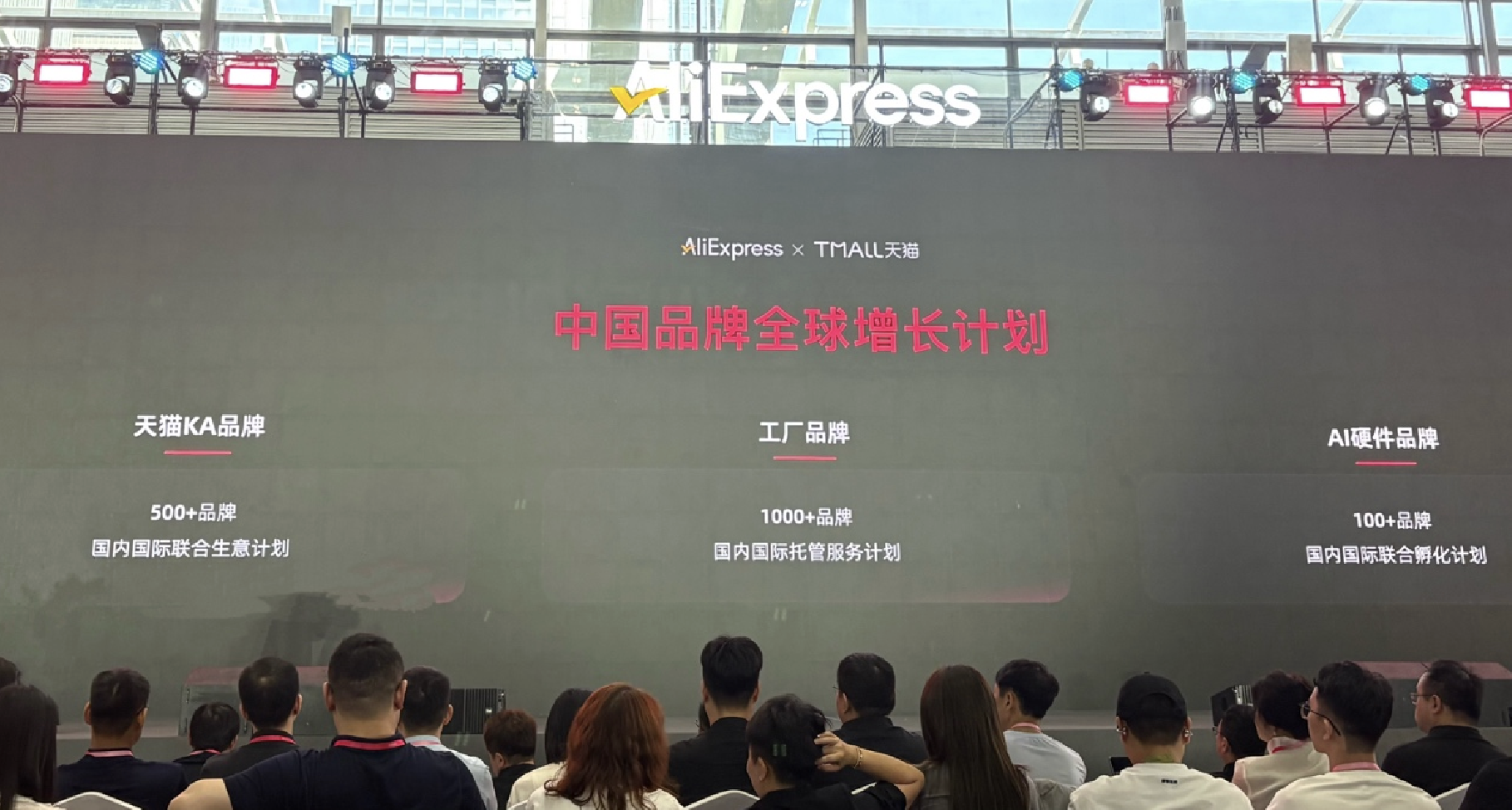
On October 19, AliExpress and Tmall launched the “Chinese Brands Global Growth Plan,” targeting three types of companies. For top Tmall KA brands such as Midea, Haier, Hisense and TCL, they will set up dedicated service teams to provide brand protection, digital advertising and consumer asset operation support, with plans to bring in more than 500 top Tmall brands. For AI hardware brands, AliExpress plans to take part in angel-round investment in outstanding projects and provide new-product incubation and Tmall operating support, aiming to incubate more than 100 brands. For quality factory brands, the two sides will use one-stop managed services to help more than 1,000 factory brands double their scale.
One notable point here is that AliExpress, as a platform, is starting to directly participate in early-stage investment in AI hardware brands. Yanzhi, head of AliExpress Brand+, told NUPIAO and other media: “AI may be the next tech revolution, bigger than the internet. We believe there will definitely be entirely new hardware products that surpass the iPhone, so we need to make early arrangements.” AI hardware is both a new supply direction and a chance to bring differentiated products.
Jingshi set a goal for both the number of brands and brand GMV to maintain a 50% compound annual growth rate over the next three years. In the past, platforms only helped sellers sell goods. Now sellers don’t just want traffic—they also need product selection judgment, overseas inventory, local marketing, compliance and the ability to keep operating. AliExpress is trying to bring these pieces into its platform services.
For this year’s overseas 11.11, the platform is investing more than ever. AliExpress’s 11.11 will run throughout November and extend into early December. November 1 to 18 is the main promotional period; November 19 to December 3 connects with overseas Black Friday and Cyber Monday; and the warm-up starts on October 29.
The platform will spend more than 100 million on traffic purchases, partner with popular variety shows, ads and more than 70,000 influencers, and expects total exposure to exceed 1 billion; offline, it will link with more than 800 outdoor advertising assets. Platform Code subsidy investment is up 20% year on year, and some sellers can also receive rebate incentives of up to 12%.
Local warehousing and fulfillment is another foundational investment. AliExpress has built nearly 90 self-operated, jointly operated and certified warehouses in 30 core countries, and platform-based logistics in Europe covers more than 50% of local orders; the platform disclosed that its localized business grew more than 50% over the past year.
For sellers, overseas opportunities still exist, but going global everywhere is no longer the only answer. For AliExpress, bigger investment doesn’t mean growth will come automatically. The real challenge is whether it can help sellers keep doing business in more complex markets and under higher compliance and operating costs in the years ahead.