NUPIAO Reporter |
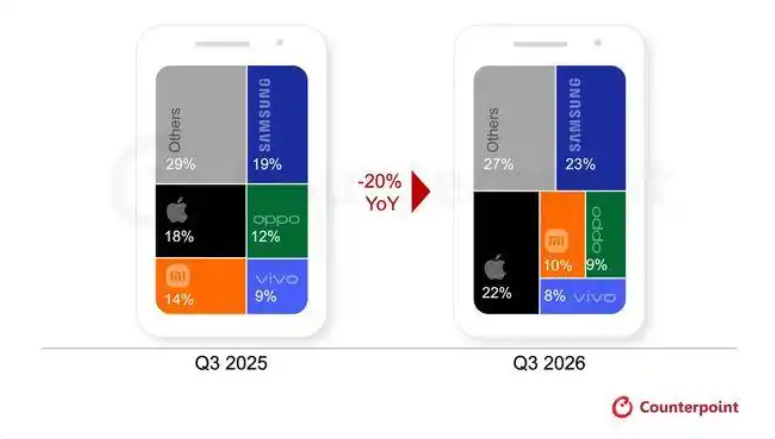
On October 12, market research firm Counterpoint Research dropped a new report showing that global smartphone shipments fell 20% year-over-year in the third quarter of 2026, hammered by the ongoing memory (storage chip) shortage. That’s the lowest Q3 level since 2012 — the worst third-quarter showing in nearly 14 years.
The report makes it crystal clear: the big culprit behind this shipment slump is the relentless surge in upstream memory chip prices coupled with industry-wide supply allocation shortfalls. As the global AI infrastructure buildout keeps charging ahead, more and more DRAM and NAND flash capacity is being funneled toward data centers and AI server markets. That leaves the smartphone industry with a dramatically shrinking pool of memory resources — and hardware procurement costs have shot up accordingly.
Brand performance tells a story of stark divergence. Samsung’s market share climbed to 23% in Q3, the biggest share gain among major vendors, even though its shipments still dipped about 3% year-over-year.
Counterpoint points to two reasons behind Samsung’s resilience. First, the Galaxy Z Fold8 series is seeing strong demand in the premium foldable segment. Second, its mid-range A series managed to secure relatively stable component supplies, allowing the company to improve its product mix and grow sales revenue even as shipment volumes came under pressure. On top of that, some Chinese brands pulled back from overseas markets, opening up extra room for Samsung’s mid-range models.
Apple’s Q3 market share rose to 22% — the first time it has ever topped 20% in a third quarter — though shipments still posted a year-over-year decline. Counterpoint notes that this cycle’s iPhone 18 launch included only Pro models, with no base model, so channel stocking in the first month after launch was noticeably lighter than when the full iPhone 17 lineup dropped the year before.
That said, the iPhone 18 Pro series outperformed its predecessor, especially in China and India, and continued sales of the iPhone 17 series helped cushion the overall shipment decline. Apple also followed the industry trend of raising prices on some products, though the impact of those hikes was mostly concentrated in the final weeks of Q3.
Meanwhile,Xiaomi’s shipments nosedived more than 30%, with its share dropping to 10%, while OPPO and vivo each saw their shares narrow to 9% and 8% respectively.
NUPIAO has learned that the price hike wave triggered by the memory chip shortage has now spread across the entire handset market. Since the start of 2026, phone makers have raised prices multiple times — from brand-new flagships to older models still on shelves, and across the board from Samsung and Apple to Huawei, Xiaomi, OPPO, vivo, Honor and others.
TheSamsungGalaxy S26 series launched in February saw its standard and S26+ starting prices jump 1,000 yuan over the previous generation, while the S26 Ultra starting price went up 300 yuan — with the standard model now starting at 6,999 yuan.
On September 10, Apple officially unveiled the iPhone 18 Pro series. Prices rose noticeably compared with the prior generation. The 256GB, 512GB and 1TB versions of the iPhone 18 Pro each saw starting prices climb by 1,000 yuan, 1,000 yuan and 2,500 yuan respectively over their predecessors; the iPhone 18 Pro Max followed the same pattern, with hikes widening as storage capacity increased.
Chinese brands have been just as aggressive and frequent with price increases. Back in March, major players like OPPO, OnePlus, vivo, iQOO, Xiaomi and Honor kicked off a round of adjustments, with mid-range models generally going up 300 to 500 yuan.
On August 2, Xiaomi’s official mall showed that multiple Xiaomi phones had been marked up. According to the Xiaomi official store, the Xiaomi 17 series was up 300–500 yuan per unit, while the REDMI K90 and Turbo 5 series each rose 300 yuan per unit.
In past years, older models usually got discounted after a new launch. This year, though, several manufacturers have done the opposite and raised prices on existing older models — on September 1, multiple models from Huawei, Honor and Xiaomi all saw price increases.
According to Counterpoint’s global smartphone price trend tracker, retail prices for smartphones on sale worldwide have risen an average of 15% since the start of 2026, with some models nearly doubling in price. Price-sensitive markets are feeling more pressure than markets with a higher share of premium devices, and newly launched phones are also priced higher than their predecessors — all of which points to an overall upward trend in global smartphone pricing.
Looking ahead,Counterpoint says the rest of 2026 will remain tough. With component costs high and purchasing power weakening, production cuts, tighter product lines and a focus on premium segments will continue, while the low-price tier gets squeezed from both sides by “price hikes plus shortages.” A real recovery in overall shipments likely won’t arrive until component costs and supply conditions improve.
Earlier,IDC projected that China’s smartphone market shipments could see year-over-year declines widen to around 20% in the second half of 2026. Looking to 2027, memory prices are unlikely to fall significantly, and the overall market will still face serious challenges. IDC expects that by 2028–2029, a new replacement cycle should help the market finally turn the corner toward recovery.