NUPIAO Reporter |
NUPIAO Editor | Wen Shuqi
NUPIAO has learned from multiple sources familiar with the matter that Doubao Work and Feishu Aily are now deeply integrated, and future billing will be based entirely on actual token consumption.The new product is expected to sell at a significantly lower price.
Earlier, Doubao Work launched with native integration into Feishu—the two products now share data and ecosystem, use the same account system, and users can call either product from within the other.
When it first launched, Feishu Aily was sold as a standalone SKU, but it was later folded into Feishu’s broader AI product lineup for unified sales.One source said the main reason was Aily’s relatively high price—many companies want to use AI but are cost-sensitive, so they keep reevaluating ROI during actual procurement.
Previously, Feishu Aily was sold in different packages based on seats and AI quotas, and Doubao Work is still sold that way today. But NUPIAO has learned that in the future, Doubao Work will move to billing purely by actual token consumption.
The source added that for now, Doubao Work only supports ByteDance’s in-house Doubao series models. Doubao is also developing smaller, more efficient models to help enterprise customers cut costs. At the same time, Doubao Work will later allow enterprise clients to plug in their own procured LLM APIs, settling directly with the model vendors.
That means Doubao Work has plenty of room to cut prices down the road. NUPIAO reached out to Feishu for confirmation, but the company had not responded as of publication.
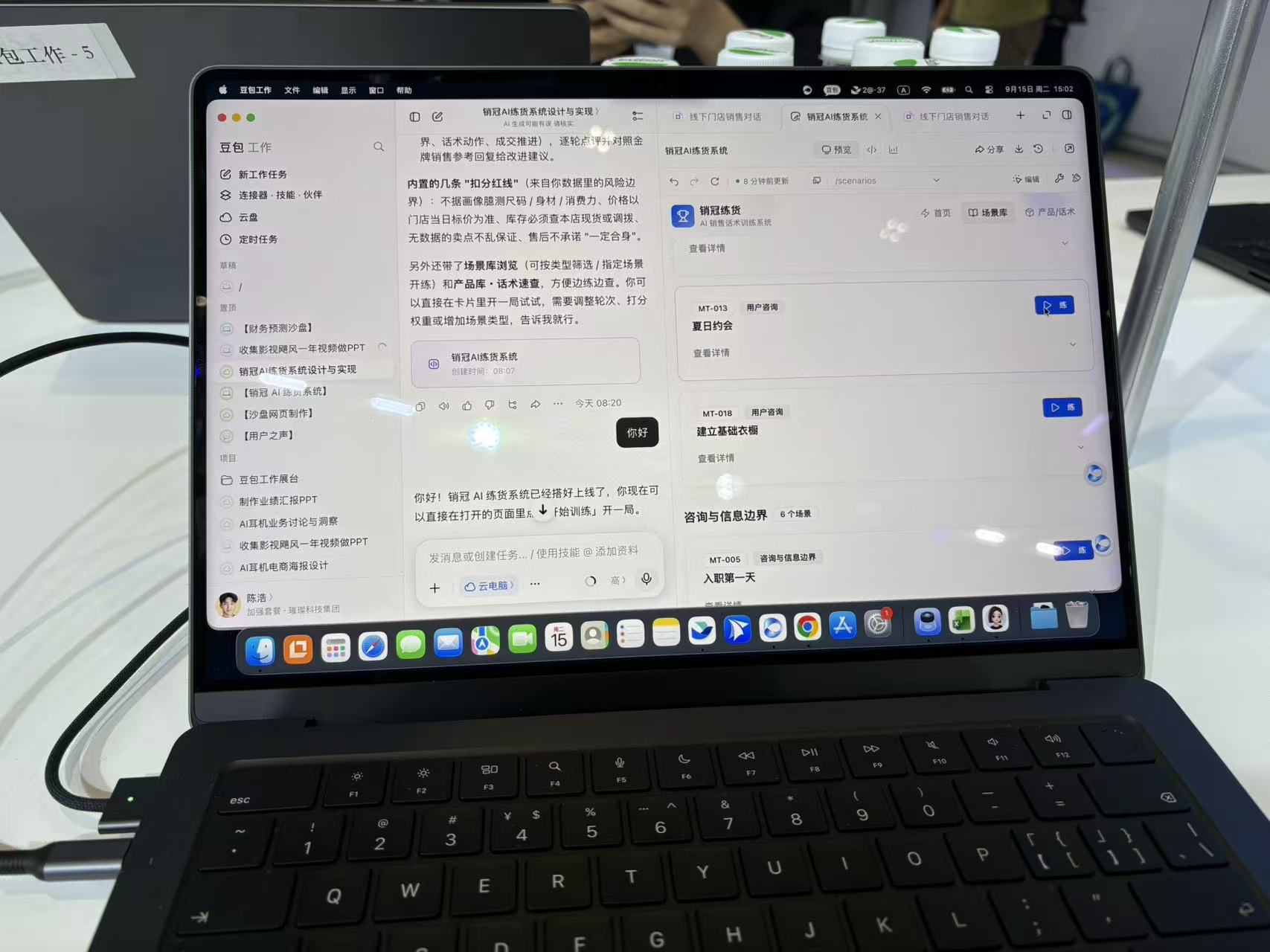
At the September 15 launch event, Feishu unveiled version 8.0, opening up data and tool capabilities fully to Agents. Feishu CEO Xie Xin said in his speech that Feishu is the best collaborative office product for the AI era.
Feishu is clearly ambitious about the new opportunities AI brings to collaborative work. That stands in sharp contrast to outside chatter that traditional office software paradigms like Feishu and DingTalk are becoming obsolete.
NUPIAO has learned that behind this is ByteDance’s reassessment of the next phase of competition in collaborative office: as Agents start entering enterprises, office platforms won’t fade into the background—they may actually become the key infrastructure for AI to truly land inside businesses.
Over the past year, one of Feishu’s core goals has remained expanding its customer base. After winning over leading companies in emerging sectors like AI and embodied intelligence, Feishu has also started poaching existing customers already signed with platforms like DingTalk and WeCom. NUPIAO has learned that over the past six months, top players in automotive, consumer, and manufacturing—including Seres, SAIC Motor, and Guming—have migrated from other platforms to Feishu.
A person close to Feishu told NUPIAO that internally, Feishu believes simply fighting for more customers is no longer the answer for the next stage of growth. As enterprises enter the AI era, only by getting AI truly into enterprise workflows can new revenue and value be created.
Feishu’s internal judgment is that AI office platforms will gradually converge in product form—even if one platform invents a brand-new form factor, others can follow at very low cost. The key to competition in AI office platforms lies in the ecosystem: who can grasp more enterprise context.
This view aligns with many third-party research firms. Fei Tianqi, a research director at Gartner, told NUPIAO that the context Agents need to understand isn’t just an enterprise’s existing knowledge and data—it also includes what teams have discussed, who information was shared with, and how far a task has progressed. Information that used to serve humans is now feeding Agents. “Ecosystem importance already existed in the big data era, and AI will amplify that value further.”
In Fei’s view, if most of an enterprise’s data sits in Alibaba Cloud and DingTalk, it will naturally lean toward Qwen Office when using an AI office platform. If the company already uses Feishu and Volcano Engine, it will be more inclined to use Doubao Work.
That means traditional collaborative office products represented by Feishu and DingTalk aren’t obsolete at all—in the AI era, they’re taking on an even more important foundational role.
Feishu’s major organizational restructuring at the end of July was also based on this judgment. NUPIAO has learned that after the adjustment, R&D for AI office products was elevated to ByteDance’s top priority and became its most important product on the B2B (enterprise) side.
Looking at the current competitive landscape of collaborative office platforms, WeCom has become the foundation for customer management thanks to WeChat’s social relationship chain, and is used by retail, finance, and other industries for front-end customer management. Feishu and DingTalk have taken the route of internal enterprise collaboration, and the two are also locked in fierce competition in the B2B market.
A source familiar with the matter said Feishu and DingTalk had different approaches from the very beginning of product development, leading to major differences in product architecture. DingTalk has separate interfaces for different functions, while Feishu has only one interface for all functions. After integrating AI, every DingTalk function needs to be connected individually, whereas Feishu only needs to be connected once.
“The difference in user experience will be a new variable in the competition between the two,” the source said, adding that this variable will also affect the competitive trajectory.