Recently, a bunch of users took to social media to call out Duolingo’s “free trial” membership, saying the whole thing is a trap designed to trick people into paying.
One user said they had been using Duolingo for free for three or four months when they spotted a “7-day free trial” sign-up for the Super Duolingo family plan inside the app. They hit subscribe — and instead of a 7-day countdown, they were instantly charged 738 yuan for the annual plan. Others said Duolingo took the money with zero warning, and they only noticed more than a month later. Another user said they signed up for the 7-day trial and ended up charged 958 yuan.
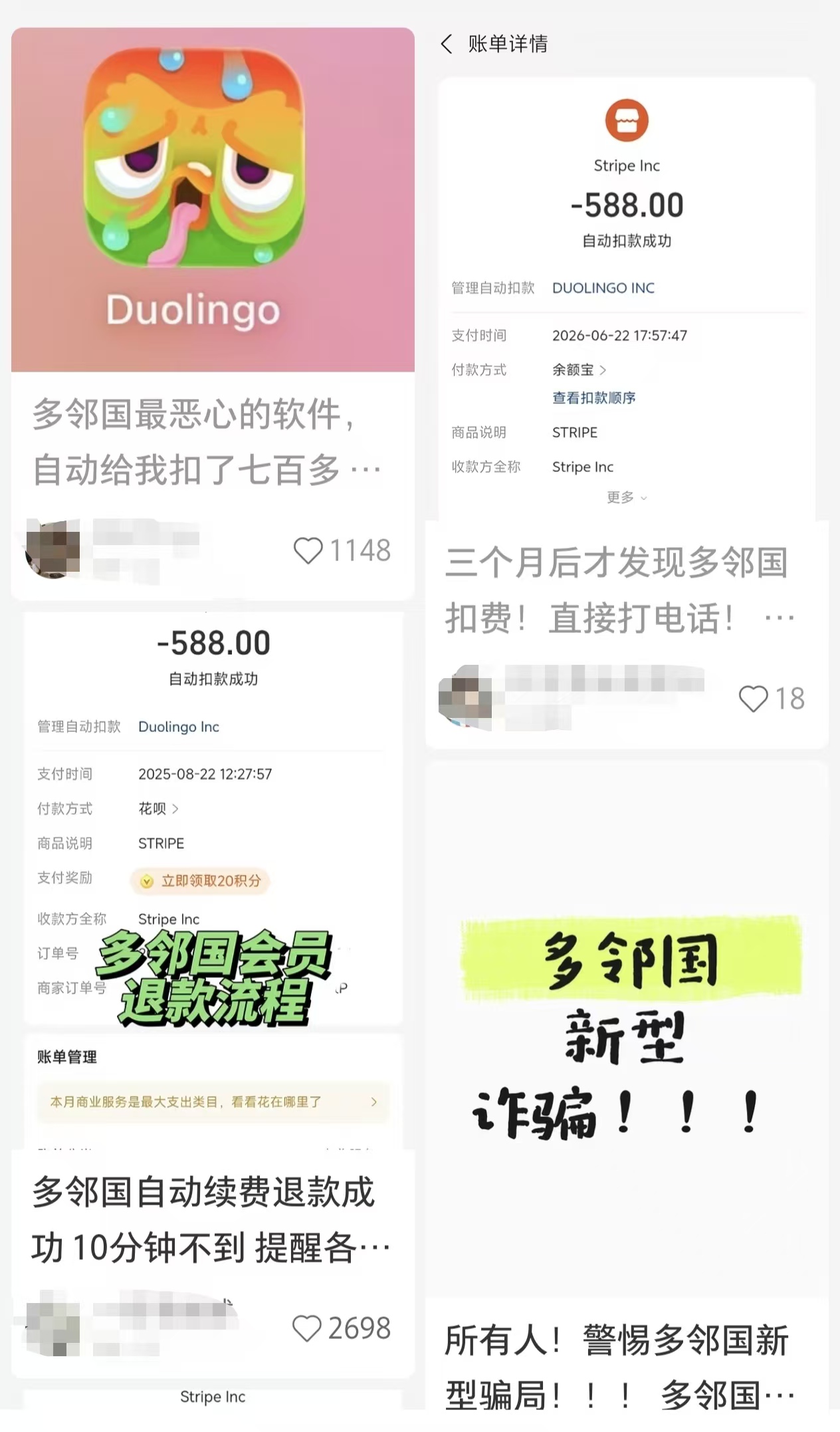
Those users did apply for refunds, and after plenty of back and forth the money did come back. Still, it leaves a nagging question: if you can’t actually try it free for 7 days, why label it a 7-day free trial?On September 22, we called Duolingo several times to ask about these concerns, but no one picked up by the time we published.
Duolingo is an AI-powered language learning app co-founded by Luis von Ahn and Severin Hacker. Founded in 2011, launched in 2012 and headquartered in Pittsburgh, it officially entered the Chinese market in 2019 and went public on Nasdaq in 2021.
The app offers courses in more than 40 languages — from big ones like Spanish, French and Japanese to smaller ones like Welsh. Its gamified, level-by-level style is seriously sticky: plenty of users have hit streaks of 1,000+ days, and its 90-day retention leaves traditional education apps far behind. At its peak, Duolingo had over 1 billion registered users worldwide and 130 million monthly actives.
From early 2023 to May 2025, Duolingo’s stock climbed 666% — far outpacing Google over the same stretch — making it one of the market’s most beloved “AI winners.” Business boomed alongside it. Revenue jumped from $369 million in 2022 to $748 million in 2024, a two-year compound growth rate of 42.4%, and in 2025 revenue still grew 39%.
This year, though, growth has slowed down. Earnings data show Duolingo’s Q1 2026 revenue reached $292 million, up 26.5% year on year, with net income attributable to shareholders of $43.46 million, up 23.7%.
Stalling user growth is another worry. Duolingo expects DAU growth to ease from 30% in 2025 to roughly 20% in 2026. Q4 2025 daily actives came in at 52.7 million — up 30% year on year, but the slowest growth since 2022.
Meanwhile, the stock has slid hard. As of September 21 local time, Duolingo traded at $149.42 a share, down 73% from its May high of $544.93, for a market cap of $6.991 billion.
Some analysts say the stock and business slump come down to big tech launching similar products. In early August last year,OpenAI showed off ChatGPT’s voice mode teaching a foreign language at its GPT-5 launch — users can practice speaking with AI in real time, totally free. On August 27, Google announced “practice,” an AI language-learning tool powered by Gemini, going straight after Duolingo’s core business with customized speaking courses.
With performance under pressure, Duolingo’s scramble for revenue is starting to show.since the second halfof last year, more and more users have complained on social media that the app is “getting harder to use.” The free version stuffed in more ads, a subscription prompt pops up after every lesson, and free users only get a limited number of “hearts” (lives) each day — run out and you either wait or pay up.
Earlier this year,NUPIAO reported that several consumers said they claimed a “free trial membership” on Duolingo and not only got no expiry warning, but were charged 588–998 yuan before the trial period even ended.And when they tried to get their money back, they found themselves stuck between Duolingo and Apple, each pointing the finger at the other.Legal experts point out that if Duolingo promises an “advance reminder” on its page but never actually delivers — leaving consumers auto-charged without knowing — that’s a textbook misleading practice, and it violates their right to know and their right to choose.