NUPIAO Reporter |
NUPIAO Editor | Wen Shuqi
In Qipanjing, at the far western edge of Ordos, heavy trucks keep shuttling between coal yards and power plants, hauling coal ash and other bulk materials—but there is one obvious change: many of the cabs are now empty.
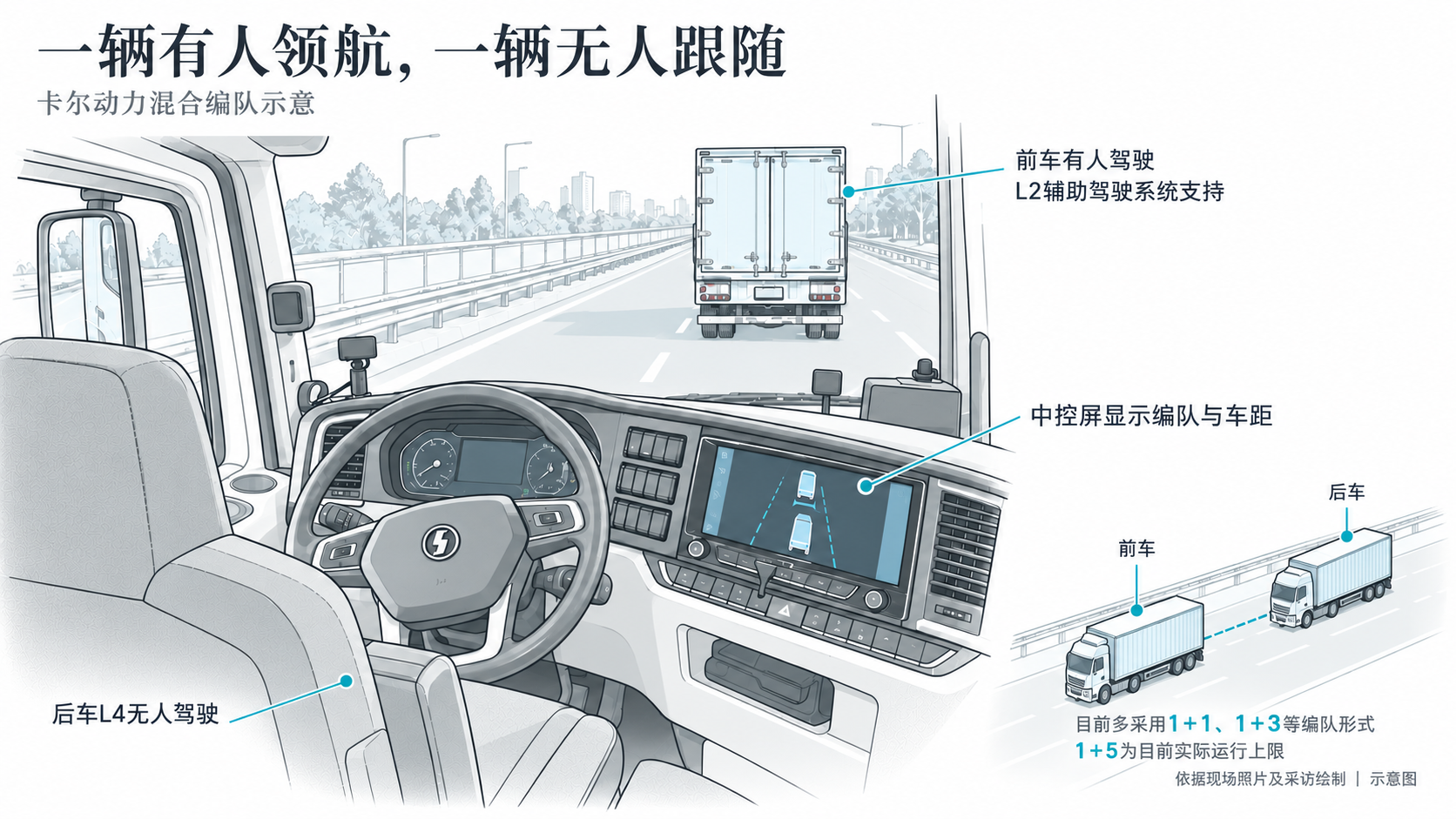
On Sept. 22, NUPIAO’s on-the-ground visit found that L4 autonomous truck company KargoBot has put unmanned convoys into regular operation there. A typical convoy is made up of two heavy trucks: the lead truck still has a driver and runs with L2 driver assistance; the follower truck’s cab is empty, and it trails about 20 meters behind. After entering the yard, the two trucks take turns loading and weighing, and the rear truck can even move back and forth on its own to let coal ash drop more evenly into the cargo box.
KargoBot calls this “human in front, unmanned behind” setup a “1+N” mixed intelligent convoy. The lead driver is more like a pilot for the whole convoy. The follower truck does not mechanically trace the lead truck’s path; it has independent autonomous driving capability and makes its own judgments and control moves based on road conditions. Right now, one pilot truck can lead up to five L4 autonomous trucks.
This approach may not look like full autonomy, but it is turning into a more realistic route for the industry. Pony.ai also disclosed this year that it has been testing “1+N” unmanned convoys in northwest China, with a safety-driver lead vehicle guiding multiple unmanned followers, and it has been approved to run rear-vehicle-unmanned convoy tests on cross-province highways in the Beijing-Tianjin-Hebei region.
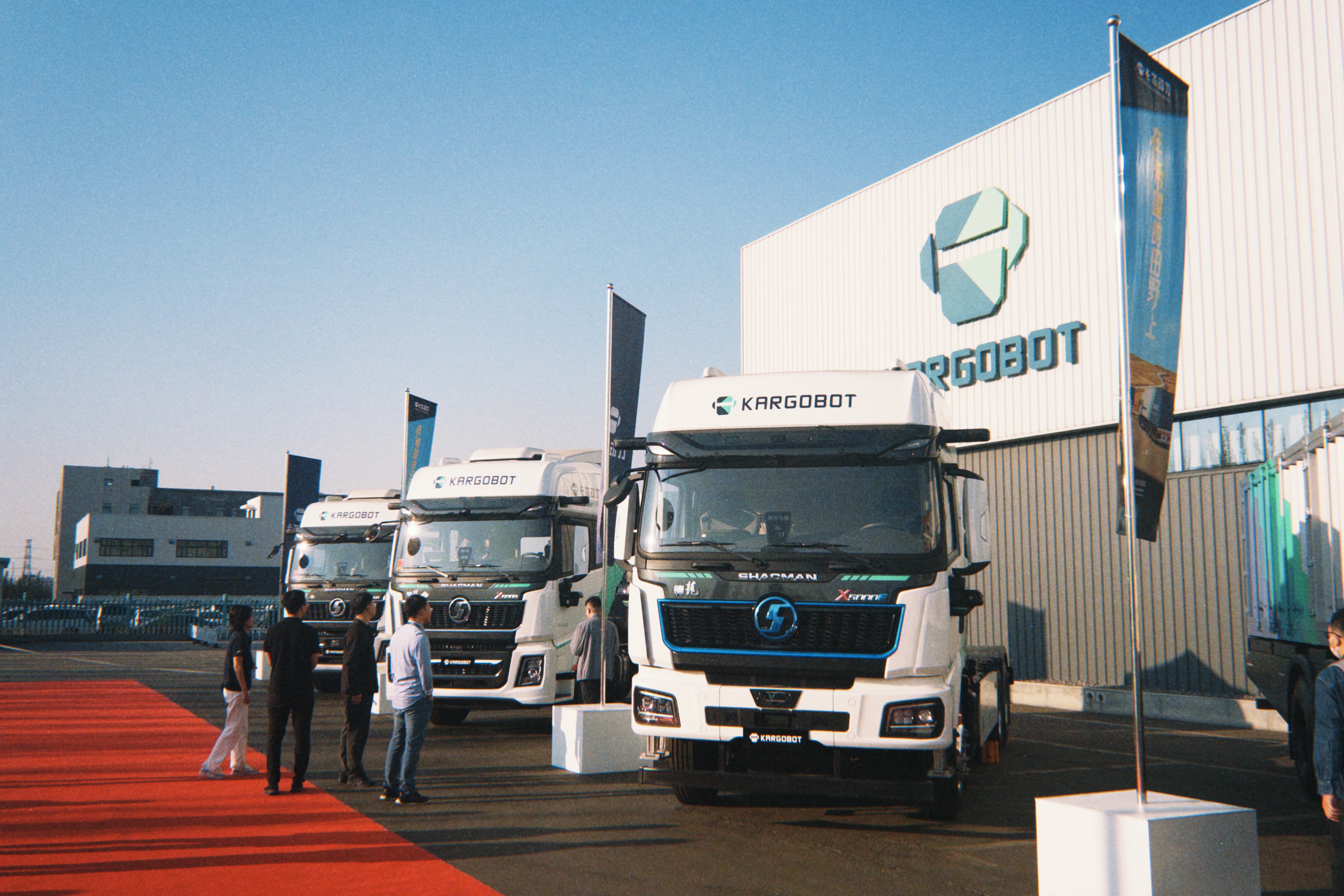
As commercialization spreads, commercial-vehicle autonomy—which had gone quiet for several years—is heating up again. In March this year, KargoBot closed a Series B round of more than $100 million; in May, Uisee Technology listed on the Hong Kong Stock Exchange; in June, Trunk.tech filed again for a Hong Kong listing. In September, PlusAI, the overseas entity of Zhijia Technology, tried again to pursue a U.S. listing via a SPAC.
Unlike the technology-driven phase a few years ago, competition in commercial-vehicle autonomy is increasingly coming down to a plain question: can autonomy actually make hauling freight cheaper?
On Sept. 22, KargoBot announced in Ordos the launch of a scaled AI transportation network. Over the past few years, it has gone from single-truck testing to operating at the hundred-truck level. Next, it has to prove whether one proven route can be copied into an economically viable transport network.
Convoys are just the first step. KargoBot CEO Wei Junqing told NUPIAO and other media that the company tried single-truck autonomy early on, but once it entered industrial transport, it quickly ran into problems outside the traditional autonomous-driving playbook: toll stations on national roads require QR-code payments, traffic police may spot-check load weights, and potholes and standing water on mining and industrial roads change with the weather.
A truly driverless truck has to handle all of these hassles by itself. KargoBot chose to keep one person in the lead truck to deal with these temporary issues, while the follower truck runs unmanned.
That actually fits the business logic of heavy trucks better. Urban NOA driver assistance in passenger cars can sell a better driving experience—but “a truck is first and foremost a production tool,” said Wang Ke, KargoBot’s vice president of technology strategy. If a driver still has to sit in every truck, a more expensive driver-assistance system is hard to turn directly into profit for a freight company.
Wei Junqing explained that traditional freight costs can roughly be broken down as “33211”: tolls and bridge fees about 30%, energy 30%, labor 20%, and maintenance and vehicle depreciation 10% each. The new-energy transition has already pushed down part of the energy cost, while driver wages have actually risen in recent years. The more unmanned vehicles in a convoy, the more labor costs are diluted.
KargoBot has already announced that its single-truck UE (unit economics) turned positive. This key profit target means a truck’s daily operating revenue covers its costs. KargoBot COO Li Xiaoxiao further explained that the UE model is the result of comparing operations with human-driven vehicles after a period of actual operation, including vehicle depreciation, maintenance and insurance; the 10% to 18% gross-margin improvement still comes mainly from lower labor costs brought by autonomous driving.
But that math has an important precondition: autonomous driving first has to be put into the right transport scenario.
Wei Junqing said that when the team previously studied an autonomous freight route from Guangzhou to Suzhou, even a top logistics company might have only two or three trucks per day in one direction on a route. In Inner Mongolia, some coal-mine-to-power-plant routes need about 400 truckloads a day, and some routes even reach thousands. With more stable, denser cargo volumes, the fixed costs of the autonomous system and fleet operations are easier to spread out.
That also determines why it is hard for KargoBot to be just a software supplier selling algorithms or autonomous-driving systems.
Wei Junqing told NUPIAO that customers “may not need to buy a standalone AI,” and what they ultimately care about is not just buying a truck equipped with an autonomous-driving system, but whether that truck can complete the transport job.
KargoBot therefore sums up its business boundaries as “one vertical, one horizontal.” Vertically, it tries to connect AI, vehicle products and transport solutions; horizontally, it does not plan to take the entire value chain into its own hands. Vehicles are still developed with commercial-vehicle OEMs, while sensors, chips, communications infrastructure, and specific cargo sources and logistics operations also require different partners.
This division of labor also creates a coopetition relationship between KargoBot and OEMs. Yao Kai, KargoBot’s senior vice president of strategic ecosystem and government affairs, responded that the company has no plans to build vehicles. It hopes automakers will continue to own vehicle engineering capabilities such as complete vehicles, chassis and drive-by-wire. Delivery of autonomous-driving software is only the starting point; after that, it must keep iterating through road tests and data—KargoBot is betting on the irreplaceability of that continuous development capability.
But autonomy on a single route will eventually move toward a larger network.
This network first has to become denser. KargoBot vice president Zhang Na said that as the fleet grows from ten trucks to a hundred, and then toward a thousand, the hard part shifts from autonomous driving itself to after-sales, operations and maintenance, and dispatch. Bulk commodity transport is seasonal and cyclical, so the company needs to allocate vehicles according to cargo-volume changes on different routes while building out mobile repair and safety-support systems. KargoBot has therefore started using KargoCloud’s dispatch network and algorithms to solve this problem.
Beyond vehicles, cargo sources and operating entities also need to increase. Currently KargoBot mainly operates routes itself or jointly with large logistics companies; Li Xiaoxiao said that as technology and products mature, it hopes to open up in the future to small and medium-sized fleets with only a few or a dozen trucks.
Cargo sources will not come only from fixed routes. Wei Junqing said the company is in contact with partners that operate freight platforms. Besides planned logistics of a fixed one or two hundred truckloads a day, it hopes to take on unplanned demand on platforms too. The goal is simple: when shippers need trucks, trucks should be available, and autonomous trucks should sit idle as little as possible.
On the other side, this network also needs to reach farther. Wei Junqing stressed that line-haul logistics itself requires goods to flow across larger corridors: “If it’s only over a very short distance, then it’s really not line-haul logistics.”
But cross-regional operations still face policy thresholds. A practitioner in autonomous-driving policy told NUPIAO that currently domestic autonomous-driving testing, demonstration and operating qualifications are still mainly regulated by provincial and municipal authorities, and permits issued in one place usually cannot be used directly across provinces. For vehicles to operate across regions, they often need to reapply at the destination, or local governments need to establish mutual-recognition mechanisms. A unified nationwide cross-province autonomous-driving qualification system has not yet taken shape.
According to NUPIAO, KargoBot currently operates on highways, national roads, provincial roads and mining-area roads in northern energy belts such as Shaanxi, Shanxi, Gansu and Xinjiang, with scenarios similar to those in Inner Mongolia. As for future expansion strategy, Li Xiaoxiao summed it up to NUPIAO as “1+X+N”: starting from production logistics that has already been proven, continuing to replicate bulk commodity transport in similar regions such as northwest and north China, and gradually entering consumer logistics such as express parcel and express freight. He also mentioned that as regions and scenarios expand, product forms will change accordingly.
The current “1+N” is not KargoBot’s only product form. The company roughly divides its products into three categories: convoys, L4 single trucks, and cabinless transport robots.
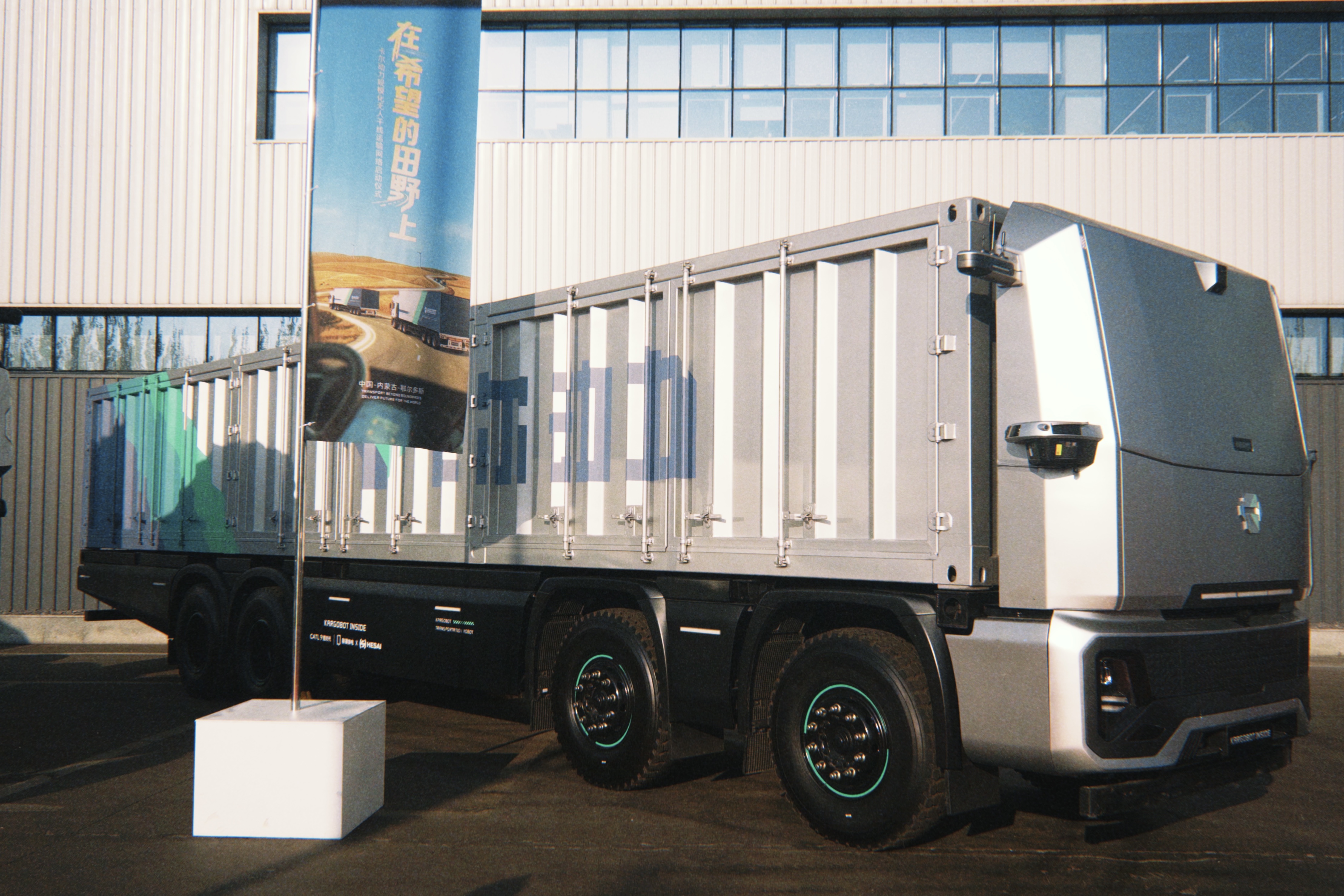
The cabinless transport robot is more like a machine truly redesigned for “no one driving.” KargoBot Space 2.0 simply eliminates the cab and gives the freed-up space to cargo. According to data provided by KargoBot, cargo space increases by about 25%, and payload capacity rises by about 10%.
However, for now it can only stay in simpler places. Because cabinless transport robots cannot yet drive on public roads as ordinary vehicles, KargoBot first puts them into closed or semi-closed scenarios such as industrial parks, steel plants and auto factories.
Sun Liang, KargoBot’s senior vice president, said that in these scenarios, cabinless transport robots can run continuously 24 hours a day, and short-distance shuttling that drivers used to do repeatedly can be handed over to the vehicles. If road access is further opened up in the future, such transport robots may also enter broader roads and dynamically form convoys with other vehicles.
That will turn “convoy” into something else. Maybe we can imagine it more boldly: in the future, what lines up on a logistics trunk line and carries your goods might be a group of transport robots with no cabs at all.