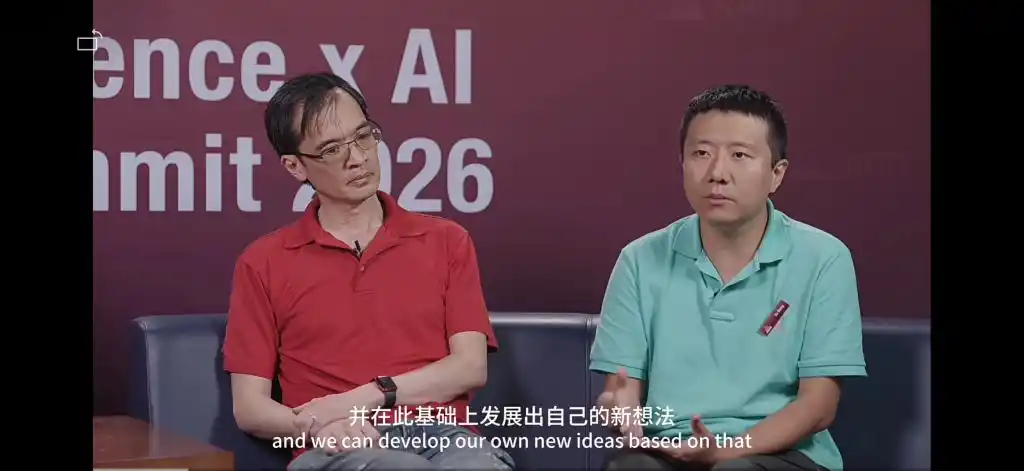
Recently, the SAIR podcast hosted a high-profile academic conversation. Deng Yu, a newly minted Fields Medalist and math professor at the University of Chicago, and Terence Tao, Fields Medalist and chair of the SAIR Foundation, explored how the AI era is affecting academic research in mathematics.
This conversation not only offers a cool-headed view of the current “AI + math” hype, but also shows how academics are reflecting on the risks of technological alienation.
SAIR Foundation (Science and AI Research Foundation) is a nonprofit launched by Professor Terence Tao and other leading scholars. It works to promote responsible use of open-source, safe, and traceable AI in basic science.
The conversation was prompted by recent moves by tech giants in generative AI. On October 6 this year, OpenAI dropped 722 academic preprints in a single day, claiming breakthrough progress on 372 complex math problems in geometry, algebra, computer science, and other areas. These preprints were not released through traditional peer-reviewed journals or the academic community’s usual arXiv preprint platform; instead, OpenAI uploaded them directly to its own GitHub open-source repository.
But this “industrial-scale piling up of compute” quickly hit an awkward moment. Some preprints had to be urgently withdrawn because of basic notation errors, and there was a clear disconnect between a lot of the written proofs and their Lean formalization code.
In the weeks before that, AI companies represented by OpenAI and Anthropic were releasing AI math “breakthroughs” on social media almost every few days. They touched on nearly every famous math problem people know, drawing media attention and sparking debate inside academia.
In response, on September 11, Terence Tao, Deng Yu, and several other Fields Medalists co-signed an open letter titled “A Severe Misalignment of AI in Mathematics.” They pointed out that “AI companies treating solving math problems as a benchmark to push forward is harmful to mathematics as a science and to the math community.”
In the latest blog conversation, the two mathematicians discussed the impact of commercial AI on academia from several angles: the nature of mathematics, research norms, and what future tools should look like.
First, neither denied that AI’s math abilities are improving. They are even bullish on AI’s potential to strengthen and speed up real mathematical research.
Part of the reason tech companies keep announcing new AI “breakthroughs” on math problems is that the math community itself cares deeply about solving them.
But what they really oppose is the unverified and unexplained narrative of “AI conquering mathematics.” They worry that AI companies mass-producing “true/false” statements faster and faster could destroy the fertile ground where new ideas grow. Mathematics is not just a “problem-solving contest”; what matters more is “deep human understanding” and an “open and transparent academic community.”
Deng Yu proposed his “two boundaries” theory. In the past, mathematics had only one boundary: “problems that already have a proof.” Traditionally, if a proof existed, some human necessarily understood it, so the two boundaries completely overlapped. But when AI can directly generate a result without showing its thinking process, it creates a second boundary: “there is a proof, but only AI knows it, and humans do not understand it.” He stressed that the core motivation of mathematics is for humans to understand the abstract and the real world. Without deep human insight, a bare answer is not the same as scientific progress.
Tao criticized tech companies for treating proofs as a “by-product” of model training. He said the traditional math community rewards problem-solvers because they also have the broader ability to explain principles, raise new questions, and train the next generation of researchers. Now, when tech companies treat problem-solving as a benchmark and dump a huge number of proofs lacking deep insight, it is no different from dumping “toxic waste” for mathematicians to clean up. He argued for changing the evaluation mechanism: if a preprint does not contain human-absorbable, inspiring ideas, it should not be included in the formal academic literature.
Tao also noted that AI models have absorbed the literature wealth humanity has accumulated over thousands of years, but when they output proofs, their reasoning logic and cited sources are opaque. This black-box operation “cuts off the chain of academic intellectual inheritance” and hides AI’s dependence on existing human work. He called on tech companies to change strategy and invite mathematicians to collaborate from the early stages of research and development.
Deng Yu offered direct criticism of AI’s lack of traceability. He mentioned that there is even a gray area where AI directly absorbs ideas someone else typed into ChatGPT to generate proofs. If AI does not even provide a basic chain of thought (CoT) and reference materials, that is “utterly absurd” at the level of academic ethics.
On the balance between efficiency and “slow research,” Tao used a “car and walking” analogy: cars really are faster than walking, but you wouldn’t want to replace every situation where you used to walk with driving. Sometimes you do want to walk—maybe to enjoy it, maybe for safety, environmental, or other reasons.” Scientific research needs to preserve the deep understanding and community-building that “slow research” brings. The mission of AI tools should be to “augment human capabilities,” not to make humans degrade into spectators who depend on answers.
Deng Yu thinks the ideal collaboration model is “humans build the roadmap, AI fills in the tedious details.” When researchers have a clear grasp of the big picture, handing heavy logical derivation to AI can save a lot of energy and let mathematicians focus on asking more valuable new questions.
With many old rules in mathematics changing, many young mathematicians feel anxious about it. Both top scholars said they are full of confidence in the younger generation. Tao said, “With the right tools, they can do amazing things.”