Tech reporter | NUPIAO
October 26 — In OpenRouter’s latest weekly rankings of global AI model API calls (October 19–25), the top spot goes to DeepSeek’s V4.1-Flash-1017 update released on October 17. The model pulled in 33.6 trillion tokens in a single week, a jaw-dropping 801% jump from the previous week. That makes it the breakout star of the week and the main engine driving the overall growth of Chinese-made models.
Public records show that V4.1-Flash-1017 builds on the V4.1 Flash released September 10, keeping the same asymmetric MoE architecture with 552B total parameters, 8B input activation, and 16B output activation. It natively supports multimodal input and puts extra focus on optimizing code, automated agents, and vision tasks.
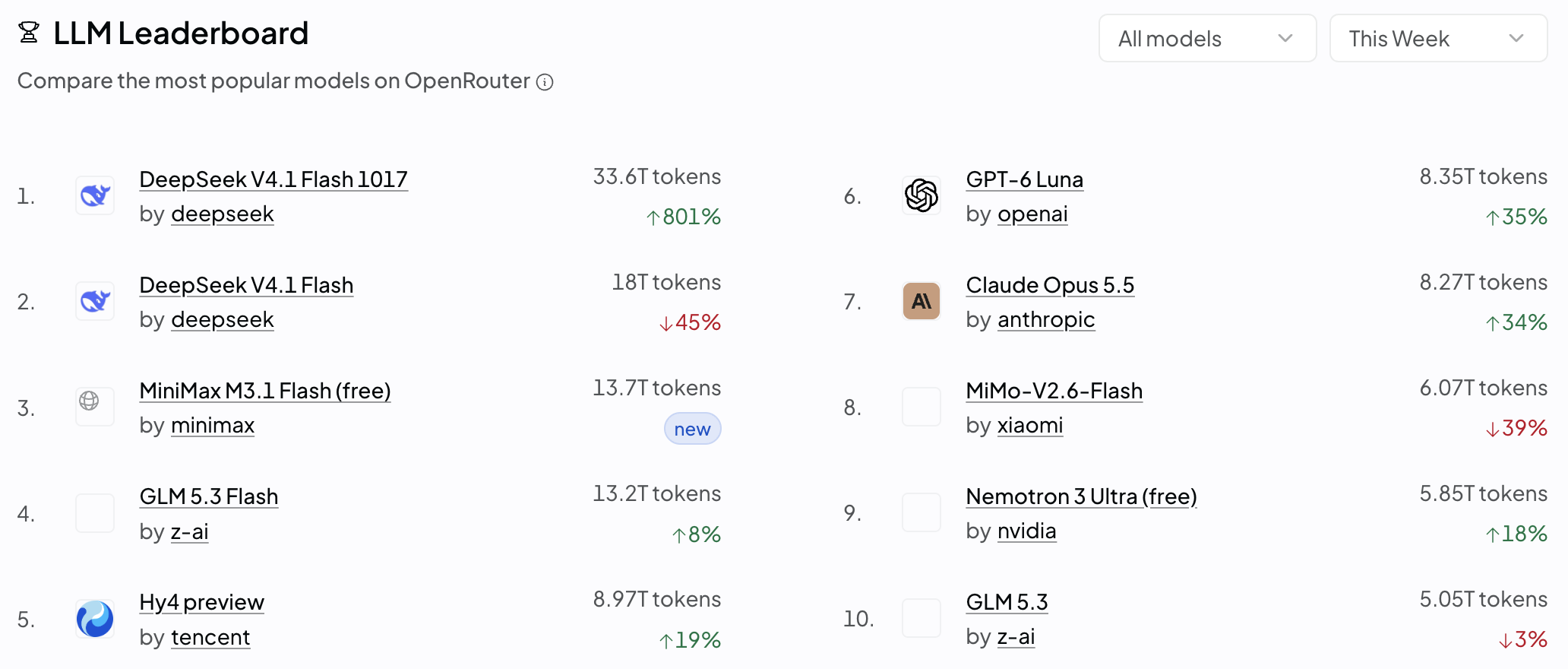
Coming in second is the older DeepSeek V4.1 Flash, which launched September 10. It logged 18 trillion tokens this week, down 45% week-over-week—a clear sign that developers are migrating to the new version fast.
DeepSeek has been on a roll lately. On October 20, it announced the open-sourcing of DeepInfer, its in-house large-scale inference framework that powers the high-throughput serving behind the V4.1 Flash series. Then on October 22, according to the Shanghai Securities News, DeepSeek is looking to raise around 100 billion yuan in its latest funding round, with Tencent and CATL as the biggest backers. The deal is expected to close within days.
Third place goes to MiniMax M3.1 Flash, launched October 19, with 13.7 trillion tokens in weekly calls. This model targets complex agents, computer operation, and software development scenarios. The company says inference speed is nearly 3x faster and call costs are down 70%, aimed squarely at small and mid-sized developers who need batch automation. MiniMax is also pushing hard on commercialization—its official flagship store is now on e-commerce platforms, offering tiered subscription plans to widen revenue from consumers and small business users.
The rest of the top ten includes Zhipu AI’s GLM 5.3 Flash, Tencent’s Hy4 preview, and overseas models from OpenAI, Anthropic, and Nvidia.
Zhipu’s GLM 5.3 Flash launched August 26 with a sparse-plus-linear attention hybrid architecture—320B total parameters with 18B activated. It’s built for long-context agents and code review, pulling in 13.2 trillion tokens this week, up a modest 8% week-over-week. Zhipu’s GLM 5.3 series recently landed on Amazon Bedrock, kicking off a revenue-share model with overseas cloud providers while also expanding partnerships with domestic cloud platforms.
Tencent’s Hy4 preview keeps iterating on agents and office productivity scenarios and holds a steady spot on the leaderboard. On the overseas side, flagship models from OpenAI, Anthropic, and Nvidia still dominate the high-end reasoning market. Their weekly growth is impressive, but overall share still trails the Chinese Flash series.
Looking at the top ten, it’s obvious that lightweight Flash versions have become the absolute traffic drivers on the platform—heavy-parameter flagship models are no longer developers’ first choice. On top of that, million-token long-context windows have basically become standard for top-tier new models, with long documents, video understanding, and persistent agent tasks now must-haves. Another big shift: model iteration cycles are shrinking fast, new versions launch in rapid succession, and traffic switches over quicker than ever. The advantage window for any hot model keeps getting shorter. Competition now centers on effective reasoning capability per unit cost—low price and high throughput are the most direct levers for getting developers to switch.
Overall, global AI model calls totaled 188 trillion tokens last week, up 14.63% week-over-week. Chinese AI models on the list accounted for 93.54 trillion tokens, up 18.14%, while US models logged 22.47 trillion tokens, up 29.44%. Chinese models have now out-called US models on this platform for 26 consecutive weeks, holding the top spot.
Zooming out to the past month, the market shift becomes even more striking. A month ago, overseas closed-source models held more front-row seats, and Chinese models were scattered across the rankings. Over the last 30 days, Chinese vendors have been pushing iterative releases at a furious pace, with multiple new Flash products crashing into the top ten and gradually squeezing overseas models out of the front row.
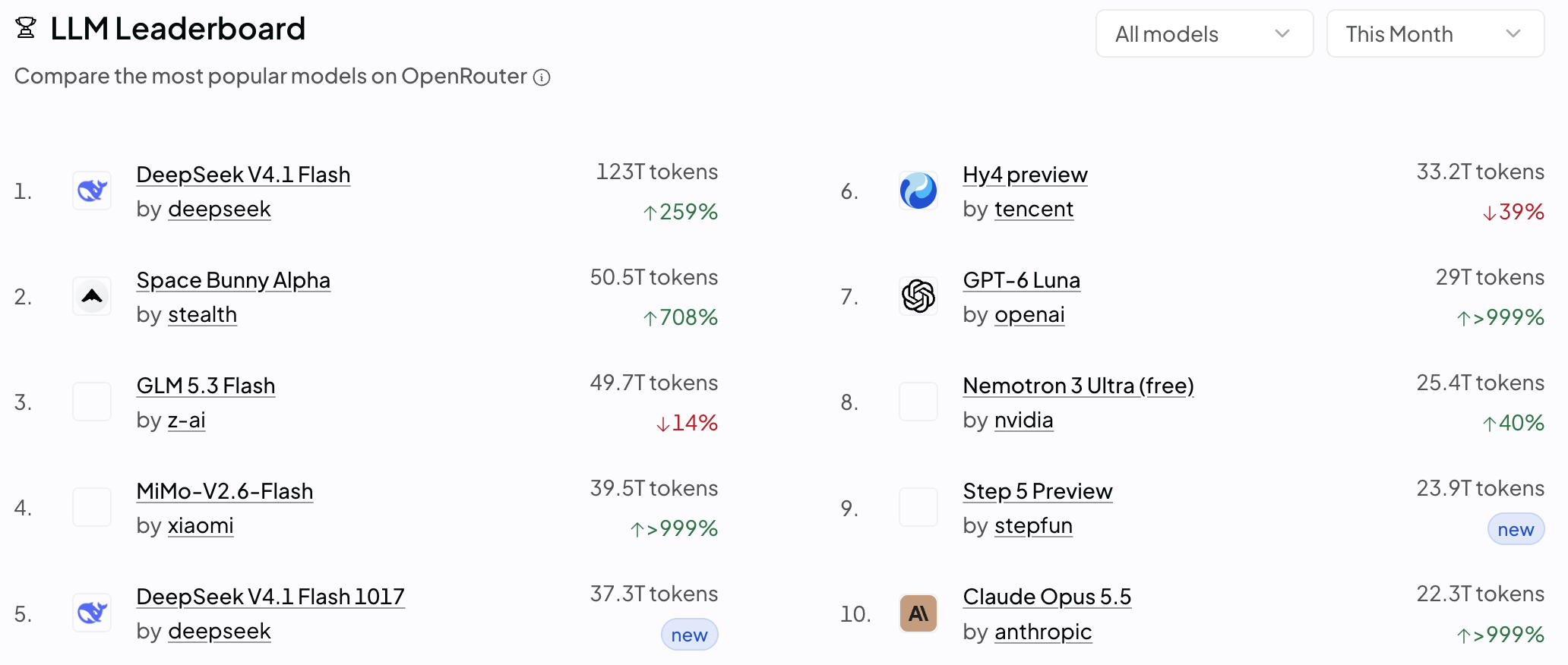
Three forces are driving this shift. First, architecture innovation—asymmetric MoE, hybrid attention, compressed KV caching, and similar approaches keep pushing down per-inference costs, turning “good enough capability + low price” into a standardized product. Second, iteration cadence—Chinese vendors push fine-tuned versions on a weekly basis, specifically patching gaps in web access, coding, and agent capabilities. Third, developer-friendly strategies—most new versions stay compatible with old APIs and don’t raise prices, dramatically lowering the barrier to switching.
As one analyst put it, the LLM race has moved past pure benchmark contests and into a battle over effective output per token cost. Long-tail automation demand is the real core source of this round of growth.
Worth noting: the data above only covers public call traffic through OpenRouter’s aggregated API channel. It doesn’t include requests through vendors’ own websites, standalone apps, or private deployments. Still, it remains a clear barometer for what independent developers and SMEs around the world actually need.
Global LLM competition is no longer just about rankings. OpenAI and Anthropic continue to lean on stable, complex reasoning to defend their high-end closed-source turf with large enterprises. Meanwhile, Chinese vendors have found a differentiated lane—concentrating resources on high-throughput, low-cost, multimodal-heavy Flash series that precisely target the growth blue ocean of small developers and batch automation tasks. These two paths are running in parallel, shaping the main trend of today’s global race.
Under this industry logic, leaderboard shakeups will become the norm. Today’s top version can be overtaken at any moment by another fast-iterating newcomer. Only by continuously iterating and balancing capability, speed, and cost can vendors earn a long-term seat at the table.