On September 8, Chinese large-model maker DeepSeek dropped its latest hiring plan, opening about 150 spots aimed mainly at seasoned engineers with 2 to 10 years of experience. Unlike the company-wide expansion in June, this round takes a sharp turn: every role sits on the engineering and deployment side, with not a single AI research position in sight.
For an AI company long known for staying small and lean, adding 150 people is no small move. According to DeepSeek’s job postings, the hiring splits into two main tracks: server-side development engineers covering six areas—large-model research platform, Agent framework components, R&D efficiency infrastructure, DeepSeek API, online services, and data engineering—and Agent elastic computing R&D engineers, split between platform development and low-level systems.
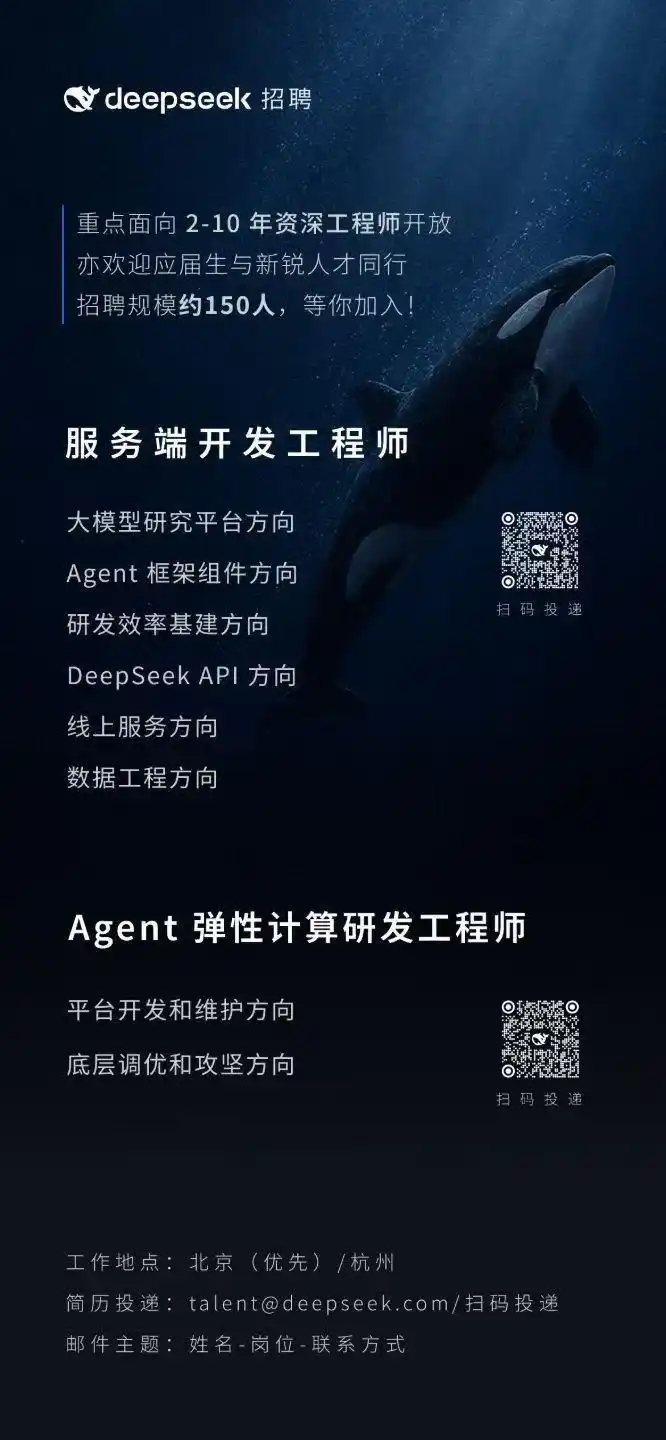
Zooming in, the six server-side directions cover the full chain from supporting model research to serving end users. The large-model research platform team builds infrastructure tools for researchers; the Agent framework components team focuses on agent development frameworks; the R&D efficiency infrastructure team works on internal engineering productivity; the DeepSeek API team develops and optimizes external interfaces; the online services team keeps user-facing services stable; and the data engineering team builds out the data processing system.
The Agent elastic computing R&D role maps to DSec (DeepSeek Elastic Compute), the elastic computing platform first disclosed in the recent DeepSeek-V4 technical report. It’s a scheduling system tailor-made for Agent tasks and is seen as DeepSeek’s core infrastructure for the agent era.
Cui Tianyi, who leads DeepSeek’s Harness team, explains it this way: once anything in computing scales up, complexity explodes—data volume, machine containers, training tasks, evaluation tasks, Agent environments, users, and requests are all surging. This hiring round is precisely about tackling the systems engineering challenges that come with rapid business expansion.
This is actually DeepSeek’s second hiring push this year. On June 25, the company issued a rallying call, saying it aimed to at least double every department, covering seven areas—full-stack development and algorithms, AI core systems R&D, operations, product, model data strategy, deep learning research, and functional teams—with 33 job categories open in Beijing and Hangzhou. Compared with June’s broad hiring, this 150-person focused expansion is more targeted, aimed at solving the system bottlenecks created by fast business growth.
Public information shows that in early 2025, DeepSeek’s core team was only about 150 people, and that lean crew launched the DeepSeek-R1 reasoning model. By the time V4 shipped in 2026, the company’s research and engineering teams, plus business compliance and other functional departments, had grown to more than 300 people.
Continuous fundraising has given DeepSeek plenty of ammunition for talent expansion and infrastructure buildout. At the end of May this year, DeepSeek closed its first external funding round since founding, raising about 50 billion yuan (roughly $7 billion). Investors included Tencent, JD.com, NetEase, CATL, and several investment institutions, while founder Liang Wenfeng personally put in about $3 billion. After the round, the company’s valuation topped $50 billion, putting it among China’s most valuable AI companies.
Just a month and a half later, in mid-July, word spread that DeepSeek had started a second funding round, with a pre-money valuation target of about $71 billion. Whether or not that round closes, the first round’s 50-billion-yuan cash pile is already enough to support simultaneous pushes in compute, engineering talent, and data platforms.
DeepSeek has clearly stepped up commercialization this year. On June 29, the official DeepSeek V4 launched alongside a peak-and-off-peak pricing mechanism. During peak hours, Pro-tier output pricing doubled from 6 yuan to 12 yuan per million tokens—the company’s first attempt to use price levers to balance supply and demand.
On August 6, DeepSeek’s official site posted a notice saying it planned to raise API service pricing across the board in the near term, with a relatively large increase expected. Continued growth in API calls and higher pricing raise the bar for system stability, concurrency, and throughput—and that means more engineering talent to keep service quality up.
Right now, competition among China’s top large-model players has gradually shifted from parameters, benchmark rankings, and open-source buzz to API stability, inference costs, Agent workflows, and enterprise integration. In the early days, algorithm prowess was the core competitive edge—companies fought over model parameters, benchmark scores, and reasoning ability, and AI researchers were the scarcest resource. But once model capabilities reach a certain level, user scale crosses a tipping point, and commercialization enters deep water, systems engineering capability quickly moves to the forefront. That’s reshaping the talent structure at large-model companies, and the industry is moving from the first half of the tech race into the second half of engineering and commercialization.