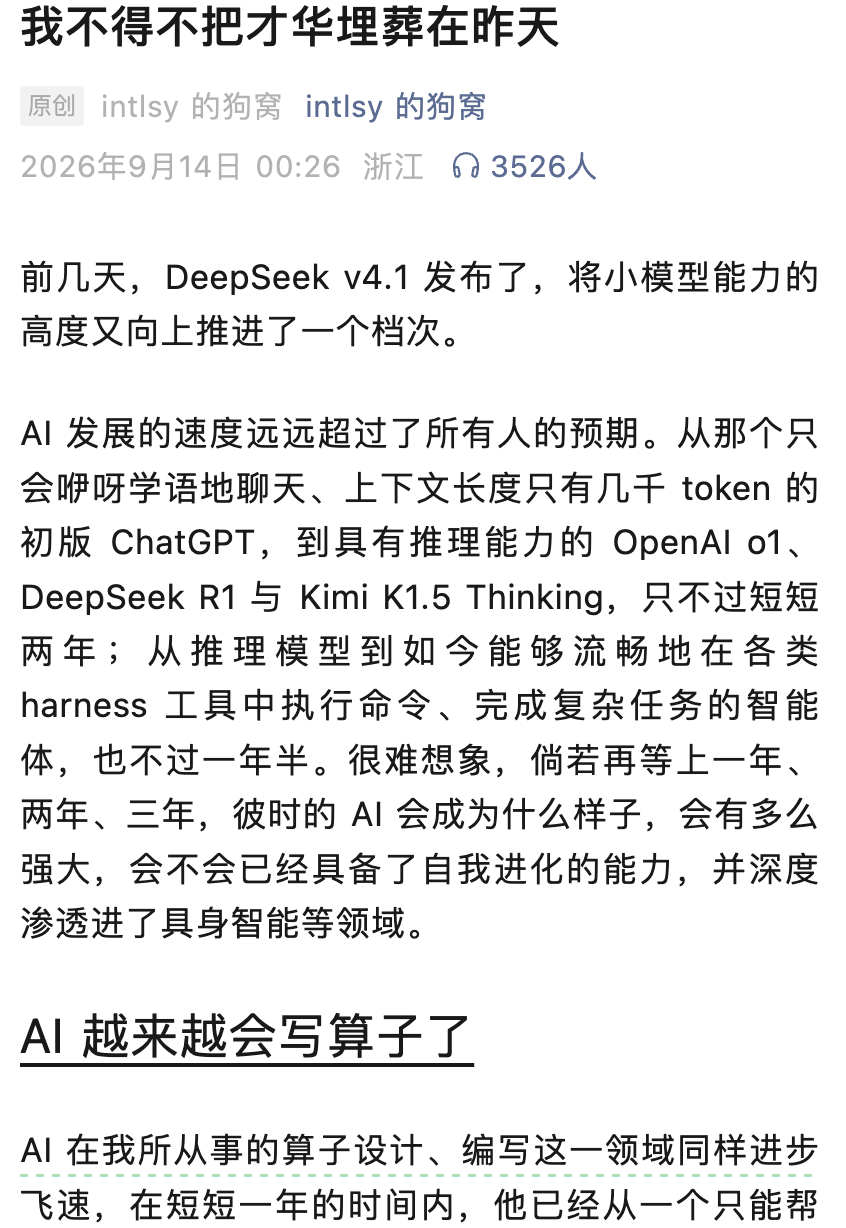
Recently, DeepSeek v4.1 operator lead Liu Shengyu publisheda long essay titled “I Had to Bury My Talent Yesterday”,and it quickly went viral for hitting a nerve with workers facing career anxiety in the AI boom. In the piece, he wrote things like “I probably won’t be ‘unemployed,’ but I’ll definitely have to ‘switch careers,'” sparking widespread resonance and discussion.
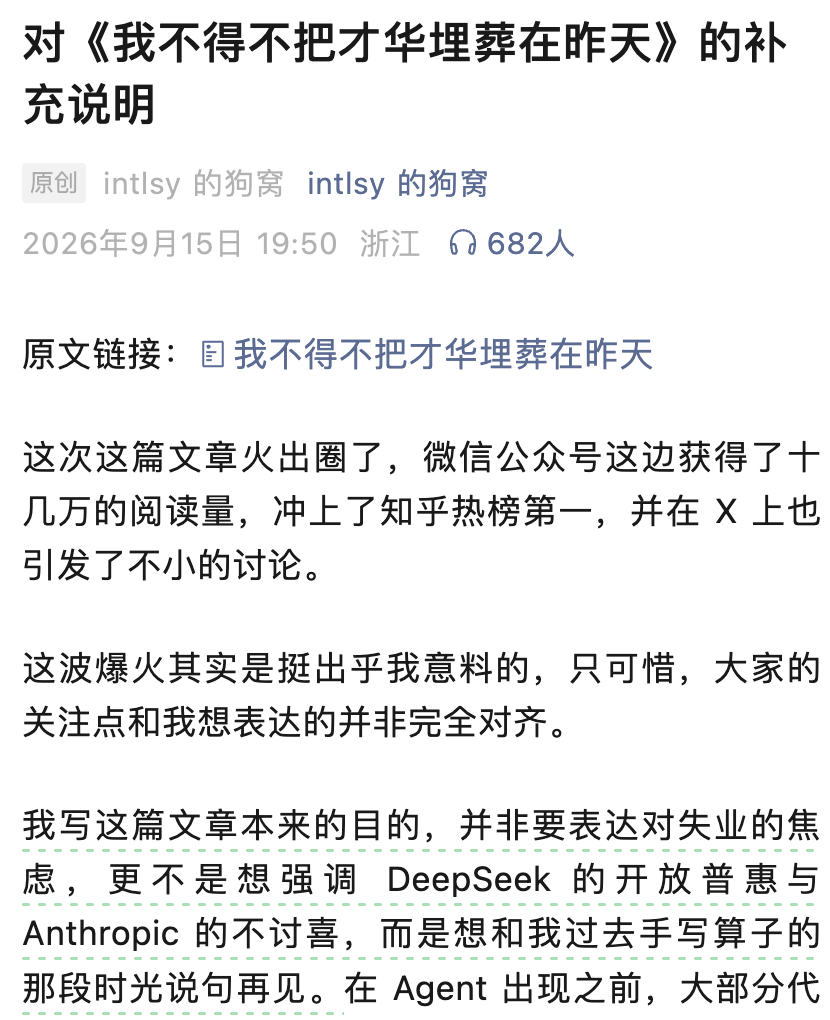
On the evening of September 15,Liu posted a response saying the essay’s popularity was unexpected. He said hedidn’t write it to express anxiety about losing his job, and definitely not to highlight DeepSeek’s openness and accessibility versus Anthropic’s less likable side.“Instead, he wanted to say goodbye to the days when he hand-wrote operators.”
Public records show that Liu studied in the 2021 Turing Class of the Information and Computing Science program at Peking University’s School of Electronics Engineering and Computer Science. In 2025, Liu joined DeepSeek,where he works on machine learning systems and operator design and optimization.
For context, AI operators are the basic computational units in artificial intelligence. In machine learning and other fields, they process data and support tasks like model training, deep analysis, and predictive analytics. Their functions broadly fall into prediction, classification, clustering, regression, time-series forecasting, and evaluation. How fast and cost-efficient a model runs depends not only on its architecture but also on whether its operators can fully unleash the performance of hardware like GPUs.

In “I Had to Bury My Talent Yesterday,” Liunotes that he wrote the main attention operator for DeepSeek v4.1 and is proud of the model’s success. But he also says that in six months to a year, AI-written operators will likely be just as good as his—maybe even better.
Liualso wrote about a “technology paradox” that resonated with many:“The better I write operators, the faster our new models train and infer, the faster model capabilities advance—and the sooner I get replaced.”He added, “Of course I hope I won’t be disrupted, but if I have to be, I’d rather be the one disrupting myself.”
He also voiced some concerns about AI’s relentless progress. He worries that as AI develops, students will get more used to relying on it to finish their assignments, which could leave the next generation of developersseriously lacking in engineering skills—things like organizing code, building systems, thinking ahead about future needs and designing for them in advance, and abstraction.
His concerns aren’t unfounded. Research has found that AI is already hurting students’ ability to learn. According to NUPIAO, over the past three years, Wu Yanhui, an economics professor at the University of Hong Kong, and David Strömberg, an economics professor at Stockholm University in Sweden, tracked 26,811 middle and high school students in a county in central China. They found that after students started outsourcing homework to generative AI, their homework grades improved by about 18% in the short term, but their monthly exam scores dropped by an average of 20% within six months. The deeper impact showed up two years later—students’ high school entrance exam and college entrance exam scores fell by as much as 24% and 18%, respectively. They summed up the finding as the “AI learning penalty.”
AI’s rise is also putting more pressure on workers.Google CEO Sundar Pichai revealed in April that 75% of Google’s new code is now generated by AI, with engineers shifting from “writing code” to “reviewing code.” That share was 25% in October 2024, crossed 50% by fall 2025, and hit 75% in less than two years.
On September 11, at a press conference held by the Ministry of Industry and Information Technology, Lü Weifeng, vice chairman and secretary-general of the China Software Industry Association, responded to claims that “AI will replace programmers.” He said AI is driving a transformation in software production methods, and the skill structure of software talent and job requirements are adjusting accordingly.
Still, despite the tough reality, Liu remains optimistic. In his September 15 response, he said he will“keep pushing forward in this field,” “try to find my own happy place in the age of AI,” and hopes to build the most powerful intelligence to benefit everyone.