NUPIAO
Oct 15 saw a landmark shakeup in the A-share market cap rankings. Industrial and Commercial Bank of China (601398.SH) closed at 8.50 yuan today, up 0.59%, with total market cap hitting 3.03 trillion yuan, reclaiming the No. 1 spot. CXMT (688825.SH) opened low and kept sliding, closing down 5.24% at 43.59 yuan, with market cap falling back to 2.96 trillion yuan. It was overtaken by ICBC and China Construction Bank in succession, dropping to third place.
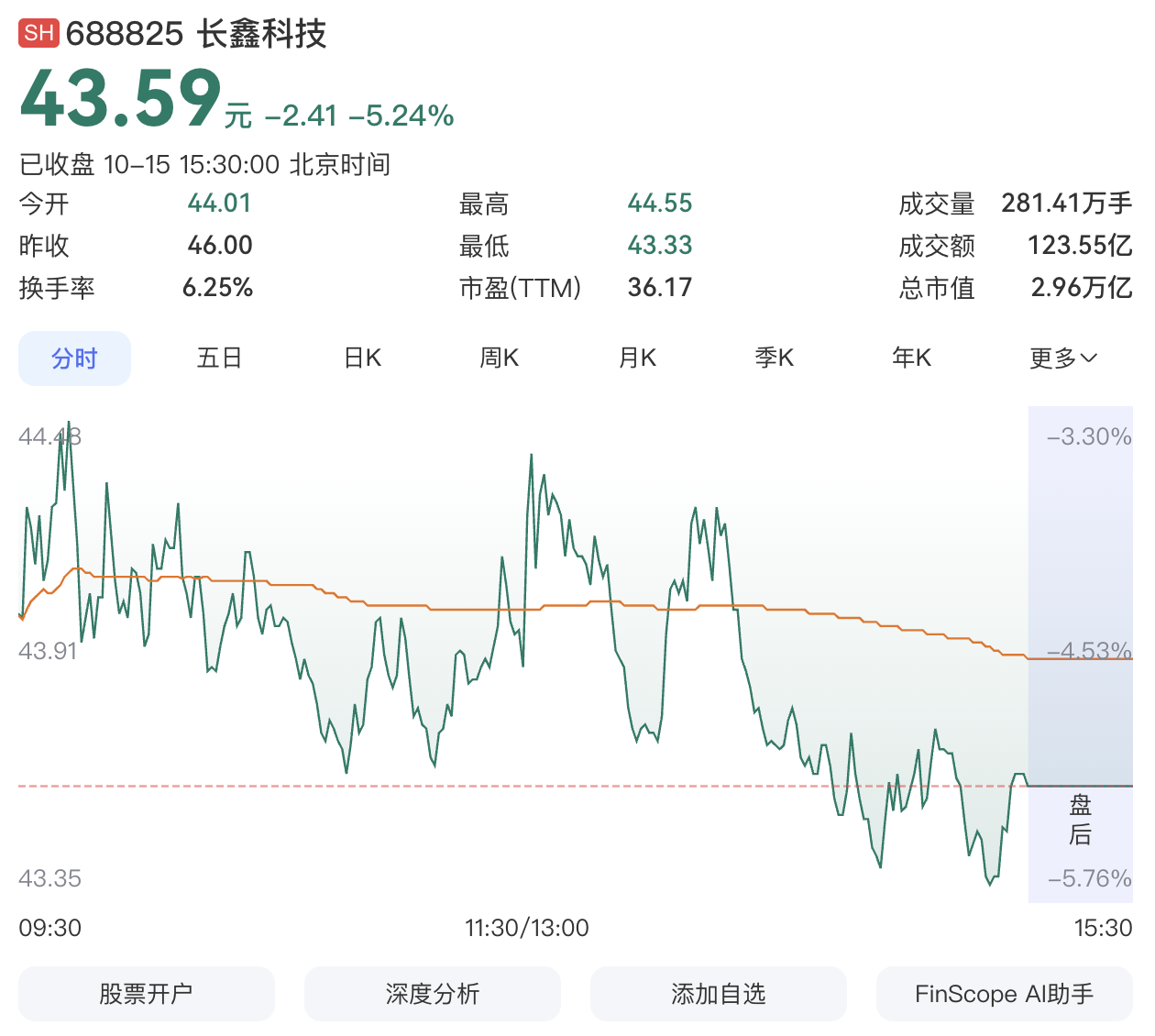
Since its Aug 17 peak, CXMT has lost over 1 trillion yuan in market value over two months, making it one of the most closely watched valuation pullbacks in the A-share market this year.
ICBC’s return to the top isn’t a one-off fluke. As a long-standing heavyweight on the A-share market, ICBC has topped the market cap chart multiple times since its 2006 listing, later trading the crown with giants like PetroChina and Kweichow Moutai, and has reclaimed the throne several times in 2024 and 2025.
This year alone, ICBC has lost the top spot twice, briefly overtaken by China Construction Bank on May 26. This latest comeback rides on the sustained strength of the banking sector, as low-valuation, high-dividend assets keep drawing long-term capital. Unlike tech stocks with their wildly swinging valuations, ICBC’s market cap growth is steadier and less volatile, making it a natural magnet for risk-averse money when market styles shift.
CXMT, by contrast, has seen its market cap retreat sharply from the peak, kicking off a valuation reset for the domestic memory chip leader.

CXMT listed on the STAR Market on July 27 and surpassed ICBC in intraday market cap on its debut day, briefly seizing the A-share crown. On Aug 17, its share price surged to 61.8 yuan, pushing total market cap to a peak of 4.13 trillion yuan.
Since that high, the stock has been on a volatile downward path. Over the past 15 trading days, CXMT’s market cap shrank by about 760 billion yuan; on a one-month basis, the pullback widened noticeably; and over two months, it has shed over 1 trillion yuan, with shares down 25.57%, stepping down through the 4-trillion and 3-trillion yuan thresholds.
Even after such a steep correction, the stock remains far above its 8.66 yuan IPO price, leaving investors who bought at the top sitting on sizable paper losses.
The market’s focus on CXMT centers on whether its growth expectations match its valuation. On one side are a string of major product launches; on the other are worries about future capex and intensifying competition. On Sept 7, ChangXin Memory announced that its self-developed LPDDR6 chip had completed mass production and commercialization, debuting in Xiaomi’s 18 Fold flagship foldable — the first commercial rollout of LPDDR6 in a flagship phone globally. Each die offers 16Gb capacity, expandable to 16GB after packaging, with peak transfer speeds of 12,800Mbps — 60% more bandwidth than LPDDR5X and 20% lower power consumption.
According to ChangXin Memory, LPDDR6, as the latest low-power, high-speed product, will eventually land in phones, PCs, smart cars, edge servers, wearables and robots.
Also in September, NUPIAO reported, citing people familiar with the matter, that ChangXin Memory plans to set up a NAND flash R&D production line at a new plant in Beijing. The company has also established a research institute in Beijing, with projects including NAND development. ChangXin Memory has already discussed its NAND flash plans with customers, including a newly founded startup that intends to buy its NAND chips for storage products used in AI systems and supercomputers. The source declined to name the company. It remains unclear when the R&D line will start operating, or whether ChangXin Memory plans to move from R&D and trial production to large-scale commercial manufacturing.
The move means CXMT could soon face direct competition from the three global memory giants: Samsung, SK Hynix and Micron. In the global DRAM market, these three have long held the lion’s share, and CXMT is one of the few domestic players to break through the oligopoly. Counterpoint data shows that in the second quarter of 2026, CXMT ranked fourth globally with a 7% share of DRAM revenue.
In NAND, the market is highly concentrated, with massive capital requirements and costly technology upgrades. New entrants need sustained heavy capex, which will weigh on profit levels in the near term. Several institutions argue that CXMT’s cross-track expansion means R&D and capacity investment will keep climbing over the next few years, prompting the market to reprice the company’s long-term earnings expectations and putting pressure on its high valuation.
Looking at the latest financials, CXMT’s fundamentals remain in high-growth mode, but whether that growth can last has become the focal point of market debate. Its 2026 interim report shows first-half revenue of 150.31 billion yuan, up 873.64% year on year; net profit attributable to parent of 77.605 billion yuan, swinging back to profit; non-GAAP net profit of 78.793 billion yuan; and net cash flow from operating activities of 131.156 billion yuan, up 2,985.64% year on year.
In the second quarter alone, net profit attributable to parent reached 52.843 billion yuan, a sharp sequential increase. R&D spending during the reporting period was 6.859 billion yuan, up 87.38% year on year, with continued investment in the G5 process platform, LPDDR6 and automotive-grade memory. Its customers include Alibaba Cloud, ByteDance, Xiaomi and Honor.
The standout interim results confirm that the memory upcycle is delivering a earnings boost, but the market is also wary that memory price swings will directly affect profitability, and combined with expansion into new tracks, earnings growth remains uncertain.
Whether the company’s market cap can climb again will no longer depend solely on the domestic substitution narrative. It will hinge more on the progress of its NAND flash business, changes in the global memory cycle, and whether it can steadily deliver on earnings.