By NUPIAO
August was a rough month for the US game hardware market. Let’s not sugarcoat it.
Fresh numbers from Circana show US game hardware unit sales dropped 15% year over year in August to just 559,000 units. That’s the lowest August total since 2013. Hardware spending dipped 3% to $302 million. Through August, 2026 hardware spending sits at $2.5 billion, down 11% year over year.
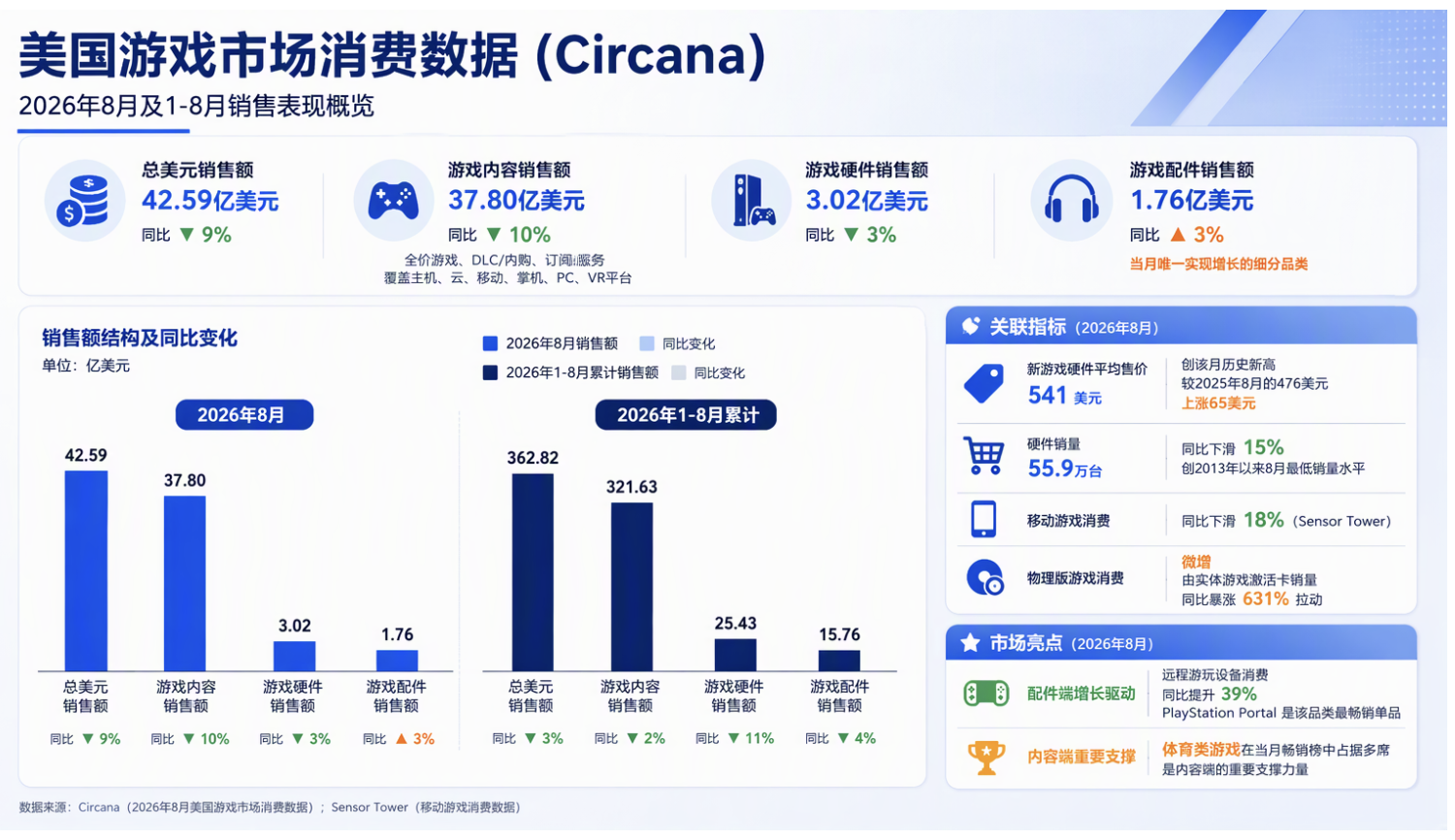
This weakness did not come out of nowhere. July had already sent a warning shot: Circana data showed US game hardware spending fell 29% year over year, a clear sign that console demand was shrinking. August kept the downward trend going. Overall game market sales slid 9% year over year, with both content and hardware dragging things down. Mobile game spending was the main reason content weakened.
August game content spending totaled $3.78 billion, down 10% year over year. Accessories were one of the few bright spots, rising 3% to $176 million, helped by strong sales of remote streaming devices.
Console makers’ sales data tells a split story, and the “more revenue, fewer units” effect from price hikes stands out. Sony’s PS5 hardware revenue rose 17% year over year in August, but console shipments fell 11%. Microsoft’s Xbox Series hardware spending dropped 13%, while unit sales plunged 31%, the steepest decline among the big three. Nintendo hardware spending fell 13%, and unit sales slid 15%. Even Switch 2, which still leads both unit sales and revenue for August and year to date, could not turn around the broader US console hardware slump.
Mat Piscatella, senior director and games industry advisor at Circana, said the average selling price for new game hardware in the US hit a record high for August at $541. The previous August record was $476 last year. Rising console prices are directly sapping everyday players’ motivation to upgrade.
The console industry is stuck in an awkward spot: hardware keeps getting more expensive, and fewer people are willing to pay up.
Higher chip costs are the shared reason Sony, Microsoft and Nintendo keep raising console prices. Global AI computing buildout is driving demand for memory chips, pushing up prices for RAM and flash components and squeezing console makers’ margins.
In May, Nintendo announced it would raise Switch 2 prices in major global markets to cope with rising component costs. Official notices showed the US retail price for Switch 2 would go from $449.99 to $499.99 starting September 1, a $50 increase. In Europe, the price moved from 469.99 euros to 499.99 euros, up 30 euros. In Canada, it rose from 629.99 Canadian dollars to 679.99 Canadian dollars, up 50 Canadian dollars.
In Japan, Switch 2 got a price hike first in late May. The Japan-only domestic model went from 49,980 yen to 59,980 yen, up 10,000 yen, while the multilingual version rose from 69,980 yen to 79,980 yen.
Nintendo said on its earnings call that higher memory component prices plus tariffs would create a cost hit of about 100 billion yen this fiscal year. The company also cut its Switch 2 sales forecast, expecting 16.5 million console units in fiscal 2026, down 16.9% year over year and well below prior market estimates.
Sony announced in March that, with the global economy still under pressure, it had decided after careful review to adjust suggested retail prices for PS5, PS5 Pro and the PlayStation Portal remote player worldwide. The updated PS5 suggested retail prices took effect April 2 in the US, UK, Europe and Japan. In the US, PS5 went from $549.99 to $649.99, the PS5 Digital Edition also rose $100 to $599.99, and PS5 Pro, the high-performance version, jumped $150 to $899.99.
Sony also raised prices in China. The PS5 Slim Digital Edition went from 3,499 yuan to 3,999 yuan, up 500 yuan. The PS5 Slim with a disc drive moved from 4,299 yuan to 4,399 yuan, up 100 yuan. PS5 Pro rose from 5,599 yuan to 6,299 yuan, up 700 yuan. It marked Sony’s second price adjustment for mainland China PS5 models since 2022 and the first for PS5 Pro since launch.
Microsoft got an earlier start. In May 2025, it raised prices across the Xbox Series line: Series X went from $499.99 to $599.99, and Series S went up by $80.
With memory costs still climbing, Sony expects console sales to keep sliding in fiscal 2026. Its message was blunt: consoles just are not moving this year.
In Sony’s fiscal 2025 third quarter, PS5 shipments reached 8 million units, down 16% year over year. The hardware decline directly pushed sales in its Game and Network Services segment down 4% year over year. Soaring memory chip prices and other raw material costs have squeezed hardware margins even further.
Still, weaker console hardware demand does not mean the game content market is dead. August’s US game software chart brought a wave of new releases. NBA 2K27 took the monthly sales crown, Madden NFL 27 came in second, and Marvel Tokon: Fighting Souls landed third. Six of the top ten were new titles, with sports games serving as a steady revenue engine.
Elden Ring also got a boost from its Switch 2 release, jumping from No. 41 in July to No. 7 in August. But software momentum is not enough, at least for now, to offset the demand chill from expensive consoles.
The console industry’s cycle also magnifies today’s pressure. PS5, Xbox Series and Switch 2 are all in the middle of their product cycles, and the launch-era upgrade rush is long gone. Existing owners have little reason to buy an expensive new console unless they have a really strong need to play.
In the near term, memory chip prices are unlikely to fall much, leaving little room for console discounts. The hardware market’s slump will probably stick around for a while.