NUPIAO | Staff Writer
On October 14, Omdia released its Q3 2026 mainland China smartphone report, and the headline number wasn’t pretty: total shipments came in at 59.3 million units, down 12% year over year—the weakest third quarter since 2013. The market split was unmistakable: among the top five, only Huawei and Apple posted gains.
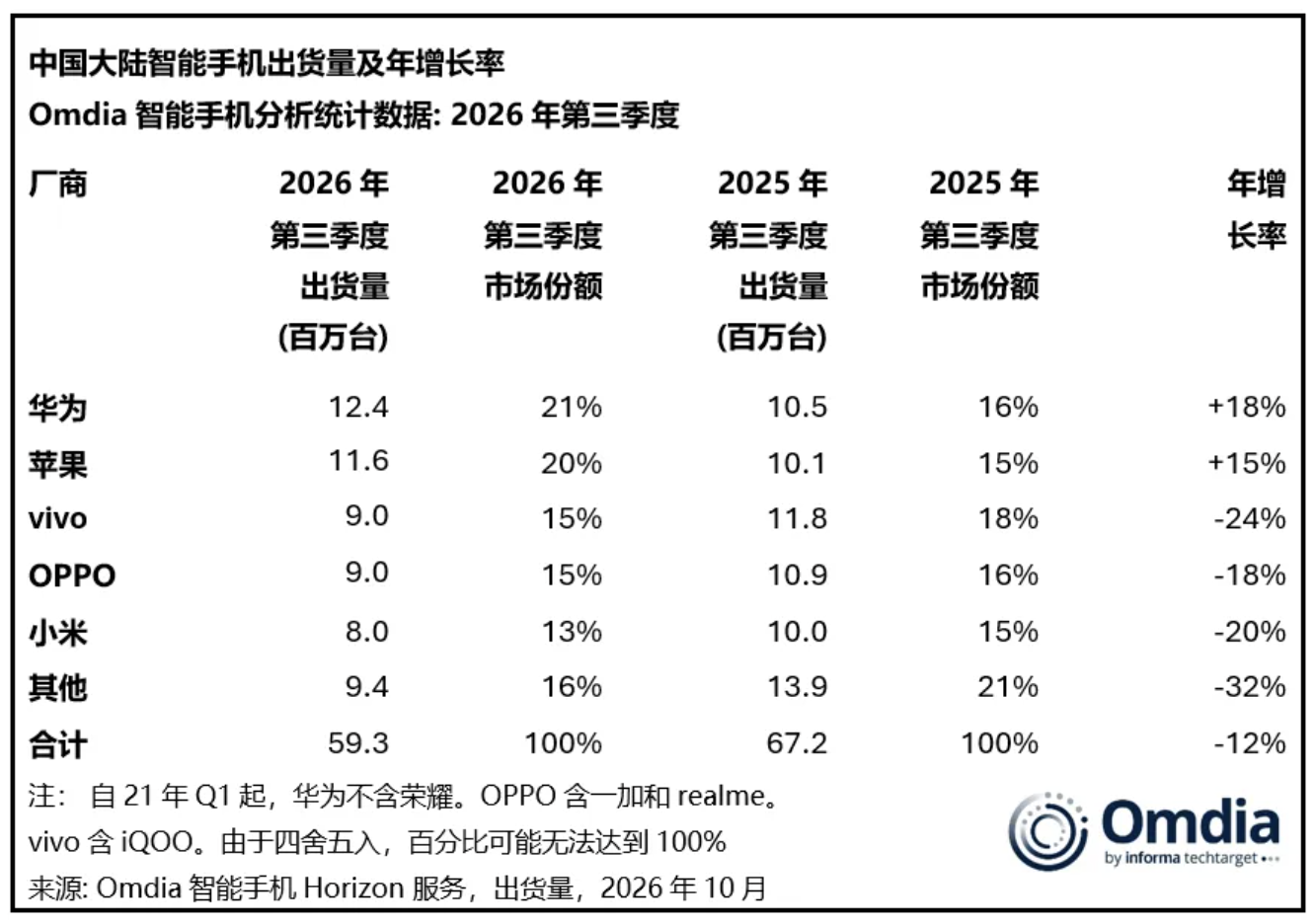
Huawei led the pack with 12.4 million units, a 21% share. In Q3 2025, it shipped 10.5 million units for a 16% share, so the latest quarter marks 18% growth. The company leaned on a full price-band lineup, disciplined pricing, HarmonyOS ecosystem upgrades, and strong sales of its new “wide-screen” form factor to keep its lead.
Apple followed with 11.6 million units and a 20% share, up from 10.1 million units and 15% a year earlier—a 15% increase. Together, Huawei and Apple controlled 41% of the domestic market, nearly half the pie.
Omdia noted that Apple changed its launch cadence this year: in September it only rolled out the Pro series, while the standard models moved to the following year. That shift doesn’t just reshape Apple’s own full-year shipment curve; it also changes the competitive windows for local brands. Domestic players need to adjust launch timing, resource allocation, and product mix to grab the gap created by Apple’s old-to-new product transition.
The other local brands all slipped to varying degrees in Q3. vivo shipped 9 million units for a 15% share, down from 11.8 million units and 18% a year earlier—a 24% drop. OPPO also shipped 9 million units for 15%, compared with 10.9 million units and 16% in Q3 2025, down 18%. Xiaomi shipped 8 million units for 13%, versus 10 million units and 15% a year earlier, down 20%. All remaining vendors combined shipped 9.4 million units for 16%, down sharply from 13.9 million units and 21% a year earlier—a 32% fall. In these figures, Huawei excludes Honor, OPPO includes OnePlus and realme, and vivo includes iQOO.
Behind that polarization sits a shared headache: memory costs remain stubbornly high. AI servers are eating up a big chunk of memory chip capacity, DRAM and NAND flash prices keep climbing, and the bill of materials for phones is going up.
Vendors are stuck between a rock and a hard place. Raise device prices and you risk cooling consumer upgrade appetite; hold prices and your margin gets squeezed. The report shows brands are taking different routes. Huawei is banking on new product cycles and existing users’ upgrade demand, digging deeper into premium, and using its in-house product strengths to offset upstream component price hikes. Apple is leaning on its supply chain bargaining power to keep memory procurement stable, while new iPhones continue to pull in high-end Chinese buyers. vivo, OPPO, and Xiaomi are trimming product lines, slowing low- and mid-range launches, shifting resources toward premium models, controlling output, and reducing inventory risk.
Omdia Chief Analyst Hou Lin said in the report that memory prices hit a near-term high in Q3, with cost pressure passing top-down to end products and hitting each brand’s shipments to different degrees, further intensifying market divergence.
The pressure in China isn’t an isolated case. Counterpoint also released its global smartphone shipment monitor on the 14th, showing Q3 2026 global shipments down 20% year over year—the lowest for the period since 2012.
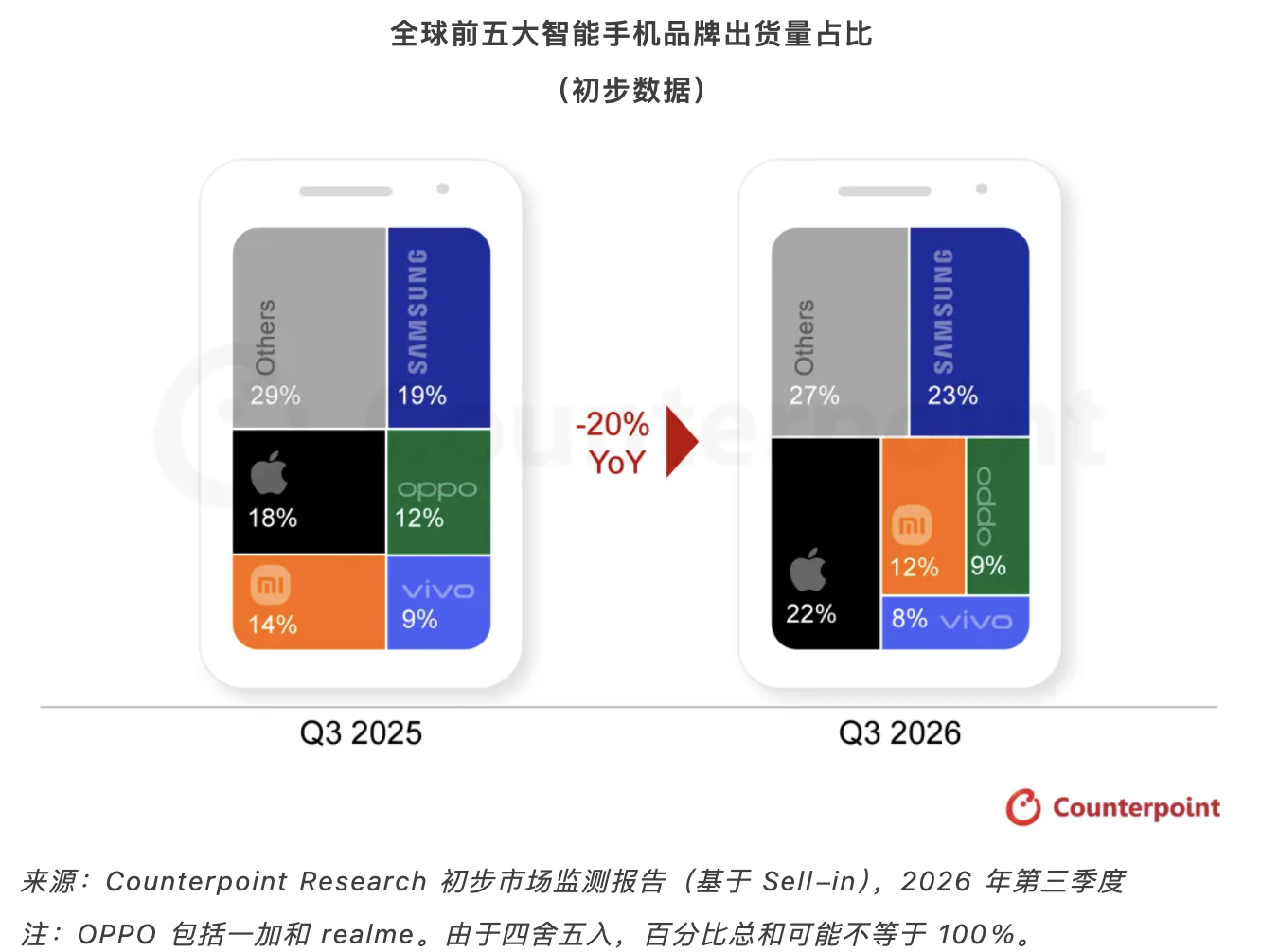
Looking at brands globally, the top five remained stable. Samsung held the No. 1 spot with a 23% share. It managed to lift share against the downturn, even with a slight shipment decline, relying on a diversified global market footprint to cushion the industry slide.
Apple ranked second with 22%. Despite a year-over-year shipment decline, its share still reached 22%—the first time Apple has topped 20% in a third quarter. Counterpoint said the decline mainly stemmed from the base iPhone 18 not yet launching, which left first-month channel stocking below the full iPhone 17 series a year earlier.
Xiaomi, OPPO, and vivo took third through fifth globally, with shares of 10%, 9%, and 8%, respectively. The top global brands together held 72% of the market, another sign of rising concentration.
Brands face very different realities across regions. In China, structural opportunities are concentrated in premium. Huawei and Apple’s growth proves that brands with real product barriers can still unlock demand in a mature market. Globally, Chinese vendors can still hold their base in Southeast Asia, Latin America, and other overseas markets to offset losses from a shrinking domestic pie.
For the rest of 2026, the China market will remain under pressure. Omdia forecasts full-year 2026 mainland China smartphone shipments to fall about 7% year over year.
Omdia Senior Analyst Lucas Zhong said China’s smartphone AI battle is shifting toward OS-level architecture, how well Agent assistants complete tasks, and cross-app ecosystem coordination. The industry is buzzing with different approaches, but agent deployment still runs into real-world roadblocks: app permission openness, protocol unification, and on-device compute limits. Most products are still moving from technical validation to scaled commercialization. With memory costs high, vendors must balance R&D spending, hardware costs, and retail pricing. Only by turning AI into practical, high-frequency use cases can they truly spark upgrades in a mature market.
Globally, Counterpoint believes that with component costs high and consumer purchasing power under pressure, OEMs are increasingly putting profitability ahead of shipment growth. The trend of cutting output, streamlining product lines, and focusing on premium models may continue, while price-sensitive markets face more pressure from device price hikes and constrained component supply. Until component costs and supply improve, global smartphone shipments are unlikely to see a meaningful rebound.