News reporter |
News editor | NUPIAO
Up until early 2026, DHH (David Heinemeier Hansson) still refused to give up hand-writing code—that old-school craft.
The programmer, famous for his love of coding, created Ruby on Rails, a software development framework that has helped countless people turn ideas into websites and businesses. For more than two decades, he believed writing code was something worth loving for its own sake. Faced with the temptation to let AI do the work, he once wrote in a blog post that he would rather retire than permanently hand the keyboard over to AI.
But on September 23 this year, standing onstage at Rails World in Austin, he said his company no longer treats hand-written code as the standard way to build software, and told his peers, “Pencils down.” The figure who had long criticized AI-generated code and defended human programmers had to compromise with the technology.
DHH doesn’t think programmers will lose all their value. But he admits some companies may no longer need as many of them. Long-term progress that benefits humanity as a whole can still create short-term pain for real people.
That situation has made programmers even more anxious. Large models are racing to catch up with the edges of their abilities. The more AI models fill up their “health bar” in benchmarks, the more the value space for programmers gets squeezed.

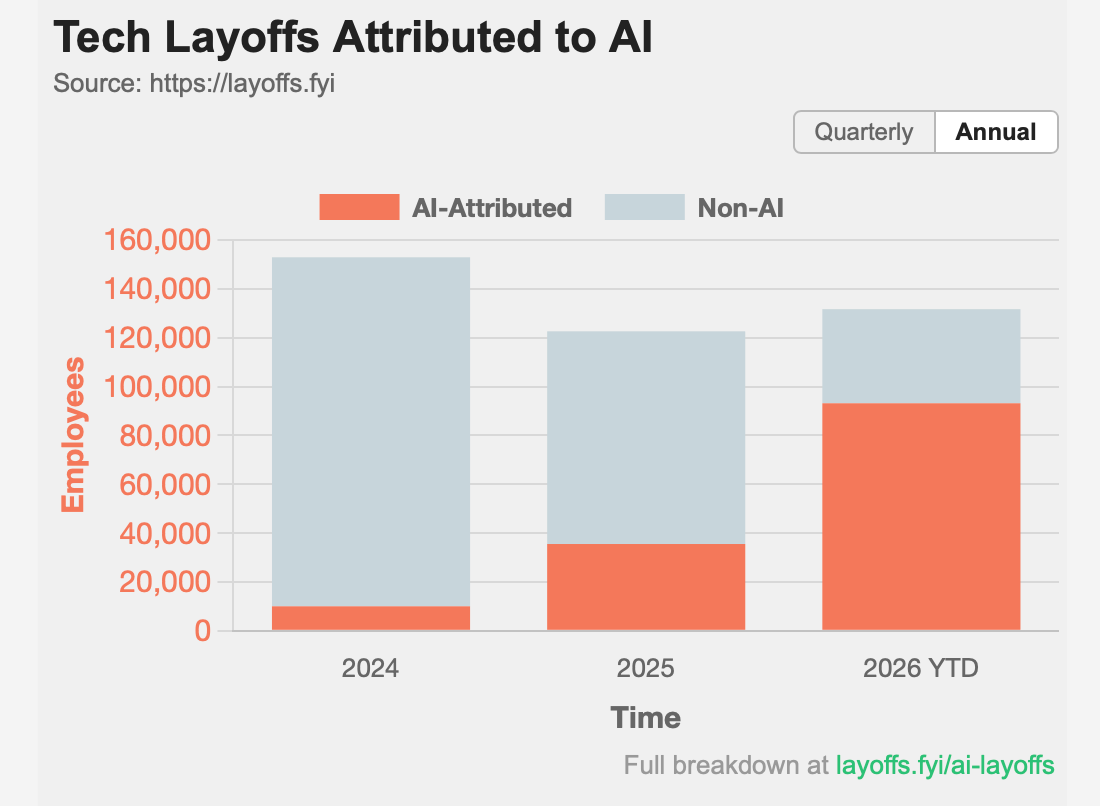
At its Cloud Next event in April, Google disclosed that nearly 75% of new code inside the company was already AI-generated; two years ago, that share was only 15%. Stats from Layoffs.fyi show that in the first half of 2026, global tech layoffs topped 120,000 for the year, already matching all of 2025, with most tied to AI.
For China’s big internet companies, the cost-cutting and efficiency push is just as harsh. How can programmers prove they’re more useful than AI?
More programmers feel this directly during interviews. Many of them may have spent an entire career learning exactly what AI can now do—and those skills are no longer valued. Employers have adopted a blunter attitude: “You’d better know something AI doesn’t.”
Acceptance
Wu Tianyu started using AI for coding in 2023. Back then, Vibe Coding products like Cursor weren’t mature yet, so he just used ChatGPT to write code and then copied and pasted it. By early 2024, he could clearly feel that, the code AI wrote was better than his—cleaner, faster, and able to finish “a day’s work in a few minutes.”
Unlike the “thrilled,” “excited,” and “mind-blown” reactions all over social media, Wu’s first reaction was anxiety, which turned into resistance. For months, he was stuck in a subconscious feeling that “using AI makes me look incompetent, like I’m slacking off.”
At the time, Wu was a second-year PhD student in intelligent manufacturing and robotics. The senior students in his lab were generally strong coders who almost all wrote code by hand. When he occasionally opened an AI coding window, he had to hide it from his labmates’ eyes.
Then came two years of explosive growth in AI models’ coding abilities. From early 2024 to mid-2026, flagship models from OpenAI, Anthropic, Google, Zhipu AI, MiniMax, and Kimi posted big gains on mainstream coding benchmarks such as HumanEval, MBPP, and SWE-bench Verified (including the original version). The first two especially rose by nearly ten percentage points across the board.
Most programmers actively embraced AI during this period.
Wang Guangyan, a backend developer at a big internet company, was also deeply distrustful of AI at first because early models still hallucinated badly. “I thought it might be like AlphaGo—take off in leaps, then slow down.” Only after heavy use over the past year did he find that AI coding was delivering increasingly obvious efficiency gains.
In the past, Wang might spend 60%–70% of his day writing code, with the rest going to confirming requirements, design, and debugging.Once AI entered his workflow, that split flipped.
Wu also “gave up the fight” in mid-2024 when his graduation project began. His advisor wanted him to independently build a robot-related app, and the workload was so huge that he had to rely on AI.
After AI easily produced some UI work he couldn’t have pulled off, Wu’s anxiety and resistance melted away. He realized clearly that AI was replacing the mechanical brainwork of “old-school programming,” which actually freed people to spend more time on creative ideas and aesthetic details. He not only started using it openly but also recommended it to his senior labmates.
In the process of accepting AI, almost everyone wondered at some point: will AI replace me?
More interviewees said this is indeed rough for workers. Many believe 2026 is the “year zero” of tech layoffs; over the next one to three years, the industry could lose 30%–50% of jobs, and the final number could be even higher—maybe 80%–90%, or maybe it will hit a ceiling at some point.
But they still think it’s necessary to stay calm in the short term and optimistic in the long term—they can still see human value, and see that behind the AI replacement trend is a shift in what human abilities matter.
For example, one counterintuitive take: AI coding may actually have a positive career impact on programmers over 35.
Before AI, the saying that “programmers only last until 35” was already a popular consensus. For these “older programmers,” the career cycle was already that short; whether AI came along or not wouldn’t cause much extra shock to their careers.
“AI actually brings a bit of freshness—it highlights the value people can create,” Wang said.
“Indirect Replacement”
Most of the time, technology doesn’t replace people overnight.
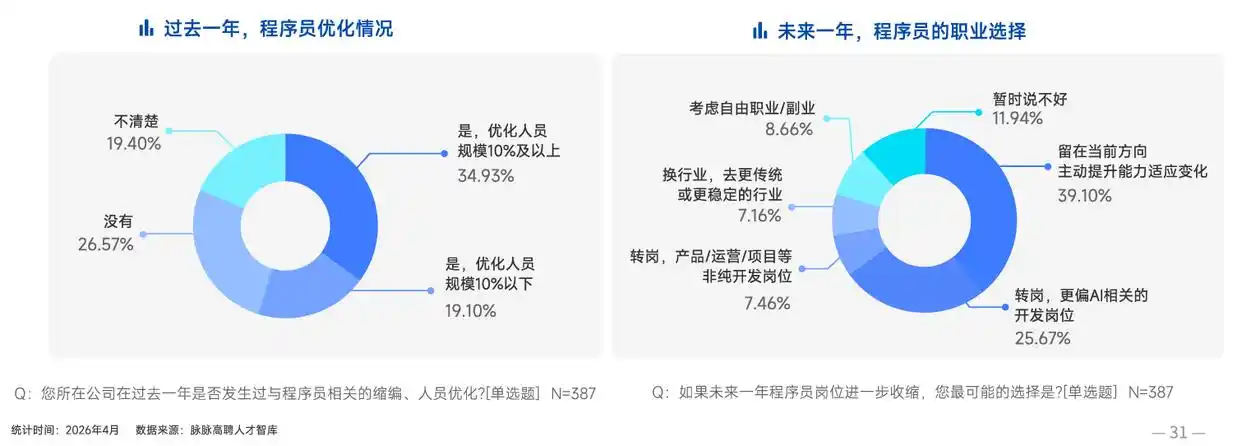
At big companies, it usually shows up indirectly. For example, teams get tough KPIs that fuel internal competition and a horse-race style of survival of the fittest, so headcount can stay at 70%–80% of what it was, or even half.
Another more obvious change: interview experience or tricks built for “old-school programming” have stopped working.
A new graduate who just went through spring recruiting said last year’s experience no longer applies this year, and every specific change has to be figured out the hard way. “If you’re not a perfect match for the role, they’ll hit you with very hard questions to prove you have the potential to solve unknown problems.”
Based on job seekers’ experience, companies now hire in only two ways. One is paying for experience: “You’re deeply experienced in this field and have stepped in enough pits and hit enough mines.” The other is paying for potential, such as fresh graduates from Tsinghua or Peking University, or PhDs from Ivy League schools. Willingness to pay for talent in the middle is falling, “because AI can do most of the work.”
Headhunters are also sensitive to changes in the industry’s “water temperature.”
Qiu Yuewen has been a headhunter in the internet industry for nearly ten years. In the two years since AI coding took off, he deliberately moved away from traditional internet roles and toward embodied AI, which is now hot.
What he’s observed is that big companies’ demand for vertical business expertise has soared, sharply narrowing the candidate pool headhunters can choose from. A Java programmer at Alibaba’s P7 level was “very easy to sell” seven or eight years ago, but today there’s no headhunting budget for that profile at all—almost everything has shifted to RPO (bulk HR outsourcing) or ITO (IT project outsourcing). What’s still in demand are high-end vertical roles at least at architect level or P8 and above.
Behind this, technical value is losing weight while business understanding is gaining.
Another talent trend at big companies: outsourcing is replacing full-time headcount, and AI is replacing outsourcing.
As full-time frontline headcount shrinks sharply, many big companies and even second-tier internet firms are massively using outsourced workers to fill basic, highly replaceable work such as testing, front-end, and data labeling.
Not long ago, rumors flew that a major internet company was cutting outsourced staff on a large scale. “I won’t claim exact numbers, but large-scale cuts of outsourced workers really did happen,” Qiu said. “The root cause is AI replacement.”
Across all programmer roles, algorithm jobs are the least replaceable because they depend heavily on “understanding the business and coming up with algorithm strategies.” But even in algorithm roles, there’s a polarization: high-end talent is in demand while the low-end market shrinks.
From a headhunter’s perspective, Qiu points out the truth of this “indirect replacement”: AI has only boosted labor productivity, not created a massive wave of new jobs.
In the AI era, traditional internet hasn’t produced new business models that create large-scale employment. In fact, from food delivery and mobility to content platforms, they’ve become even more “involuted” in a zero-sum market.
“Right now, AI just makes everyone more efficient at dividing the cake—the cake itself hasn’t gotten bigger.” With no new business growth, once efficiency rises, fewer people are naturally needed. That may not change until the next tech breakthrough.
A Different Exit, a Different Mindset
Over the past two years, with Elon Musk and others promoting it, a futurology hypothesis has become more popular among the public: carbon-based humans may just be a temporary vessel for intelligent civilization, whose real purpose is to create artificial intelligence and migrate intelligence onto silicon chips to complete the next iteration of civilization.
Some people really do face the future with that mindset. But they’re not anxious or panicked; they just take rational precautions, like cutting meaningless consumption and investment and keeping cash flow healthy.
But on the bright side, under an irreversible trend, do programmers have a Plan B for their careers?
At Qiu’s headhunting firm, one business line with real growth is placing former programmers from top-tier big tech into traditional industries such as pharma, retail, FMCG, and manufacturing. These sectors are going through digital and intelligent transformation and have lots of internal demand for AI Agent development.
“Many programmers with AI skills who don’t want to keep grinding in the internet industry now choose to go into traditional industries and lead AI efforts.” Their total pay package may shrink, but because the workload is far lighter than in internet companies, their hourly pay doesn’t change much.
Traditional companies have one more advantage: they’re less strict about age than internet firms. “Even 40-year-olds can get in; if you’re more senior, they’ll accept you up to 45.” In some pharma companies, most R&D staff are PhDs, so the average age is already higher than in internet. These companies also relatively respect the technical foundations of big-tech engineers and strongly favor people with internet backgrounds making the switch.
Call it a “forced landing path” into traditional industries—at least it can stretch a career by another five to ten years.
Beyond that, AI coding has opened up a new “one-person company (OPC)” route for many people.
Zhou Ziyou, who studied computer science as an undergraduate, is currently overseas. He works as a senior developer at a big company while running a small startup on the side.
Outside his full-time job, his daily side business is taking tasks or requirements from clients and writing “tickets” for an AI Agent. Because the Agent he’s trained over time already holds a lot of background knowledge, Zhou usually only needs to give it basic information—sometimes just the chat log with the client. Once coding starts in the background, he only needs to review the code and handle final quality control and branch merges.
“Before, our startup team was always just two people. In early 2025 I thought we had to hire, but we didn’t bring in a single new person all year—and our delivery volume was still several times that of previous years,” Zhou said. “I’m confident I can match the efficiency of a traditional 10–20-person coding team that doesn’t use AI tools—and even deliver better quality.”
As an undergrad, Wu’s dream was still to become a big-tech programmer. But he’s given up that idea and chosen entrepreneurship, building a robotics company in embodied AI.
In Longhua District, near Shenzhen North Station, Wu’s team rented a 180-square-meter apartment in a residential complex. Three of the four bedrooms serve as offices, and one is a warehouse. Wu’s desk is in the living room, which doubles as the robot “test site,” with four prototype robots and a robotic arm set up.
Three monitors sit in front of him, with code and modeling windows open, and AI coding tasks running on almost all of them.
It’s 7:30 p.m. on a weekday, and soon a tech executive from an embodied AI unicorn will visit to discuss human-robot interaction collaboration. Tomorrow morning, he’ll meet an investor.
“Full of challenges.” That’s how Wu describes his life now. “I don’t resist it, I’m not afraid of it—I actually enjoy it.”
(At the interviewees’ request, Wang Guangyan, Qiu Yuewen, and Zhou Ziyou are pseudonyms.)