“We’ve been quiet for almost half a year, and we spent that time digging into one question: how far can reinforcement learning (RL) actually go?” In the early hours of September 17, Luo Fuli, head of Xiaomi’s MiMo large-model team, shared the latest update on Xiaomi’s large models in a social-media post.
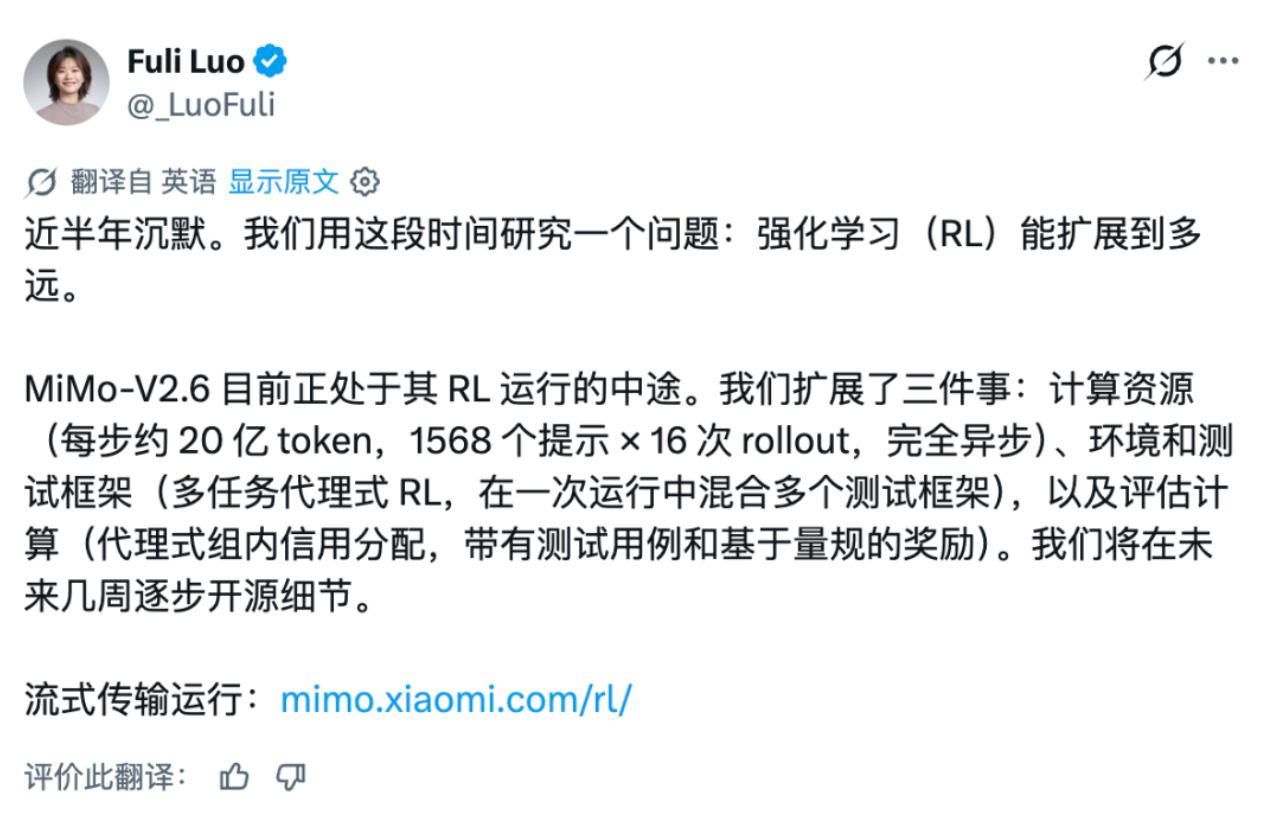
According to Luo Fuli, Xiaomi MiMo-V2.6 is currently in the middle stage of reinforcement learning, and the team is scaling in three areas: compute resources (about 2 billion tokens per step, 1,568 prompts × 16 rollouts, fully asynchronous); environment and testing frameworks (multi-task agent reinforcement learning, mixing multiple frameworks in a single run); and evaluation compute (agentic intra-group credit assignment, with test cases and rubric-based rewards). The Xiaomi MiMo team will gradually open-source the relevant details over the coming weeks.
Worth noting, Luo Fuli also directly posted the real-time training dashboard for MiMo-V2.6, giving the outside world its first look at part of the training status during this generation’s RL phase. The dashboard covers two versions, MiMo-V2.6-Pro and MiMo-V2.6-Flash, and shows training progress, token consumption, training cost, sample count, and changes in several internal metrics.
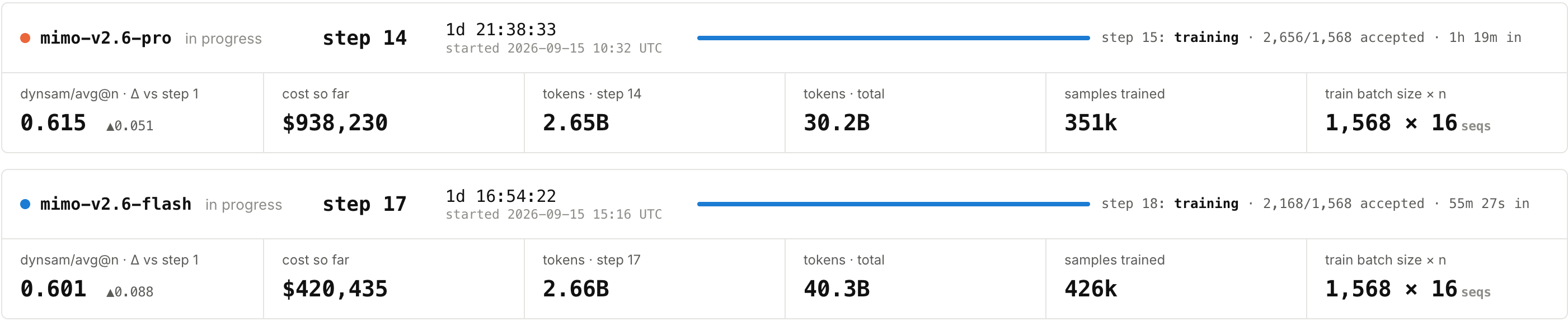
As of the afternoon of September 17, when this story was filed, the two versions had racked up more than $1.35 million in cumulative training costs. MiMo-V2.6-Pro had run for 1 day and 21 hours and burned over $930,000, averaging more than $20,000 per hour; MiMo-V2.6-Flash had trained for 1 day and 16 hours and spent over $420,000, averaging more than $10,000 per hour.
All told, the two versions together were burning about $31,000 per hour, equivalent to more than 200,000 yuan.
Luo Fuli was born in Yibin, Sichuan, in 1995. She studied as an undergraduate at Beijing Normal University majoring in computer science, and earned her master’s from the Institute of Computational Linguistics at Peking University in computational linguistics. During her studies, she published 8 papers at ACL, a top international AI conference, in 2019, 2 of them as first author.
Her career began at Alibaba DAMO Academy, where she led development of the multilingual pre-trained model VECO and pushed forward the open-sourcing of AliceMind. In 2022, Luo Fuli joined DeepSeek’s parent company High-Flyer to work on deep learning, and later became a deep-learning researcher at DeepSeek, taking part in the development of models such as DeepSeek-V2.
Last November, Luo Fuli officially announced she was joining Xiaomi. In a WeChat Moments post, she wrote: “Intelligence will eventually move from language to the physical world. I’m at Xiaomi MiMo, alongside a group of creative, brilliant, and genuinely passionate researchers, working to build that future and sprint toward the AGI we believe in.” It is understood that Xiaomi MiMo is Xiaomi’s first reasoning large model.
A month later, as head of the MiMo large-model team, Luo Fuli made her first public appearance after joining Xiaomi. At Xiaomi’s “Human-Car-Home Full Ecosystem” partner conference, she laid out the specifics of Xiaomi’s large models and shared her views on AI.
At the event, she pointed out that the next generation of agent systems will center on Agent execution and Omni perception, covering memory, reasoning, autonomous planning, decision-making, and execution. They should move from answering questions to completing tasks, and unify multimodal perception to lay the groundwork for understanding the physical world.
In March this year, Luo Fuli joined Yang Zhilin, founder and CEO of Moonshot AI, Zhang Peng, CEO of Zhipu AI, and other top AI names at a roundtable forum. Talking about the then-hot OpenClaw (Lobster), Luo Fuli saw it as a revolutionary and disruptive event for AI frameworks, and because it is open source, it helps the whole community get involved in deep improvements. “Also, from a technical point of view, it guarantees a model’s lower bound while raising its upper bound. In most scenarios, its task completion is already very close to the latest Claude model.”
Luo Fuli also said that in the next year, the most critical thing in the AGI process is “self-evolution.” She believes that with powerful models and Agent frameworks, letting models continuously iterate and optimize under verifiable constraints will enable them to learn and evolve on their own and come up with better solutions. She predicts that within the next one to two years, large models combined with self-evolution frameworks will bring exponential acceleration to scientific research—not just replacing human labor, but letting AI explore the unknown like top scientists.
Xiaomi also launched three self-developed large models in March: Xiaomi MiMo-V2-Pro, Xiaomi MiMo-V2-Omni, and Xiaomi MiMo-V2-TTS.
Among the three, MiMo-V2-Pro is the flagship text foundation, built for high-intensity Agent work scenarios and focused on reasoning, planning, and tool calling. MiMo-V2-Omni is the full-modal Agent foundation, natively integrating text, vision, and audio perception to connect the full path from understanding to execution.MiMo-V2-TTS is the speech-synthesis large model, designed to give Agent warm, emotional voice-expression capabilities, completing the final piece of the full stack.
Among them, MiMo-V2-Pro as the flagship foundation model, is deeply optimized for Agent scenarios. It has been supervised-fine-tuned and reinforcement-learned for complex and diverse agent architectures, with stronger tool-calling and multi-step reasoning capabilities, and ultimately delivers results. Architecturally, the model total parameter count breaks through 1 trillion (1T), with activated parameters at42B, adopting an improved Hybrid Attention mechanism (Hybrid Attention), which greatly improves model capacity while preserving inference efficiency. Its context window is further expanded to 1 million Token, supporting ultra-long task chains and complex workflows.
Also unveiled alongside were MiMo-V2-Omni and MiMo-V2-TTS, which complete the two missing pieces of perception and expression. The former’s core value lies in aligning audio, images, and video. The latter supports a fine-grained emotional expression engine, giving Agent the ability to express itself more like a human.
Xiaomi founder Lei Jun said in a social-media post:“In AI, our R&D and capital investment this year will exceed 16 billion yuan.” He also noted that the large model MiMo-V2-Pro ranks eighth globally on Artificial Analysis’s comprehensive intelligence leaderboard for large models. Ranked by large-model brand, it comes in fifth worldwide, ahead of xAI Grok.