NUPIAO Reporter |
NUPIAO Editor | NUPIAO Editorial Team
When a company suddenly gets a flood of users, how does the system handle the sudden demand? Before an app launches, how many servers and network resources does it need? What if one link fails, how can it recover quickly without affecting the business?
These questions usually don’t show up in ordinary users’ view. But for cloud computing professionals, they are part of daily work.
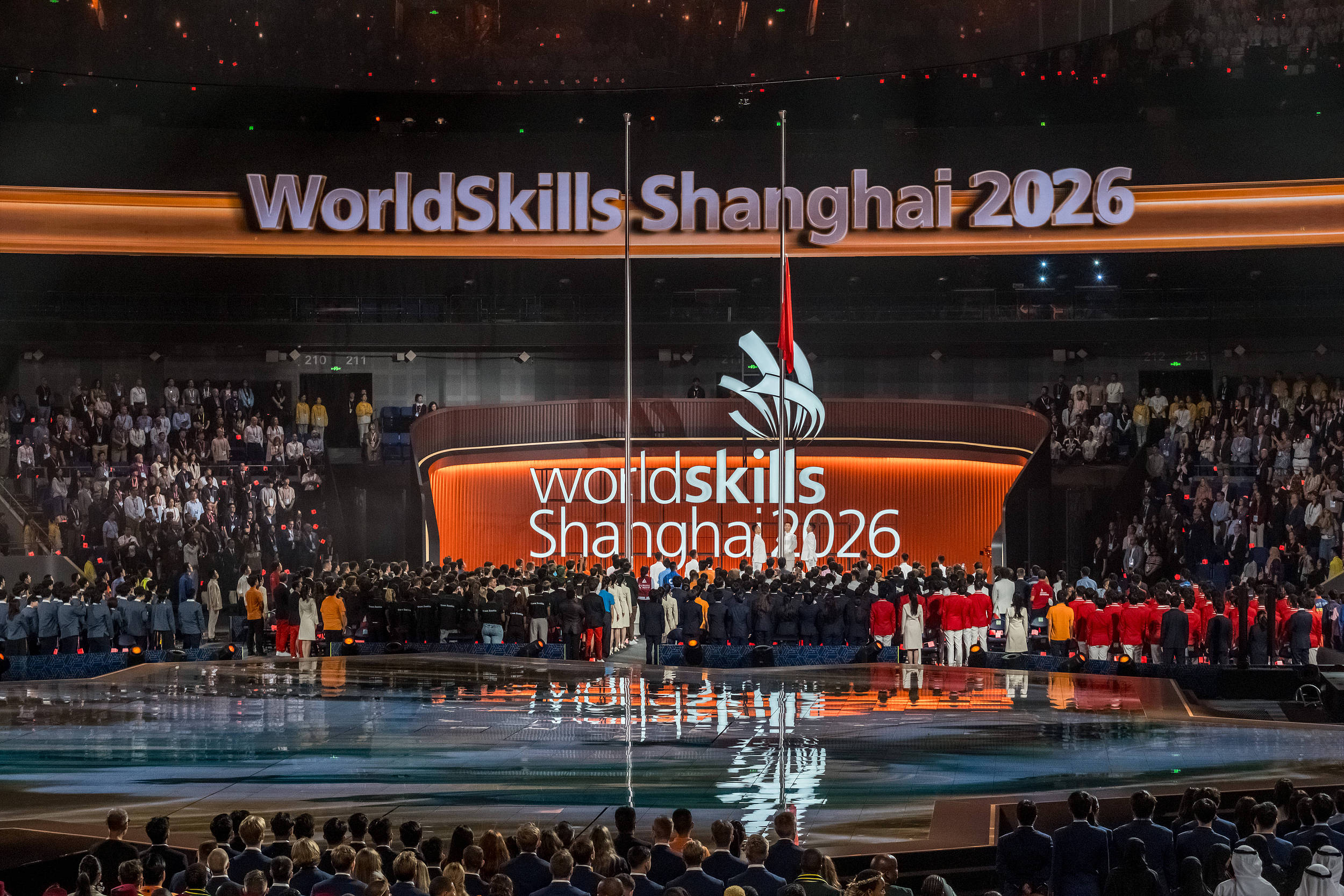
The 48th WorldSkills Competition (hereafter“WorldSkills“) has already officially kicked off in Shanghai . With the theme “Skills Change the World, Skills Light the Future”, this edition has attracted 1,385 competitors from 68 countries and regions. The Chinese delegation will compete in all 64 events.
Among the 64 official events, cloud computing is one of the information and communication technology competitions, in the 45th WorldSkills Competition in 2019 it became a newly added event. In this event, competitors need to select, create, and configure suitable public cloud services based on the task description and industry norms and standards, deploy corresponding information systems, and perform automated maintenance and real-time troubleshooting. They must comprehensively use network architecture, operating system configuration, application deployment, and scripting to achieve high performance, high availability, security, elasticity, and low cost.
If we compare a complex information system to a building, cloud computing is closer to its “foundation.”
According to data from the China Academy of Information and Communications Technology (CAICT), the global cloud computing market is expected to approach $2 trillion by 2030. As technologies like AI continue to penetrate industries, cloud computing is no longer just about traditional storage and computing—it is gradually becoming the infrastructure for running AI applications.

During the 2022 WorldSkills Special Edition, Chen Xinyuan—a 2020 graduate of Shenzhen Institute of Technology’s Communication Network Application program and now a teacher at the institute’s School of Information and Communication—won the gold medal in the cloud computing event, bringing home China’s first gold medal in an IT event at WorldSkills.
At the subsequent 47th WorldSkills Competition, Chinese competitor Huang Jiajie also won gold. And this year, the competitor representing China in cloud computing is Yin Zhiwei from Jiangsu Province Changzhou Technician College. For the past two months, Yin has maintained 12 hours of high-intensity training every day.
This high-intensity training isn’t a last-minute sprint; it comes from the field’s emphasis on “comprehensive situations.” At WorldSkills on-site technical support Yuan Ming told NUPIAO, on the first day, competitors were tasked with architecture deployment and setup, including how to design system architecture, automate processes, and build AI agents. The difficulty of tasks also varies each day, even increasing day by day. Yuan himself also works in the field, and he said the competition tests multiple skills, including networking, security, low-level and system operations.
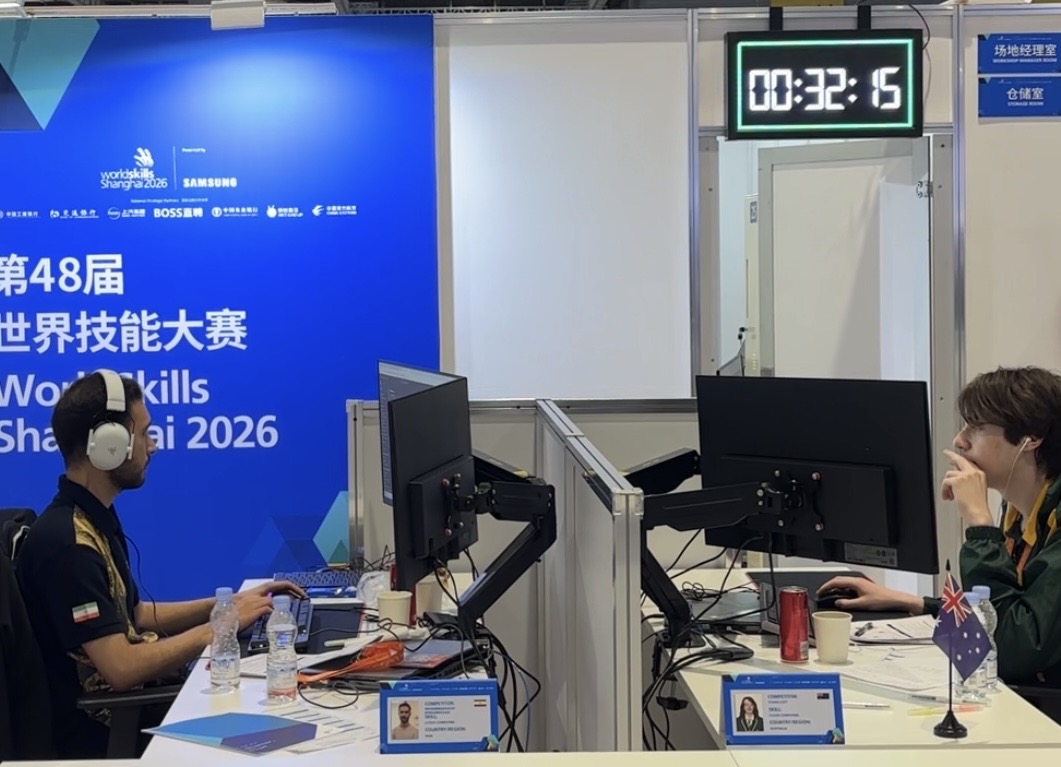
The problems competitors deal with have some similarities to real-world cloud computing work.
In fact, the cloud computing competition doesn’t test a single technology but a complete set of system capabilities. Competitors need to configure public cloud resources, deploy applications, set up networks and systems, and complete monitoring, testing, and troubleshooting. The final system must also deliver high performance, high availability, security, elasticity, and cost control.
In a real enterprise environment, these tasks correspond to a range of different technical roles. Take cloud architects for example. Compared with traditional IT architects, cloud architects face more dynamic systems. Companies no longer need to purchase large numbers of servers in advance; instead, they can allocate cloud computing, storage, and network resources based on business needs. Scale up when business grows, scale down when demand drops; when problems occur, they need to quickly locate and restore service. So a cloud architect’s job isn’t simply “moving servers to the cloud.”
A cloud computing professional told NUPIAO that the barrier to entry isn’t high, and with the explosion in demand, many people from traditional IT are transitioning into this field. Different cloud roles have different levels and salaries, the professional said. Depending on experience and ability, operations salaries can range from a few thousand to tens of thousands of yuan per month. But he believes cloud computing roles have a high ceiling and rely heavily on accumulated experience.
And the development of AI is pushing this career chain further forward.
According to a report released in July by Liepin’s Big Data Research Institute, currently the AI labor market is forming a more diversified skill structure. Companies need talent for model R&D and algorithm optimization as well as people who can embed generative AI into business processes, build and manage agents, operate robots and smart devices, drive model engineering deployment, and handle governance issues. Therefore, for cloud engineers, keeping pace with the AI era is a must.
The report notes that in terms of job numbers, technical roles remain AI ‘s main demand area, with AI job numbers and AI penetration significantly higher than other categories , and AI penetration is about 23%. Software development, algorithm R&D, data processing, and system operations have strong digital foundations, and the spread of AI-assisted programming is accelerating AI ‘s entry into daily workflows of technical roles.
This means AI’s changes may not just add a few new job titles but shift the skill boundaries of existing technical roles.
As Huang Jiajie once said, “Technology in this field updates extremely fast; only continuous learning can keep you up with the times.” Lv Xuanmin, head coach of this year’s cloud computing event and deputy dean of the School of Information Services at Jiangsu Province Changzhou Technician College, also said that this year they focused on getting familiar with AI at home and abroad, along with corresponding models and algorithms.
But in an industry born from traditional IT and still growing, the talent gap remains.
Pearson, a global lifelong learning company, in the first half of this year released a report showing that globally, high-risk, high-impact areas such as AI, machine learning, cybersecurity, and cloud computing have the most prominent skill gaps. The report shows that 42% of surveyed Chinese business managers believe their IT teams do not yet fully possess the latest skills to cope with current technological developments. Among them, cloud computing (78%) and AI/machine learning (74%) are considered the areas with the most prominent skill gaps.
Yuan Ming also told NUPIAO, “Cloud computing” is also a new profession, and many competitors actually come from software development, cybersecurity, and other majors. For example, the Chinese competitor this time had previously in software development won multiple honors. Competitors moving from “software development” to “cloud computing” events is actually a microcosm of industry change.
“Industry-academia collaboration” training mechanisms may be one way to improve the talent shortage in cloud computing. Huang Jiajie once said that his school’s School of Information and Communication signed collaboration agreements with Huawei Technologies, Amazon AWS, Tencent Technology, and other companies, and developed scientific talent training programs. During school, Huang even obtained Amazon AWS’s top SAP certification, building a solid technical foundation.
Compared with other technical majors, cloud computing is relatively special in that it doesn’t have a work scenario that ordinary people can quickly understand, like designers, chefs, or auto mechanics do. Often, cloud architects’ work doesn’t even appear directly in front of users. But when an app needs to handle massive concurrent users, when a company needs to scale quickly, or when an AI model needs massive computing power, these invisible infrastructures become especially important.
WorldSkills brings this kind of ability onto the competition floor. For competitors, they compete on solving problems within a few days; for the industry, companies really need people who can continuously solve new problems as technology changes.