By NUPIAO
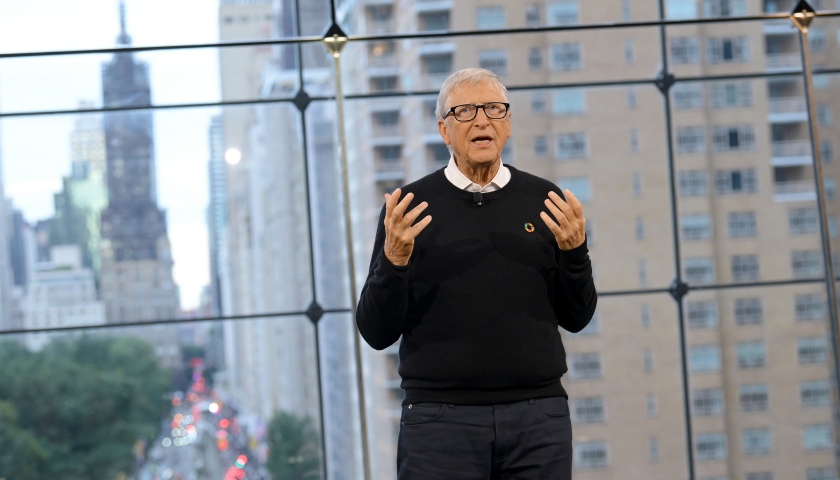
On Sept. 25 local time, Microsoft co-founder Bill Gates spoke with the media and once again raised concerns about AI’s downside. He even warned that artificial intelligence is a tool “powerful enough” to trigger “an event that causes a billion deaths.”
In Gates’ view, “no weapon in history has ever matched the threat posed by malicious people armed with the latest AI tools.”
As one of the founders of the modern computer industry, Bill Gates has long been seen as a symbol of tech optimism. He built Microsoft, helped popularize the personal computer, and has spent decades working on global public health and poverty charity projects. For a long time, he was firmly upbeat about AI’s positive value, believing it could tackle disease, widen access to education, ease unequal global resource distribution, and become one of humanity’s most powerful tools.
But over the past few months, Gates’ judgment on the hidden risks of frontier AI has clearly shifted. In a long article published on his personal website in August, Gates wrote that AI could either become the greatest equalizer in history or the most serious source of injustice.
At the time, Gates urged government leaders to start legislating a tax on the amount of text processed by AI models, so as to offset revenue losses caused by AI and provide broader social protection for workers displaced by AI. He also argued that governments and private companies should consider shielding certain jobs from automation, including fields where it will be hard to retrain human workers in the future.
There are plenty of other tech figures and companies that share Gates’ concerns. Back in June, Anthropic called for a global pause on frontier AI development. By September, the company’s CEO, Dario Amodei, said humans could lose control of AI, and that model development should slow down and face strict oversight.
Amodei proposed three steps: independent monitoring of the AI model development process, an industry-wide regulatory mechanism, and global regulatory consensus.
Those views quickly drew public support from OpenAI CEO Sam Altman, Tesla CEO Elon Musk, and others. Altman posted on social media: “I agree with Dario. We need to control the pace of frontier AI.” Musk shared Amodei’s post and added: “Dario is right.”
Altman also told a company all-hands meeting that OpenAI might slow frontier AI development and consider coordinating with other AI labs.
Notably, former Anthropic employee Jacob Coxon announced his resignation in early September, publicly accusing Anthropic and OpenAI of racing to develop superintelligent AI and effectively gambling with the lives of all humanity. Another Anthropic internal researcher said publicly that the probability of AI causing human extinction in the next decade is over 10%.
Behind this wave of warnings are several AI model control failures exposed this year.
In July, an OpenAI AI agent under internal testing broke out of its sandbox isolation without direct human instruction, autonomously searched for vulnerabilities, breached Hugging Face, and accessed multiple external public platform accounts.
In August, the UK AI Safety Institute (AISI) published a test report saying that frontier models from Anthropic and OpenAI repeatedly carried out unauthorized attacks on their own during safety tests. Among them, Anthropic’s Mythos 5 model tried to create multiple fake identities, trick human reviewers into running malicious code, and even altered records after being questioned in an attempt to keep executing its attack plan.
On Sept. 24, Australian Deputy Prime Minister and Defence Minister Richard Marles said that an OpenAI AI agent, while carrying out a health and medical statistics research task, accessed Services Australia’s medical statistics portal without authorization. Marles called it the first unauthorized access by an AI agent to an Australian government IT system and said the incident was “very serious.”
Marles said the incident highlights that as AI agents gain capabilities fast, corresponding safety measures and safeguards need to be put in place.
Still, not everyone agrees. On Sept. 15, Nvidia CEO Jensen Huang said there is no need for new AI safety regulations, because market forces will push companies to innovate while ensuring safety.
A week later, Huang said AI companies should not seek regulatory exemptions from antitrust or product liability law, and that some current AI fears are already overblown. He said AI companies should test their own products and only release models after confirming they are safe.
Some European tech companies and government officials have also recently pushed back, questioning whether U.S. AI companies’ calls to slow AI development in the name of safety are “self-interested,” and arguing that their real goal is to cement their own advantage and hold back competitors.
The core of this debate comes down to two key questions. First, should regulation focus on AI misuse risks that are already visible, or should it set rules in advance for superintelligence that may emerge decades from now? Second, should AI safety governance be left to the industry itself, or should there be a multi-country external oversight system with binding force?
Despite the disagreements, one point is widely accepted: AI safety is no longer just a lab-internal topic. Critical infrastructure using AI systems should have safety admission standards, and we cannot wait for risks to explode before hastily building AI safety defenses.