NUPIAO Reporter |
NUPIAO Editor | Wen Shuqi
It’s not just China’s tech giants rushing intoAI office tools — Amazon Web Services wants in, too.
AWS recently shipped the desktop version of itsAI productivity productAmazon Quick, and it runs on bothMacOS andWindows. The app bundles more than60 officially configured tools and supports over1000 app integrations. It plays nicely with theMCP protocol, and tasks run7×24 on the device — close your laptop and the work keeps chugging along in the background, with progress synced to your phone.
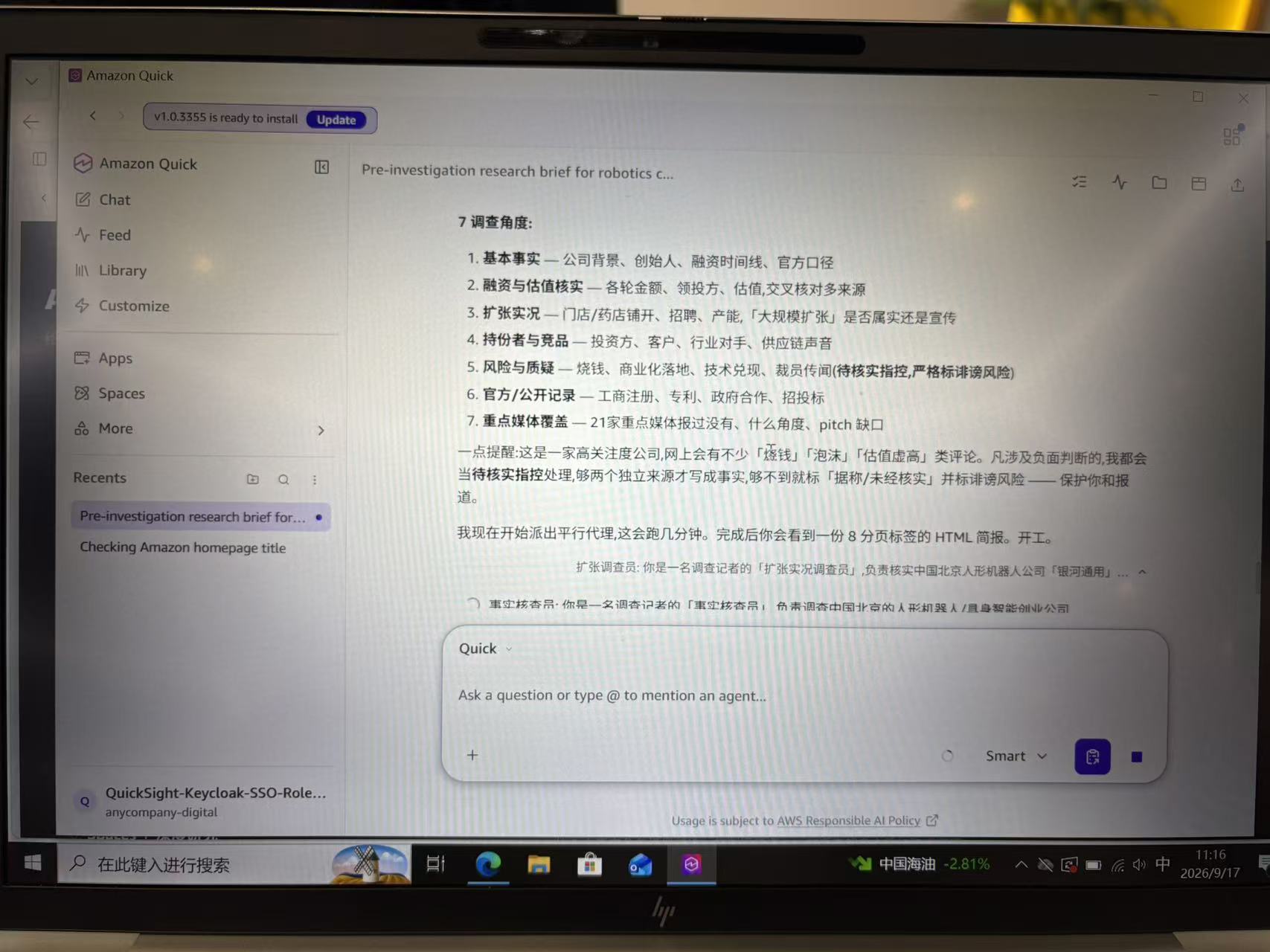
After trying it out, NUPIAO found thatAmazon Quick‘s look and feel are a lot likeWorkbuddy, Qwen Office, Doubao Work and otherAI productivity tools. ButAmazon Quick also works as a browser extension and anOffice suite plug-in, so you don’t have to move your whole workflow intoAmazon Quick — you can embed it right inside your usual browser,Office apps and other environments withAmazon Quick.
Here’s another twist:Amazon Quick bills in a way that’s totally different from China’sAI productivity tools. Guo Ren, anAI technology director in AWS’s product division, told NUPIAO at a media briefing thatAmazon Quick doesn’t charge bytoken. Instead it uses a new billing unit — the agent hour (Agent hour) — meaning you pay for how long a task actually runs in the background, billed by the second.
One thing worth noting: the time a task spends running in the background isn’t the time you feel it eating up on your screen — it’s only the time the model is genuinely being called during execution.
According to the website,Amazon Quick comes in personal and business editions. The personal one has three tiers — free,20 USD/a month, and 100 USD/a month. The free tier gives each user about 1 hour of usage per month. The business edition has two tiers, 20 USD/a month and 40 USD/a month, which work out to 8 hours/person/month and 18 hours/person/month of usage, respectively.
Guo says that inside Amazon,340,000 employees are already usingAmazon Quick, averaging 10 agent hours per person per month. That’s probably a pretty good proxy for what most companies actually consume today.
Compared with token billing, charging by time has one big upside: it turns a fuzzy, hard-to-grasp model cost into something users instantly understand — how long the AI actually worked.
Guo told NUPIAO thattoken billing has two problems. First, when the model isn’t smart enough, a task gets retried over and over and burns through a pile oftokens. Second, some products on the market bill bycredit, with multipliers that shift dynamically — and users have zero say in how those multipliers move.
With time-based billing, the price is far more intuitive. Long-running tasks cost more, quick ones cost less. And since how long the model runs is a known quantity, it’s much easier for users to keep costs in check.
In fact, China’sAI productivity platforms are experimenting with new billing models too. Take Feishu: itsAI products used to combine per-seat and per-token pricing, but the price tag was so steep that sales were weak. After Feishuaily merged with Doubao Work, the platform is moving to a model billed purely bytoken.
AI productivity platforms trying out different billing models really comes down to one thing: the cost structure ofAI products is already nothing like traditionalSaaS. Platforms have to find a balance — make it attractive enough that people actually use it, cover the constantly shiftingAI costs, and keep growing revenue asAI capabilities improve.
Feishu tweaked its pricing to lower what enterprise customers pay forAI, and AWS’s new billing model is chasing the same goal. Guo says that with time-based billing, runningAmazon Quick actually costs less than comparable products on the market.
As for who AWS is targeting in China, Guo says every company and organization is a potentialAmazon Quick customer, but the easiest to reach are AWS’s existing accounts, which span pharma, financial services, healthcare, sports marketing and plenty of other industries.
The more big tech players pile in, the more crowded theAI productivity table gets. AWS is trying a different angle: instead of only competing on whoseAI is stronger, it’s competing on who makes it cheaper for businesses to actually use. For companies hoping to cut costs and boost efficiency withAI, model quality is just the starting line — price, efficiency and real output are becoming the new yardsticks.