NUPIAO |
Editor | NUPIAO
At a stage when the technical roadmap for embodied intelligence still hasn’t converged, finding a spot in the industry that’s “needed at any given moment” may make a company’s growth a whole lot more certain. More and more companies areputting this ideainto practice.
In Shanghai’s embodied intelligence supply chain, one company hunting for opportunity in the “middle layer” is speeding up its commercial rollout.
On July 8 this year, Lingjing Zhiyuan announced it had closed over RMB 100 million inangeland angel+ roundsof funding, led by Matrix Partners China, with Shanghai Minhang state capital joining as a strategic investor.Atthe World Robot Conference (WRC) held not long ago, Lingjing Zhiyuan rolled out its newest domestically developed products and joined hands withmore than 10robot bodymakers to show off what those products can do across different scenarios.
Founded just over a year ago, this company is going after the“base layer”business——compared with the humanoid robot bodies, embodied foundation models and dexterous hands that the market has already chewed over again and again,itsposition isn’t so easy to pin down.
Sun Bo, founder and CEO of Lingjing Zhiyuan Technology, told NUPIAO in an interview that what they’re doing right nowdoesn’t evenadd up to a clearly definedtrack yet, “because nobody hasdone itbefore.”
In his telling, Lingjing Zhiyuan would rather be a platforminside the supply chain, focused on homegrown embodied computing bases and operating systems. It doesn’t build robot bodies; instead itgoes after the more foundational computing infrastructure, solving embodiedchips,operating systems andcomputingpower and model efficiency optimizationso it can fitdifferent types ofrobots and application scenarios.
Over the past year or so, embodied intelligence has heated up fast. From humanoid robot bodies to embodied foundation models to dexterous hands, sensors and data, every link in the chain is fighting for its place. Figures from Tianyancha show that China already has more than 1.165 million robotics supply chain companies, roughly 144,000 of them added since the start of this year.
Meanwhile, strategies inside the industry are starting to split. One camp keeps pushing deeper into the body itself, hoping to build product and business moats through robot hardware; another camp bets more heavily on the brain, trying to become the core gateway to robot intelligence through model capability. Still others are heading into the supply chain’smiddle layerto find a spot — and Lingjing Zhiyuan is one of them.
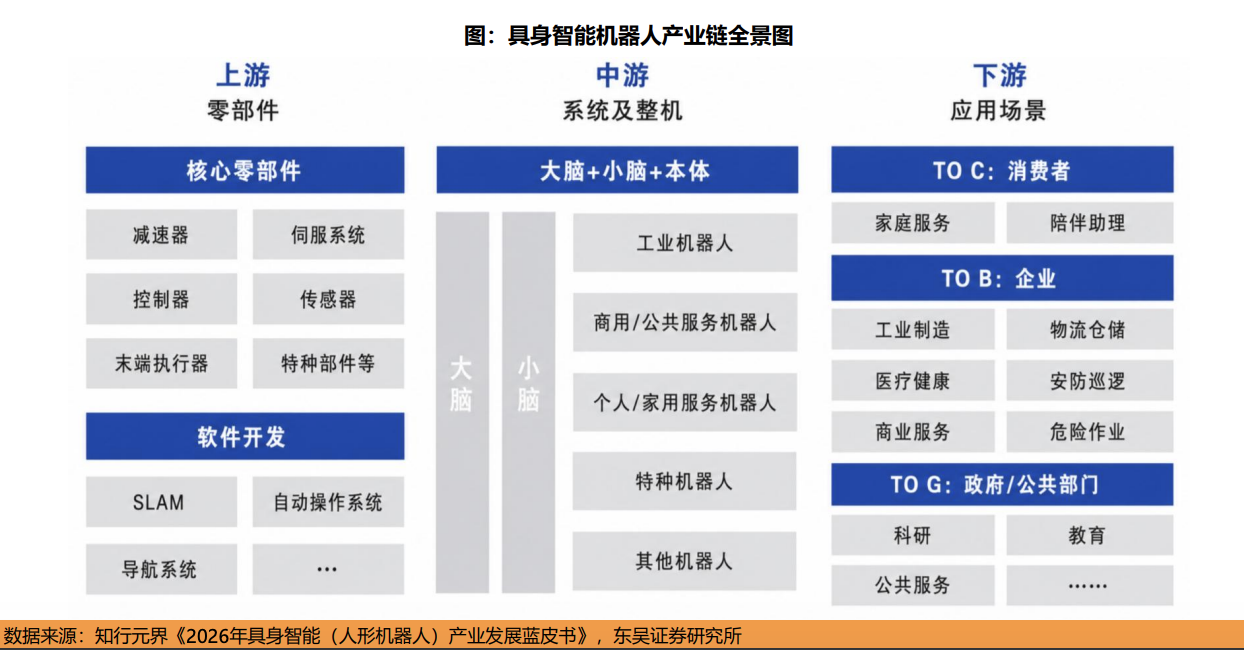
Sun reckons that compared with models and applications, few companies actually dig all the way down into the base layer and Infra. The reason: building a base takes holistic design and execution of the technical roadmap, and every round of practice is tough — but the deeper you go, the moreirreplaceableyou become.
Worth noting: Lingjing Zhiyuan hasn’t been around long, but it was incubated by the Shanghai Artificial Intelligence Research Institute, and it had already finished technical validation before it was formally set up.
The company has put forward the idea of an “Embodied Brain” — a self-developed, purpose-built hardware-software base system for embodied agents. Technically speaking, it doesn’t use the old general-purpose setup where the “brain decides and the cerebellum controls” sit in physically separate boxes. Instead, it builds on a Dvorak ultra-heterogeneous computing architecture and wraps embodied-specific chips, brain and cerebellum hardware platforms, the operating system and a brain-inspired model into one end-to-end intelligent system that closes the loop.More than 300 embodied intelligence companies have engaged with Lingjing Zhiyuan, and over 200 customers have already been installed.
What really turns technology into market results, though, is demand from the industry.
Since the start of this year, one trend everyone agrees on in embodied intelligence‘sworld is the shift from tech demos to real-world deployment. But for companies along the chain, the test keeps changing too. Once robots walk into real environments like factories, logistics and healthcare, the old lab-style custom development approach struggles to support large-scale replication.
For example,different robotshave touse different motors, sensors, actuators and computing platforms — even for similar tasks, the hardware and software often need to be re-adapted from scratch. For body makers, that means longer R&D and delivery cycles, and higher costs.
That’s exactly where the business opportunity for companies like Lingjing Zhiyuan shows up. Sun says that for embodied intelligence vendors, the most direct effect is that customers no longer have to sweat the underlying plumbing — they can just focus on development and applications. On top of that, base-layer products bring performance gains,such aslower energy consumption and better heat dissipation. And then there’s what he calls “engineering practice”: as a base-layer vendor, Lingjing Zhiyuan has worked with a lot of embodied intelligence companies, so the mass-production experience it has piled up may well outstrip that of any single body maker.
Today the company runs two product lines: the Tongjing N series, which is mainly compatible with mainstream ecosystems like NVIDIA,and the Zhijing T series, positioned as a fully domestic, full-stack embodied brain.Take one embodied intelligence company it serves: on the R&D side it used a Lingjing Zhiyuan platform that had already passed mass-production validation, and its development cycle shrank from two months to a single week.
Buthere’s the challenge any middle-layer vendor has to face:how big embodied intelligence companies’ real-world deployments get and how fast they commercialize will heavily shape Lingjing Zhiyuan’s growth. Sun told NUPIAO that the customers most willing to pay for base-layer products — and the ones getting the best results — are the mid-tier players. And right now,the customers Lingjing Zhiyuan serves are still figuring out commercialization themselves, which means the companyhas to work side by side with robot makersto hunt for the deployment scenarios with the most certainty.
Sun believes that to truly commercialize embodied intelligence, the key is giving end customers a positive return on their investment when they buy. With that in mind, Lingjing Zhiyuan picked a handful of key companies to expand scenarios with. At this year’s World Robot Conference, it showed off an application for power grid inspection. A humanoid robot carrying the company’s in-house architecture and vision-based motion controlmodel completed a string of continuous moves on site — stepping over rat guards and going up and down stairs.
Lingjing Zhiyuan’s position still doesn’t have a clear track definition,and that hands new players a certain amount of opportunity.Still, it doesn’t mean less competition or less risk.
In the market,some leadingembodied intelligencevendors have already chosen to integrate the base layer themselves, and on top of that,there are alsoquite a fewbig tech companiesmoving into infrastructure-levelconstruction.Asthe embodied intelligencesupply chainkeeps maturing,every layer’sopportunityis starting to get attention.According tothe self-media account “Embodied Artificial Intelligence”‘stally,, in 2026thedomesticnewly founded13players inembodiedintelligencehave a much clearer division of labor— they no longer pile into crowded lanes but insteadcoverthe whole map:pure software, pure hardwareandvertical scenario areas.
In theory, a base-layer company that isn’t tied to a specific robot body and doesn’t bet on a single model can capture broader opportunities from the industry’s growth. But whether that “neutrality” can really turn intodurable commercial valuestill has to be proven. Down the road,just how far embodied intelligence applications can expand, and whether customers will keep paying for base-layer capability, will be the key questions that test middle-layer companies.