On September 9 local time, at Apple’s fall product launch event, the company officially unveiled its first foldable phone, the iPhone Duo. Apple calls it the biggest experience overhaul since the iPhone was born.
But on launch day, Apple’s stock actually swung lower — at one point dropping nearly 2% intraday and shedding about $90 billion in market value. It closed down 0.28% at $315.34 per share, with a total market cap of $4.6 trillion.
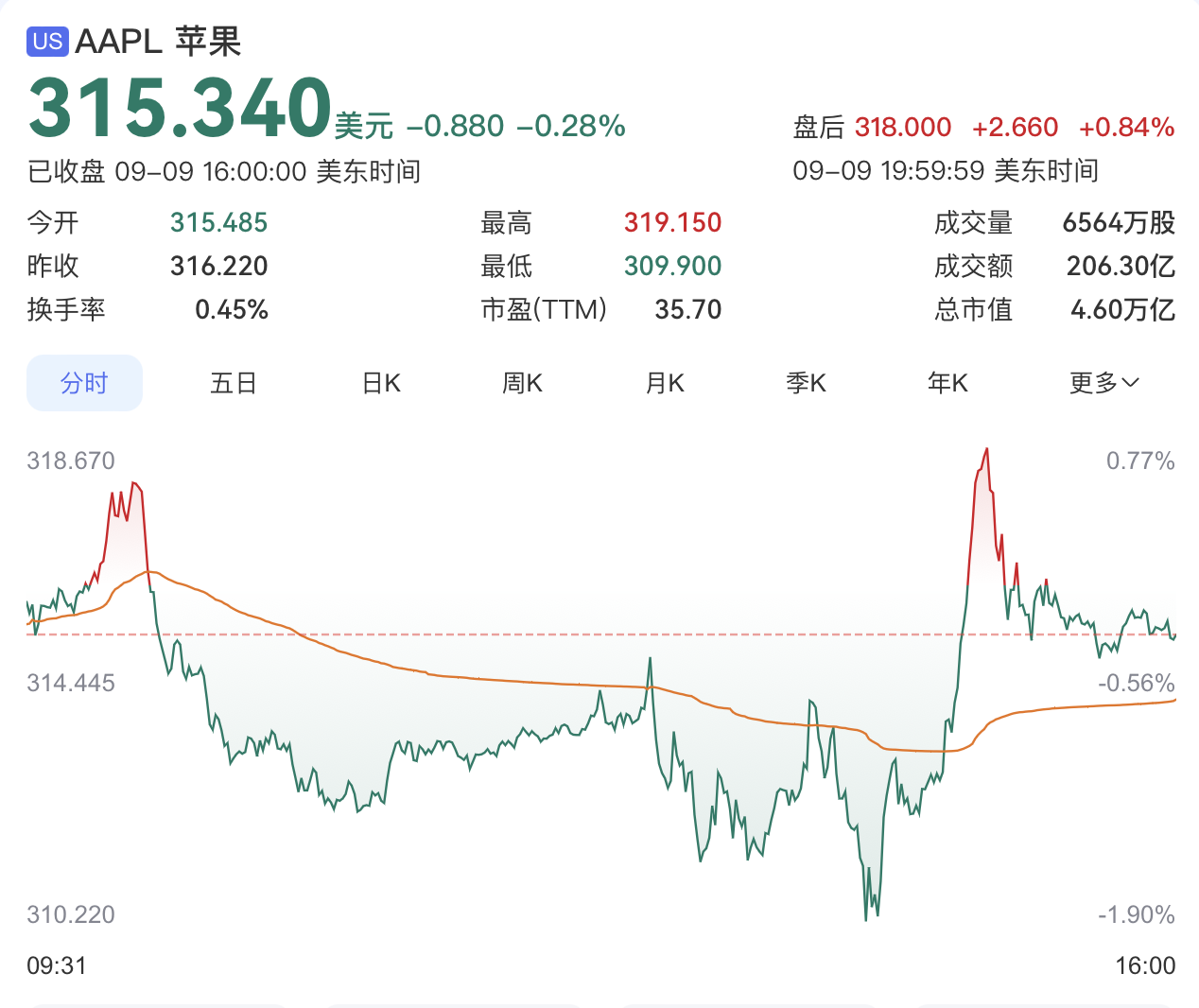
Some analysts say the post-event stock dip comes down to one thing: “good news already priced in.” The market had been hyping up expectations well before the event, so once the new products were officially announced, money that had bet on the run-up cashed out — dragging the stock down in the short term. That doesn’t necessarily mean the product will flop long-term. What really matters is how the sales numbers look down the road.
Even before the official launch, Apple’s first foldable had drawn plenty of attention. On the outside, the iPhone Duo uses a horizontal inward-folding design that’s roughly the size of a passport when closed; the outer screen measures 5.4 inches, and the inner display opens up to about 7.6 inches — the biggest iPhone display ever; unfolded, the body is just 5.2mm thick, making it the thinnest iPhone yet; folded, it’s 11.3mm thick and weighs 254 grams — a tad heavier than the 249-gram iPhone 18 Pro Max.
Crease reduction is the headline breakthrough of this iPhone Duo R&D effort. The hinge packs over 100 precision micro-components to keep the screen rock solid. Apple says the Duo’s inner display is built from ten ultra-thin layers, with a nano-textured surface to cut down glare. An optically clear adhesive between layers allows tiny sliding movements when folded, reducing stress and creasing.

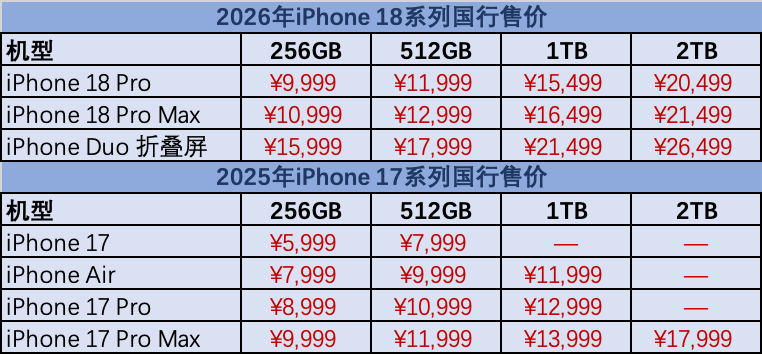
On pricing, the iPhone Duo starts at 15,999 yuan in China, with four storage options: 256GB at 15,999 yuan, 512GB at 17,999 yuan, 1TB at 21,499 yuan, and 2TB at 26,499 yuan — making it the priciest model in the current iPhone lineup.Apple’s China website has already listed the new phone, with pre-orders opening at 8 p.m. on October 16 and official sales starting October 23.

Meanwhile, secondhand marketplaces are already listing pre-order proxy services for the iPhone 18 series and iPhone Duo, priced anywhere from 100 to 588 yuan. When our reporter inquired as a consumer about what materials were needed for a proxy purchase, the seller said an Apple ID is required to place the order, and payment happens via email once the order goes through. “If you’re worried, just register a new ID or buy one for a few bucks.” Registering a new ID requires a phone number, the last four digits of an ID card number, a payment method, and a pickup city. Experts warn that such private transactions lack platform guarantees, leaving consumers vulnerable to losing both money and goods — so stick to official channels.
There’s also some market concern about iPhone Duo production capacity. Reports earlier suggested Apple plans to produce 8 to 10 million foldable iPhones this year, hoping the fresh form factor will spark demand and boost revenue. Under that plan, Apple would normally need to churn out tens of thousands of foldable iPhones per day.But reports say that due to Apple’s extremely strict quality control standards, initial output of its first foldable iPhone is only “hundreds of units” per day.
Liz Lee, associate director at Counterpoint Research, also noted that supply of Apple’s first foldable iPhone is expected to be constrained during the initial ramp-up, with 2026 shipments capped at around 6 million units.Even with a short sales window, Apple is still expected to capture 25% of the global foldable phone market in 2026 — second only to Samsung.
It’s been eight years since foldable phones went commercial. 2019 is widely considered the industry’s “year one” for foldables — Samsung and Huawei both jumped in. Samsung brought the Galaxy Fold with an inward-folding design and a 7.3-inch screen; Huawei launched the Mate X with an outward-folding design, an 8-inch display, and the Kirin 980 plus Balong 5000 chips, making it the first 5G foldable phone.
In recent years, foldable shipments have cooled off after a stretch of rapid growth. Data from market research firm Omdia shows global foldable smartphone shipments hit 18.2 million units in 2025, with growth slowing to 6% year over year — the weakest pace in years. In the first half of 2026, shipments came in at 5.1 million units, down 21.6% year over year.
But a turning point may be emerging. Omdia predicts global foldable phone shipments will exceed 22 million units in 2026, with growth rebounding above 22%; by 2028, worldwide shipments are expected to reach 36 million units — double the 2025 figure.
On September 7, according to Counterpoint Research’s latest global foldable smartphone market forecast, cumulative worldwide foldable shipments will top 100 million units by the end of 2026.
Counterpoint Research says that with Apple officially entering the fray, combined with growing demand for wide-fold form factors from Samsung and Huawei, foldable phone demand is expected to climb further — driving global foldable shipments up 37% year over year in 2027. As market growth accelerates, the foldable segment is expected to hit its next 100-million-unit cumulative shipment milestone within the next three years.