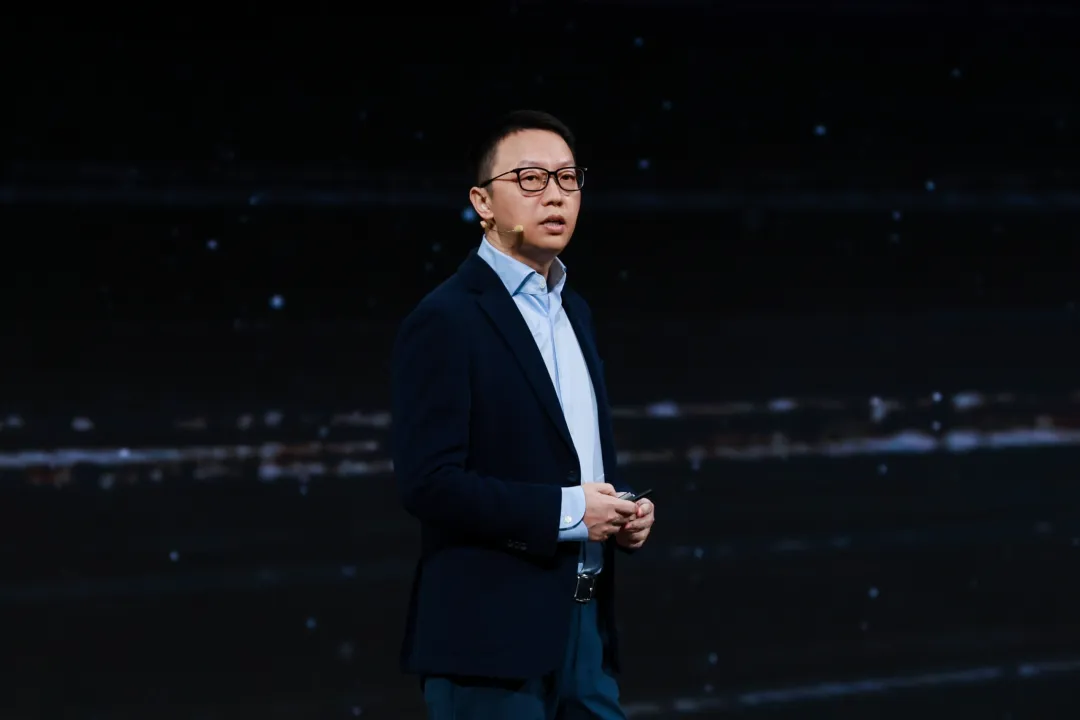
On September 22, the 2026 Hangzhou Apsara Conference kicked off in Hangzhou. Alibaba Group CEO Wu Yongming used his keynote to lay out a strategic read on the “machine intelligence” era. His bet: just as machine power ended up doing 99.9% of human physical labor during the Industrial Revolution, machines will eventually handle 99.9% of thinking—and total machine thinking will reach more than 1,000 times that of humans. Today, he said, that share is still under 3%, which means there is room for at least tens of thousands of times more growth.
Against that backdrop, Wu identified three building blocks for Alibaba in the machine intelligence era: AI models, AI chips and AI cloud.
On AI models, the Alibaba Qwen team has already made progress in recursive self-improvement. Future models will scale to 5 trillion to 10 trillion parameters, with the goal of handling more complex, longer-running tasks. On AI chips, Alibaba’s T-Head Semiconductor unveiled its next-generation AI chip, Zhenwu V900, at the conference. Its computing power is three times that of the previous generation, Zhenwu M890.
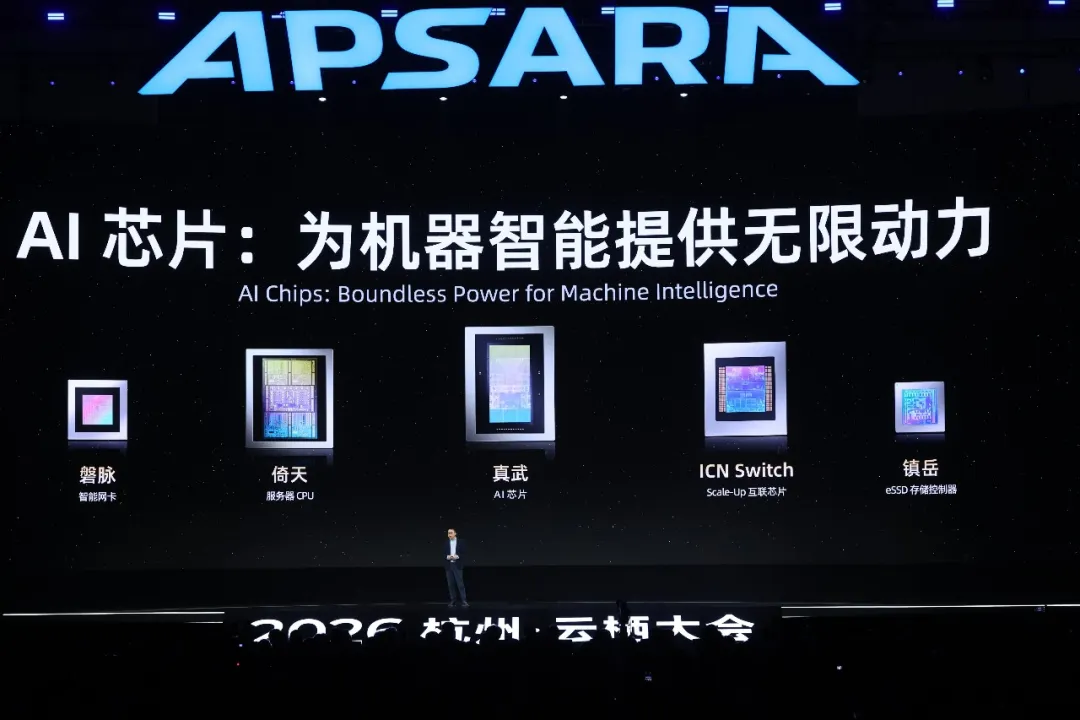
On AI cloud, Wu pledged that by 2032, the global data centers operated by Alibaba Cloud will exceed 20GW. AI cloud, he said, will become the “super grid” that carries machine intelligence. Together, AI models, AI chips and AI cloud will make “thinking” something that can be produced and distributed at scale, much like electricity.
In his speech, Wu drew a line between the “machine intelligence era” and “artificial intelligence” as concepts. The industry, he noted, has long measured AI by how human-like it is; even the Turing test is an anthropomorphic benchmark. But early industrial power first replaced human and animal labor, then went on to spawn trains, planes and rockets—far beyond the original goal of mimicking biological strength. In the same way, AI writing code, reports or PowerPoints is just the early stage. The real variable is long-horizon tasks, autonomous action and self-improvement.
From there, Wu offered two core judgments. The first is a change in the scale of thinking. On the supply side, top-tier human intelligence is extremely limited. Training a leading scientist or expert takes decades of study and practice, plus talent and luck, so many fields have long lacked enough intellectual firepower.
He used neonatal progeria as an example. Globally, only a few dozen new cases appear each year, and only a few hundred patients have ever been recorded. Under the current commercial logic of the pharmaceutical industry, few companies are willing to spend more than a decade developing a new drug for such a tiny patient group. But once AI has professional research capabilities, and as long as computing power is plentiful and cheap, every niche field could have millions of agents running research, simulation and validation around the clock. “Top-tier thinking will go from a luxury to a commodity that can be supplied at scale.”
On the demand side, he added, consumption in the industrial age was limited by population: there is a cap on how many physical goods one person can consume in a lifetime. When AI gets powerful enough, that relationship breaks. For example, ask AI to build a spacecraft bound for Mars, and it can break the job into tens of millions of subtasks, with millions of agents pushing forward nonstop. Humans only need to supply ideas and goals to mobilize enormous intellectual resources. Every “super-individual” could get 10,000x intelligence leverage.
Wu’s second judgment concerns the shape of applications. He believes the signature product of the machine intelligence era has not appeared yet. He compared today’s AI coding to the 400 electric lamps that Edison’s Pearl Street Station lit in 1882. Back then, electricity was mainly used to replace kerosene lamps and candles. Air conditioners, washing machines and refrigerators came later, and the first general-purpose computer did not arrive until 1946.
He stressed that simply replacing existing work cannot create a new era. Standing at the “light bulb” stage, it is hard to imagine the full picture of the electrical age—and today it is just as hard to predict what new products and inventions will emerge once machine intelligence takes off. To spark more brand-new applications, the first step is to build solid AI infrastructure.
At the end of his speech, Wu repeated a point Alibaba made a year earlier: “The stronger AI gets, the stronger humans become.” Technological change, he argued, will not strip humans of value. Look at history: the Industrial Revolution freed physical labor and gave rise to sports; after photography and the phonograph arrived, art became more diverse, not less. When machines take over heavy, repetitive thinking tasks, humans will be free to unleash curiosity and creativity—and explore more meaningful forms of creation and perception.