NUPIAO Reporter |
NUPIAO Editor | Wen Shuqi
For the past two weeks, college student Xi Yang has been churning out AI mini-games at a pace of roughly one per day.
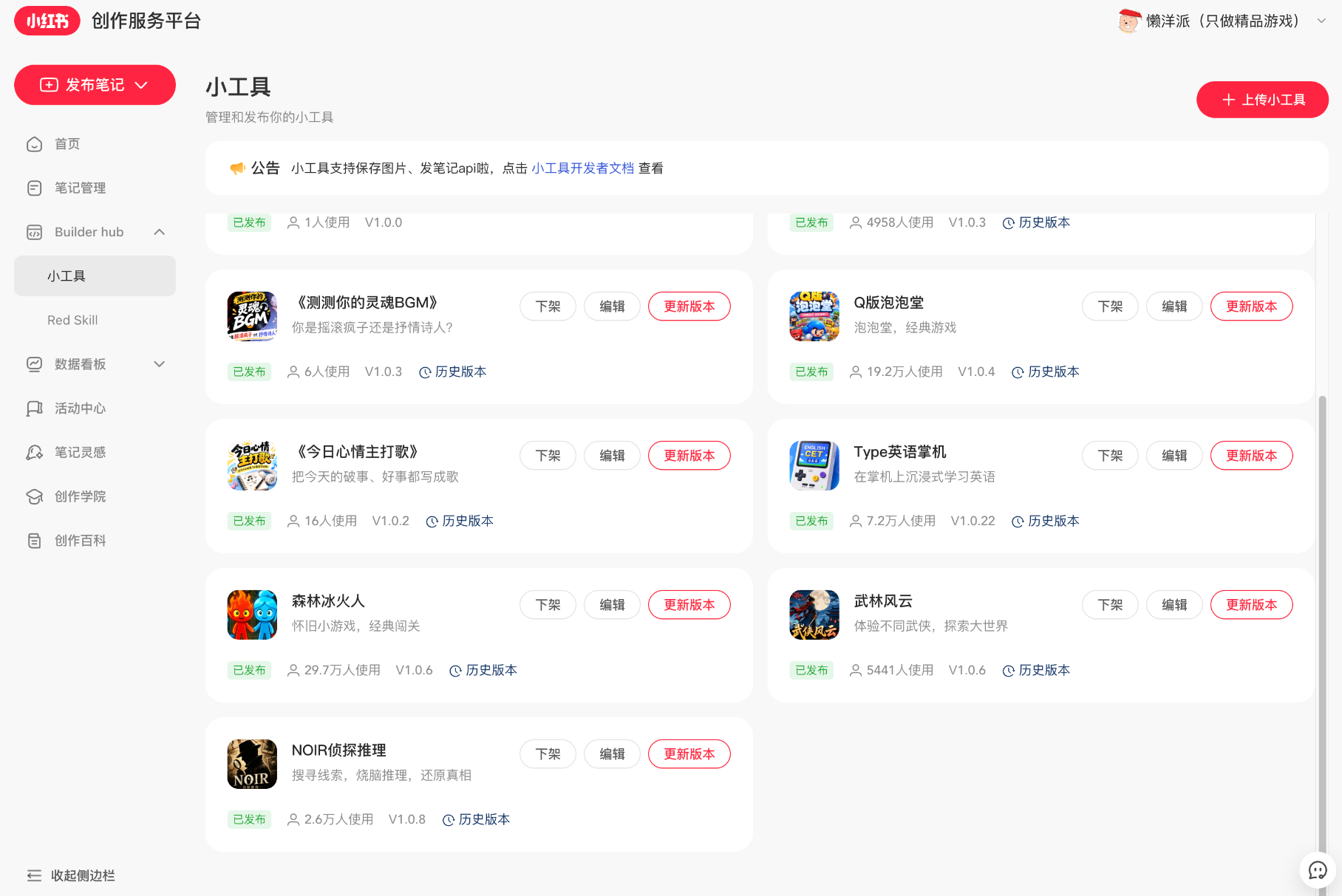
Before this, Xi Yang had zero experience making games with AI. But with AI coding tools, he’s already built dozens of them—things like “English Handheld,” a mini-game version of Forest Fire People, and detective mystery games.
Iteration after launch has sped up too. Li Xinlei, creator of the AI mini-game “Clam Opening Live Stream,” told NUPIAO that some changes she makes based on player feedback “sometimes only take three hours to fix and push live.”
These days, ordinary people using AI vibe coding to make their own mini-games is nothing new. A crop of platforms is trying to bundle game generation, iteration, and publishing into one product—so users can describe an idea in plain language and get a playable prototype.

On January 30, 2026, TapTap launched its AI game creation agent “TapTap Create,” letting users describe game ideas in natural language while AI handles code, art, music, and more. Domestic startups are jumping in too. Funloom AI positions itself as an AI interactive content co-creation platform where users type text prompts to generate AI text games. According to 36kr, Funloom had about 50,000 users after launching in March.
AI is further compressing the time from idea to playable product for lightweight games—and pulling in more people who’ve never made a game before. But when AI drastically lowers the barrier and speeds up production, who’s going to absorb this constantly growing flood of new content?
Once It’s Built, How Does Anyone See It?
For any game, being made is just step one.
Especially for this batch of AI-assisted mini-games: once production efficiency gets cranked way up, finding a low-friction publishing entry point, grabbing those first users, and getting noticed becomes the new problem beyond development.
“At first I had no clue where to even post my game after finishing it,” Luo Wenxin, creator of the AI mini-game “Pager 1996,” told NUPIAO. “Honestly, wherever you post, the traffic feels scattered.”
AI mini-games lack a natural traffic hub. There’s no mature platform for hosting games, so creators and players often struggle to find each other.
That gap gave birth to “Miyiji,” a website that collects web-based puzzle games.
Miyiji launched at the end of May this year, focusing on web puzzle and interactive narrative AI mini-games. So far it’s cataloged nearly 600 games with over 20,000 registered users.
Its two developers were originally web puzzle game players themselves. While playing, they noticed many game links were scattered across Xiaohongshu, Bilibili, and other content platforms—which all have restrictions on displaying and redirecting external links.
“Since finding games was such a pain, we figured we’d just build a collection,” a Miyiji developer told NUPIAO. At first the team actively scouted developers on Xiaohongshu and other platforms, reaching out one by one for permission. But once listings grew to around 30–40 creators, authors they hadn’t contacted started submitting on their own. Luo Wenxin—the one who “didn’t know where to post”—also published on Miyiji and racked up about 15,000 plays.
And users actually stick around on Miyiji. At the end of August, the site surveyed its roughly 19,000 registered users: about 91% who played one game went on to play a second, and around 74% continued to a third.
As submissions grow, Miyiji is taking on more active curation. It publishes “weekly picks” based on comments and player feedback, trying to boost games with low initial traffic but strong reception.
Right now Miyiji is still run part-time by just two founders, who hope to partner with other platforms and eventually earn revenue. For AI mini-games still in their early days, many business models remain unproven. But it’s clear this new content format is spawning fresh demand.
Platforms Battle for AI Mini-Games
Meanwhile, bigger platforms are entering the fray.
Starting this summer, Xiaohongshu, Bilibili, and Douyin have all opened or tested lightweight interactive content platforms.
Xiaohongshu’s offering is “Mini Tools.” It lets creators upload web apps and attach them directly below Xiaohongshu posts, so users can use them without leaving the app. Bilibili launched “Toy,” hosting tests, mini-games, tools, and interactive stories. Douyin began beta-testing “Interactive Space” in mid-July, and NetEase is also beta-testing an AI game platform called “Star Box.”
These platforms aren’t identical in form, but they’re all trying to lower the barrier for lightweight interactive content—and keep the games creators make inside their own ecosystems.
Each platform shows different strengths.
NetEase’s Star Box is still in testing, but it’s already nurturing creators through community groups, competitions, and small cash prizes. When Li Xinlei’s game “Clam Simulator” hit compatibility issues with the platform, NetEase staff worked with her directly on the Git repo to adjust both the game and platform features.
Xiaohongshu’s recommendation mechanics are also relatively friendly to new creators with no follower base. Xi Yang barely used Xiaohongshu before; after registering a new account, his first game “English Handheld” got about 50,000 uses in two days. As of publication, his “Forest Fire People” had reached 500,000 users at the time of interview.
Compared to platforms that merely host games, Xiaohongshu’s social nature makes it easier for developers to directly reach and organize their players. Li Xinlei describes “Clam Simulator” as a product “co-created with players”—after the first version launched, tons of players offered suggestions via comments and group chats, participating in iteration. Eventually multiple player communities formed, with over a dozen players volunteering as moderators.
It’s still hard to say which platform suits AI lightweight games best, but the battle for this new content and its creators has already begun.
Many creators—including Luo Wenxin and Li Xinlei—have received DMs from operators at various AI game platforms inviting them to bring their games over.
The AI mini-game “Clam Opening Live Stream” first launched on Xiaohongshu. It got about 23,000 uses on day one and jumped to around 280,000 on day two. But Xiaohongshu’s “Mini Tools” can’t do cloud saves. Players who quit after long sessions have to start over.
She later posted about the save issue. After that, a NetEase Star Box operator reached out, pitched the platform’s save feature, and invited her to join. Then TapTap operators contacted her too, explaining TapTap’s differentiated ad monetization compared to other mini-game platforms.
But looking at current product forms, each platform’s attempts still have clear limits.
Beyond the save limitations Li Xinlei mentioned, several developers interviewed brought up saves, multiplayer, and device compatibility. Luo Wenxin told NUPIAO that some full versions of his games hosted on personal servers needed features cut after porting to Xiaohongshu.
Monetization is another unsolved issue for these lightweight platforms. At this stage, many mainly handle hosting, distribution, and user feedback—creators get traffic but not necessarily direct income. If developers want ad revenue, they often still need to move to platforms with more mature monetization like WeChat mini-games.
This round of competition over AI mini-games isn’t entirely happening among traditional game publishers. Xiaohongshu, Bilibili, and Douyin are first and foremost content platforms—for them, AI mini-games aren’t just a new batch of game products.
“My take is, this is the era of short video 2.0,” the Miyiji founder told NUPIAO. He believes in the “short video 1.0” era, users were mostly content receivers. Now platforms are trying to make retention and interaction scenarios richer. Users come to the platform and can directly participate, experience, and play. The user-platform relationship shifts from passive content consumption to deeper participation.
AI lowers the production barrier for interactive content, letting ordinary creators continuously produce interactive content that used to be costlier and scarcer. Once on platforms, it offers a user interaction mode distinct from text and short video. As platforms fight over AI mini-game creators, they’re also hunting for the next content format beyond text and video.
As AI rapidly expands supply, who can absorb creators, curate works, and continuously distribute content to the right users is the next question that needs answering.
(Xi Yang and Luo Wenxin are pseudonyms.)