NUPIAO Reporter
Word on the street recently was that AgiBot and its affiliated companies had signed for office space under Shanghai Lujiazui Group—across three projects: Qiantan Origin, Qiantan Shang, and Yuqiao Smart Valley. Together, that’s more than 220,000 square meters.
On October 21, Star Market Daily reported that people familiar with the matter confirmed the lease details are legit. NUPIAO reached out to AgiBot for further comment, but the company hadn’t responded by the time this article went live.
This move straight-up smashed Shanghai’s record for the largest single office lease. The previous titleholder was Hypergryph, which inked about 90,000 square meters in Tower T1 of Xuhui Vanke Center Phase III back in August. AgiBot’s footprint is 2.4 times that—220,000 square meters is roughly the size of 31 standard soccer fields.
Here’s the interesting part: AgiBot split that 220,000-square-meter requirement across three projects with totally different vibes. Qiantan Origin accounts for about 63,000 square meters—a Grade-A office complex in the core riverside area of Qiantan, right next to the Waldorf Astoria. It’s built for HQ offices, client hosting, and brand showcases. Qiantan Shang adds roughly 73,000 square meters of low-density, block-style HQ office space, which fits smaller teams doing collaborative R&D. Together, those two sites total 136,000 square meters and anchor AgiBot in the mature Qiantan business district.
The third site, Yuqiao Smart Valley, comes in at about 88,000 square meters. That’s the Lujiazui Digital Intelligence World · Smart Valley project, which has a total GFA of 213,400 square meters—so AgiBot’s chunk takes up more than 40% of the entire park.
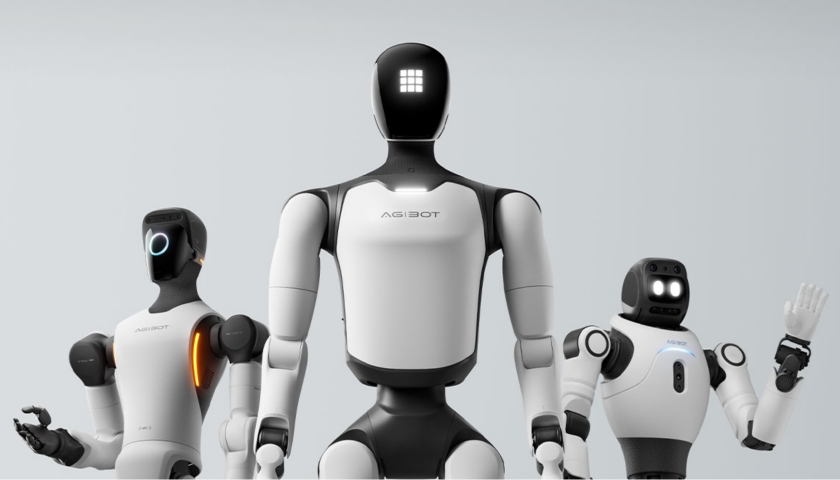
Founded in February 2023 by Deng Taihua and Peng Zhihui, AgiBot positions itself as a general-purpose AI robotics company built around embodied intelligence. It has already assembled a full-stack tech system covering robot hardware, the underlying operating system, and embodied large models. Deng Taihua is a former Huawei VP and president of its computing product line, where he led the buildout of Huawei’s Kunpeng and Ascend AI computing ecosystems. Co-founder, president, and CTO Peng Zhihui—better known as Zhihui Jun—was one of Huawei’s “Genius Youth” recruits and joined in 2020 to work on Ascend AI chips and algorithms.
Today, AgiBot’s product lineup spans Expedition full-size humanoids, Lingxi half-size humanoids, Genie wheeled dual-arm humanoids, and Kutuo quadruped robots, among other series. Real-world deployments cover industrial manufacturing, cultural tourism and commercial performances, research and education, and warehouse services. The company has about 1,500 employees, with R&D staff making up over 75%.
In just over three years, AgiBot’s revenue curve has been climbing fast. In April this year, Deng Taihua revealed at the AgiBot Partner Conference that the company pulled in 1.05 billion yuan in 2025—a huge jump from 60 million yuan in 2024. He said AgiBot is the fastest Chinese robotics company to cross the 1-billion-yuan revenue mark. The plan? Hit 10 billion yuan by 2027, open a second growth curve, and surpass 100 billion yuan by 2030.
The production and delivery ramp is just as aggressive. In March 2026, AgiBot rolled out its 10,000th general-purpose embodied robot. By September, the 20,000th Expedition A3 Ultra came off the mass-production line—a clear sign the company has settled into a 10,000-unit production cycle, with orders getting locked in ahead of time on a regular basis.
With capacity expanding and orders growing, the company officially kicked off its Hong Kong IPO process in July this year—a key step toward the public markets. At the time, investors were floating a target valuation range of HK$40 billion to HK$50 billion.
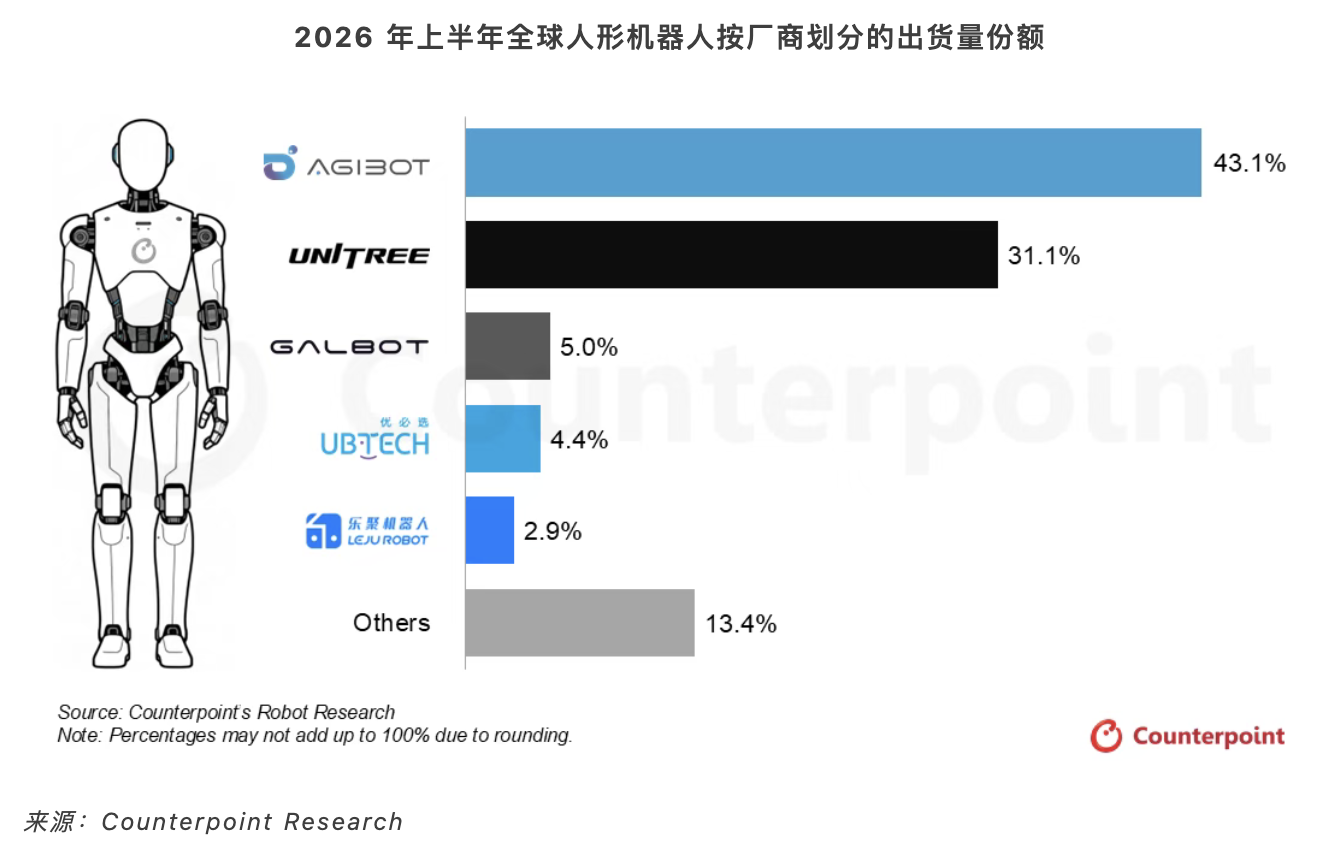
AgiBot also holds the upper hand in market share. A dedicated humanoid robot report from Counterpoint Research in August shows global humanoid robot shipments topped 22,000 units in H1 2026, up nearly 300% year over year—commercialization is clearly speeding up. AgiBot shipped about 9,700 units during the period, giving it over 43% market share and the No. 1 spot among global vendors.
Counterpoint notes that AgiBot’s three main product lines—Expedition, Genie, and Lingxi—are developing in a balanced way. Lingxi X2 has spawned multiple commercial versions tailored for entertainment performances, guided tours and retail assistance, research and education, and data collection. The series is widely used in China’s entertainment and performance rental market. Meanwhile, the Genie series has made real progress in industrial settings: through partnerships with Longcheer and Joyson Electronics, Genie G2 clusters are now doing actual work on consumer electronics and auto-parts production lines.
Unitree Robotics is right behind, shipping more than 7,000 units in H1 for a 31% share. Unitree is another star in the humanoid space, quickly grabbing share with its quadruped and lightweight humanoid products—together with AgiBot, it forms a duopoly. Galbot, UBTECH, and Leju round out the top five, with the five Chinese vendors collectively accounting for 86% of global shipments.
The report shows that while entertainment/performance and education/data collection have seen their share of global humanoid shipments dip, together they still make up more than 60%. That means real demand for smaller humanoids remains strong. Despite new entrants, AgiBot’s Lingxi series and Unitree’s G1 series remain the go-to players in this niche, thanks to mature toolchains and content-creation ecosystems.
Counterpoint Research expects global humanoid robot shipments to surpass 50,000 units in 2026, up 210% year over year. Looking ahead five years, service and industrial scenarios will pick up where entertainment/performance and education/data collection leave off, becoming the core engines of demand growth. And the core competitiveness of humanoid robot makers will shift from simply competing on model capability and production ramp speed to building closed-loop capabilities that cover advanced models, vertical-scenario deployment, data system construction, and rapid model iteration.