NUPIAO Reporter |
Editor | NUPIAO
The annual Snapdragon Summit still kicked off with flagship chips, but this year Qualcomm gave much more stage time to agentic AI. Phones still matter—but they’re no longer the only gateway.
From September 22 to 24 local time, Qualcomm held its 2026 Snapdragon Summit in Hawaii. The company officially launched two flagship mobile platforms: the Snapdragon 8 Elite Gen 6 Supreme and the Snapdragon 8 Elite Gen 6. It’s the first time Qualcomm has rolled out two Snapdragon 8 Elite-class platforms at once, and both put agentic AI front and center.
What’s more interesting than the chip specs is how Qualcomm is redefining the phone’s role.
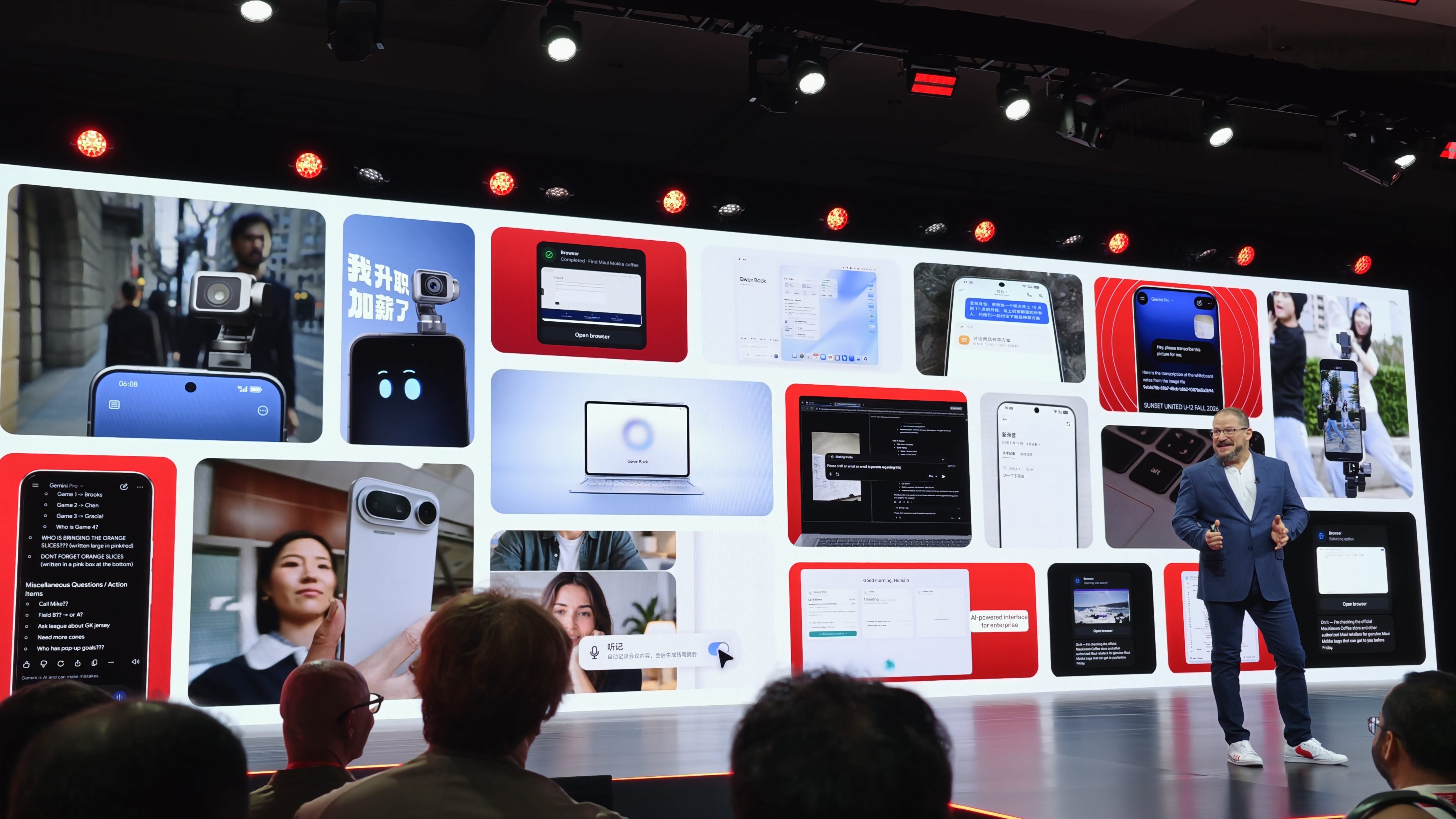
Qualcomm President and CEO Cristiano Amon said at the summit that mobile experiences are shifting from “phone-centric” to “agent-centric,” and the starting point is moving from apps to user intent. Phones won’t disappear, but they’ll evolve from tools you actively operate into key gateways where agents sense context, remember things, and act on your behalf.
Unlike previous years, this isn’t just a concept anymore.

Qualcomm showed a 30B MoE model running directly on a phone, with on-device adaptation done alongside StepFun, Wulianghuo, and Longsys. The demo walked through a full workflow—understanding an email, planning a trip, syncing the calendar, recommending flights and hotels, and drafting a reply—all without calling the cloud.
Frank Meng, chairman of Qualcomm China, is taking a longer view on when device-side agents will truly go mainstream. In an interview with NUPIAO and other media during the summit, he said terminal agents are still at a very early stage. Real device-edge-cloud collaboration—where agents continuously serve a person across phones, glasses, watches, and cars—probably won’t see more substantial rollout until 2027 to 2028.
Just because a chip can run a model doesn’t mean agents have entered daily use. The harder problem now is how to actually connect different vendors, devices, and services. Meng noted that very few companies can cover every device category, and cross-vendor collaboration takes time.
Amon offered a more concrete bar: the agent has to be simpler than doing it yourself—otherwise users will just pick up the phone and open an app. For on-device AI, compute is only the starting point. Whether it can cut steps, maintain context, and earn user trust is what determines if people actually use it.
From Device to Data Center, Qualcomm Expands Its AI Reach
Qualcomm sees this shift as a migration of interaction gateways.
Amon believes agents need to continuously understand user context, reason, plan, remember, and—with permission—execute tasks across apps. Compared with simply answering questions, the real hurdle is being trustworthy, instant, and effortless. Otherwise users will still just open an app and do it themselves.
Rick Osterloh, CEO of Google Platforms and Devices, also shared the stage with Amon. He described the next phase as adding an “intelligence layer” on top of traditional operating systems—moving AI from answering questions to completing tasks, while keeping context continuous across phones, PCs, glasses, and cars.
For Qualcomm, that means on-device AI isn’t just about adding an NPU. CPU, NPU, GPU, storage, connectivity, and the OS all have to work together in new ways.
As for this year’s two chips, both the Snapdragon 8 Elite Gen 6 Supreme and Snapdragon 8 Elite Gen 6 use a 2nm process. The Supreme version packs the new Qualcomm Oryon CPU with 2 prime cores and 6 performance cores, hitting up to 5GHz. The new Hexagon NPU gets 50% more shared memory, and Qualcomm claims up to 80% better prefill performance on some models. The Adreno GPU delivers up to 44% better performance and 40% better efficiency.

The most obvious change this year is that on-device models keep getting bigger. Chris Patrick, senior vice president and general manager of mobile at Qualcomm Technologies, said the new platform combines UFS 5.0 with storage-to-memory management to run 30B-class MoE models from flash storage.
Meng added that a year ago people were mostly talking about 7B and 8B models on-device. Now 30B is already doable, and the industry is starting to ask when 100B models will land on devices.
But bigger models mean the industry has to solve memory, bandwidth, power, and cost issues all over again. Qualcomm’s work with StepFun, Wulianghuo, and Longsys is essentially about using MoE, heterogeneous scheduling, and loading model weights from flash to ease the pressure big models put on RAM. According to Qualcomm, StepFun’s 30B-MoE model needs more than 50% less RAM than a conventional setup.
While hardware improves, AI phone penetration is speeding up. Counterpoint Research estimated in June that generative AI smartphones will account for 45% of global smartphone shipments in 2026.
But “having AI capability” and “creating frequent AI usage” are two different things. The pace of model updates is also putting new adaptation pressure on the device supply chain. Meng said that in the past, a phone could stay adapted for a long cycle; now large models may iterate every three months or even faster.
That shift is forcing Qualcomm to keep expanding beyond its old handset-chip-centric partnership boundaries.
According to Meng, Qualcomm in China now needs to work not just with phone makers but also with auto, PC, industrial terminal, wearable, and robotics companies. With more Chinese large models iterating faster, more of the adaptation work has to be handled by local R&D teams.
This is happening alongside Qualcomm’s own transformation. At its 2026 Investor Day on June 24, Amon said Qualcomm is evolving from a mobile-centric company into a “platform company,” expanding from devices into the edge and data centers.
Qualcomm also raised its fiscal 2029 non-handset revenue target to $40 billion—more than $15 billion from data centers, $10 billion from automotive, and more than $14 billion from IoT. Amon said Qualcomm is pushing further toward a platform company and sees the next three to five years as a growth window for AI data centers, automotive, robotics, and edge computing.
In the interview, Meng explained that Qualcomm wants its revenue mix to gradually become more balanced instead of relying so heavily on phones. Under the Investor Day plan, by fiscal 2029 handsets are expected to fall to about one-third of QCT revenue, while automotive, IoT, and data centers keep gaining importance.
China has long accounted for a high share of Qualcomm’s overall business. Meng hopes that as automotive and data center businesses grow, China can maintain a corresponding contribution.
Qualcomm in China
Another clear change at this year’s summit: Chinese companies have an even stronger presence in Qualcomm’s agentic AI push.
Among the first partners for the two flagship chips are Chinese brands Xiaomi, vivo, OPPO, and Honor. Meng said Chinese phone makers and Qualcomm’s flagship chips have long been tightly coordinated on timing, and in recent years Qualcomm’s flagship SoC launch schedule has been aligned with Chinese vendors’ new phone cadence.
Meng gave an example: Qualcomm used to launch flagship chips in October, but as Chinese vendors wanted to release flagship phones before major sales moments like National Day, the Snapdragon flagship platform launch gradually moved up to September. In his words, Chinese vendors’ product rhythm is now influencing Qualcomm’s flagship chip timing in return.
Beyond product timing, the partnership is extending further into model adaptation, device form factors, and local R&D.
In an interview with NUPIAO and other media, Meng called this AI wave “the best-prepared one for China’s industry” in his career.
He believes China’s AI industry is developing largely in sync with the global frontier this time, with better preparation in funding and talent than in previous tech shifts.
That synchronization is also changing Qualcomm’s relationship with the Chinese market.
Meng told NUPIAO reporters that in areas like large models, agents, and embodied AI, China and the U.S. are the two main innovation markets. “You can’t really say one completely influenced the other,” he said; ultimately, innovation on both sides will involve more mutual learning and complementarity.
Qualcomm itself is adding more R&D muscle in China. Meng said Qualcomm had around 3,000 people in China around 2018; now it has over 6,000 and is still expanding. The Shenzhen team is still growing, and a new technology center has been set up in Chengdu. One direct reason: China has many local models that update quickly, and a lot of adaptation work needs to be done by Chinese R&D teams.
You could see that shift at the summit too. Honor’s AI Robot Phone was shown as an example of an agent terminal, the Doubao phone assistant appeared in the new platform partner information, and StepFun worked with Qualcomm to fully deploy a 30B MoE model on-device.
Meanwhile, domestic AI device strategies are starting to diverge. Meng roughly groups these efforts into three paths: first, traditional phone makers layering AI on top of existing smartphones and operating systems—Honor, Xiaomi, OPPO, vivo, and others; second, hardware makers teaming up with large-model companies, as represented by the Doubao phone; and third, model companies like StepFun extending further into hardware.
The three paths rest on different capabilities. Traditional phone makers have hardware, systems, and channels; large-model companies are extending from model capabilities toward devices. Which combination ultimately works still needs to be proven.
As for which path will win out, Meng thinks it’s still too early to tell. He noted that the phone market demands heavy technology investment, especially long-term commitment. In the next stage, whether an ecosystem is complete will also become a key variable.
That also explains why cross-device agents won’t take shape quickly. Different vendors control phones, glasses, watches, and cars, and making agents run seamlessly across devices will require much more industry collaboration.
At the same time, the smartphone industry is going through a notable cost surge. IDC forecast in August that global smartphone shipments will fall 16.7% year over year in 2026 to just over 1 billion units, while average selling prices will rise 27.6% to $581. Its assessment: NAND and DRAM costs are up more than 300% year over year, and sub-$100 phones are shrinking fast.
Meng’s view is similar. He said memory price hikes hit low-end phones hardest, and there will be more higher-priced phones on the market.
He expects that, based on current trends, memory prices may stop rising as sharply by the end of 2027, but they’re unlikely to fall significantly either. Because memory costs make up a bigger share of low-end phone prices, the impact there is more direct. He thinks this will relatively increase the number of higher-priced products on the market.
Qualcomm’s first dual-flagship launch this year is also tied to cost changes. Meng said advanced processes, AI, and other technologies keep piling on, pushing flagship chip costs higher. So one product continues to show the upper limit of what the technology can do, while the other emphasizes efficiency. Both chips use a 2nm process, and Meng noted that advanced processes themselves bring higher costs—Qualcomm also has to deal with upstream suppliers raising prices.
Meng also mentioned that in the next three or four years, AI and 6G could overlap in a similar time window. Looking back at previous rounds of communications technology shifts, every industry transition brought new players—and saw some former leaders fall behind.
As for device forms further out, Amon didn’t give a definitive answer. He said at the summit that agent experiences won’t stop at smartphones—they’ll extend to PCs, glasses, wearables, and cars. Users will choose the most convenient device for the scenario, and computing tasks will be split between devices and the cloud.
In his vision, phones, PCs, glasses, wearables, and cars “will all become gateways for agents.” And in his view, the agent will become the center of the experience.