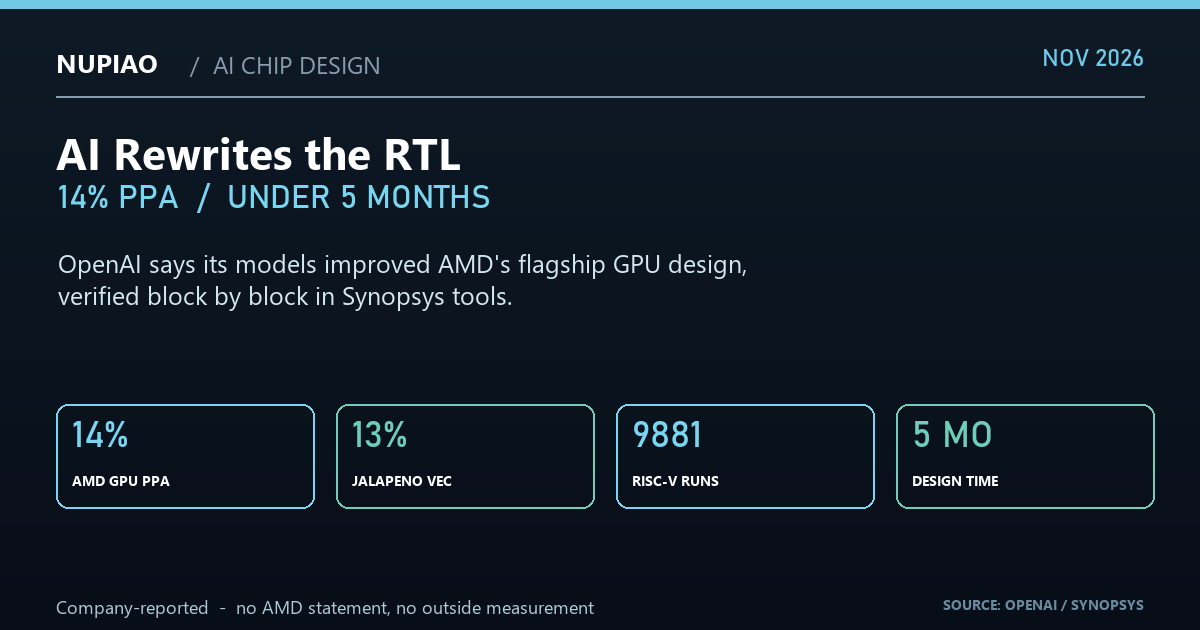
OpenAI said on November 18 that its models delivered up to a 14 percent improvement in power, performance and area on AMD’s flagship GPU design in under five months, with some of the changes already folded into a chip sent to manufacturing. The claim matters less for the number than for the method: the models rewrote the SystemVerilog that describes the circuits, and Synopsys software checked each rewrite to confirm the block still behaved the same way. Here is what was actually measured, what the fine print says, and which parts remain unverified company statements.
Verification note: the figures come from OpenAI’s November 18 post, cross-checked against The Next Web, The Decoder, Tom’s Hardware and a detailed November 19 write-up by MACCUS. AMD had published no statement of its own as of November 19, no outside party has reproduced the measurements, and OpenAI has not said which commercial chip carries the changes.
What PPA means, and what 14 percent does not
PPA is shorthand for power, performance and area — the three numbers chip designers trade against each other. Improve one and you usually pay for it in another. OpenAI says its models found up to 14 percent improvement measured against what it calls heavily optimized baselines of AMD’s design, on top of work AMD engineers had already done over years.
Two limits are worth stating plainly. The post does not say whether the 14 percent sits in power, performance or area, or which blocks of the GPU it covers, so it does not mean the chip runs 14 percent faster. And “roughly a year of progress” is OpenAI’s own estimate, with no method published for how that was calculated.
AMD did verify single-digit percentage gains on key blocks of its next flagship CPU using designs written by the model, according to OpenAI. AMD has not confirmed this publicly. OpenAI also says some of the GPU changes are in a design sent to manufacturing and others are in production design files for future versions, but names no product you can buy today.
| Claim | Reported figure | Status |
|---|---|---|
| AMD flagship GPU PPA | Up to 14% | OpenAI claim, no AMD statement |
| Time to achieve it | Under 5 months | OpenAI estimate, “~1 year of progress” |
| AMD next flagship CPU | Single-digit PPA gains | Reported by OpenAI, unverified publicly |
| Jalapeño vector unit | ~13% smaller cells | OpenAI says silicon-proven |
| Jalapeño matrix unit | ~10% smaller cells | OpenAI says silicon-proven |
| RISC-V benchmark | 9,881 scored runs | Designs not released |
From Jalapeño to AMD
The AMD work grew out of Jalapeño, OpenAI’s first in-house inference chip. The company started feeding the design to GPT-4o in early 2025. Across the project, model-proposed changes shrank standard-cell area by about 13 percent in the vector unit and 10 percent in the matrix unit — the two main computing blocks. OpenAI calls these savings silicon-proven, meaning they held up on physical hardware.
One concrete example: a redesigned multiplier used about 15 percent less cell area in synthesis and finished its calculation in a single clock cycle instead of two. A separate adder design cut cell area by roughly 15 percent while keeping its two-cycle latency. Those are specific, checkable engineering claims, which is more than can be said for the headline 14 percent.
OpenAI published its first Jalapeño results on August 25, saying AI helped the team go from initial design to tapeout in nine months. Tapeout is the point where a finished design is handed to a factory. Using its Codex agent with the GPT-Astra model, the team then brought three open-weight models outside the original plan to high performance within two months.
The RISC-V test and its fine print
To measure raw design ability, OpenAI gave its models two small open-source processor cores, PicoRV32 and Ibex, and asked them to raise throughput — instructions per second. Each design had to pass simulation checks and stay within 16 times the original core’s area. The full run covered 9,881 scored attempts across both cores, all model generations and several token budgets.
At a budget of about 112,000 tokens per run, GPT-6.2 Astra — released on November 17 — scored best on average on both cores. On PicoRV32 its score was roughly double that of the earlier GPT-6 Astra. Every model did better when designing a core from written requirements than when improving an existing one, which OpenAI attributes to the freedom to drop features such as performance counters.
OpenAI is candid about the test’s limits. It says requiring those dropped features, setting a tighter area cap and checking timing after physical synthesis “would make the test more representative of production chip design.” On Hacker News, readers also objected that the charts show scores without units and that the generated designs were never released.
GPT-Synopsys and the EDA angle
Synopsys announced GPT-Synopsys with OpenAI on September 30. The idea is a model that uses electronic design automation tools the way an experienced engineer does, revising a layout repeatedly and handing each pass back for human review. OpenAI’s November post confirms the training work is under way. There is no release date, and Greg Brockman’s September comment — that the company is using its most advanced technology to improve the systems that power AI — is as close to a promise as the two firms have made.
The verification loop is the part that makes this more than a demo. OpenAI’s model rewrote RTL and then used Synopsys tools to check behaviour and measure the power, performance and area trade-off. Richard Ho, OpenAI’s chip chief, said last month he still does not fully trust AI-generated design changes, so each one gets checked. That is a sensible posture, and it also tells you where the human engineer still sits in the loop.
Why the announcements cluster now
There is a second company claim in the same window. On November 16, Tom’s Hardware reported that Anthropic’s investor roadshow video from November 10 showed Claude Mythos Preview bringing one of its models up on AMD MI355X GPUs in about three days, with nearly all the low-level kernels written by the model. A footnote narrows that to prompt processing reaching “a useful level of performance,” a phrase Anthropic never defines. The comparison figure of six to twelve months is drawn from historical experience, not a controlled test.
Both announcements come from companies promoting their own models. Anthropic was days away from its stock market listing, and OpenAI’s post landed in the same week. Neither company has published the designs or the code. Read together, they do point in one direction: AI is being used at both ends of a chip’s life, designing circuits before manufacture and writing the software that runs after delivery. Read separately, they are marketing claims with numbers attached.
What would settle it
Two things would move this from interesting to established. The first is an AMD statement naming the products that carry changes from OpenAI’s models. The second is the release of the RISC-V designs so other teams can measure them. Until then, the honest summary is that OpenAI reports meaningful gains on blocks of existing designs, that a few of those gains have reached silicon in its own chip, and that no outside party has confirmed any of it.
OpenAI plans to start running Jalapeño in its data centres by the end of 2026. Anthropic’s first AMD MI450 chips are expected in the first half of 2027, which will be the real test of whether a three-day bring-up repeats on a new generation. Both dates are close enough that we should have answers within a year.
FAQ
Did OpenAI’s models really improve AMD’s GPU by 14 percent?
OpenAI says so, measured as power, performance and area against heavily optimized baselines. AMD has published no confirming statement, the specific metric is undisclosed, and no shipping product has been named. Treat it as an unverified company claim for now.
What is Jalapeño?
OpenAI’s first custom inference chip, designed to run its models in its own data centres. OpenAI says model-proposed changes cut standard-cell area by about 13 percent in the vector unit and 10 percent in the matrix unit, and that the savings held up on finished silicon. It plans to run the chip in data centres by the end of 2026.
What is GPT-Synopsys?
A model OpenAI and Synopsys announced on September 30 and are now training to operate electronic design automation tools. It is meant to revise chip designs repeatedly for an engineer to review. No release date has been given.
How were the RISC-V designs tested?
Two open-source cores, PicoRV32 and Ibex, were given to models with instructions to raise throughput. Designs had to pass simulation and stay within 16 times the original area. There were 9,881 scored runs in total, and GPT-6.2 Astra scored highest. OpenAI has not released the resulting designs.
Does this mean AI will replace chip engineers?
Nothing in the announcement supports that. OpenAI’s own chip chief says he still does not fully trust the changes and checks each one with Synopsys tools. What the results suggest is a shorter design cycle and a smaller team needed for certain blocks, not a hands-off process.
More hardware coverage in our News section, including our earlier piece on OpenAI’s Jalapeño inference chip. Primary sources: OpenAI , Tom’s Hardware and Synopsys .