miHoYo’s Honkai AI team has published Gamer, a vision-language-action model that plays video games by watching the screen and sending ordinary keyboard and mouse inputs — no engine access, no game-specific API, no privileged memory. The paper landed on arXiv on November 13, 2026, with code released under Apache-2.0, and it reports a generalist agent that holds a conversation, remembers what it already tried and completes long quests in Honkai: Star Rail. It is a research release, not a product, and the team is explicit that it is not a cheating tool.
Verification note: architecture, scores and training details come from the Gamer paper (arXiv:2611.18397) and the official project and GitHub pages, cross-checked with reporting by ITHome and The Verge’s AI desk. Every performance number is self-reported by the authors; no independent reproduction had been published at the time of writing. Streaming-vLLM code and the Star Rail-trained checkpoints are not included in the current release.
What Gamer actually is
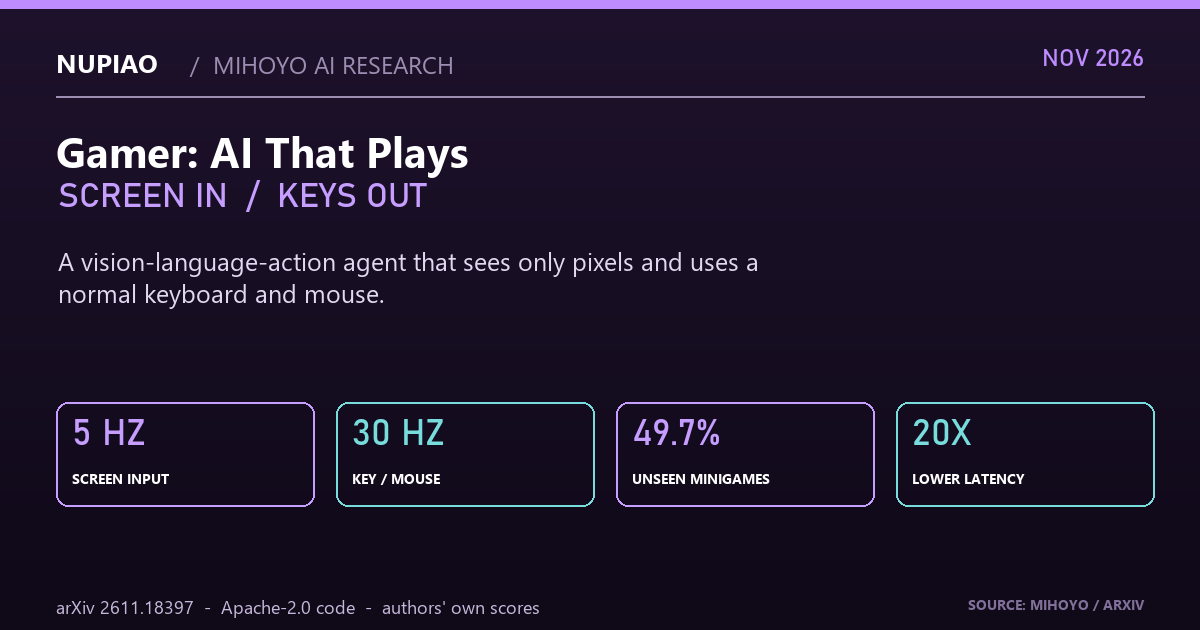
Vision-language-action models, or VLAs, are better known from robotics, where a camera feed becomes arm movements. Gamer applies the same idea to a PC game: the image comes from the display, and the “arms” are a mouse and keyboard. The model takes a screenshot five times a second, reads the task instruction, keeps a short interaction history and a longer written memory, and emits a mouse movement plus six consecutive 33-millisecond blocks of key states. That works out to roughly 30 Hz of control from 5 Hz of observation — the agent plans several small inputs between frames, much as a person carries out a fluid motion without rethinking it every instant.
The important constraint is what the model cannot see. It does not read game memory, call a dedicated API or receive hidden state. Everything it knows arrives through pixels, which is why the authors call it a generalist interface: the same action vocabulary of mouse deltas, key holds and scrolls could in principle drive any game that a person plays with a keyboard and mouse.
How the three-stage training works
Gamer starts from Qwen3-VL-8B and goes through three training phases. Continued pre-training runs on more than 10,000 hours of recorded gameplay with aligned screens and inputs. The Honkai: Star Rail portion alone contains roughly 68,000 sessions and 11,000 hours of raw video, filtered down to about 1,000 annotated hours. The team randomly remaps keys during this stage so the model cannot memorise that a particular button always means “move left”.
Supervised fine-tuning then adds roughly 1.2 million reasoning annotations and 223,000 memory annotations. These teach two behaviours that matter for long tasks. Reasoning is sparse: the model writes out its thinking only at decision points and outputs actions directly when the existing plan still works. Memory is explicit: when older interactions fall out of the context window, the agent writes a compact note of which subgoals are done, what failed and what remains. The third stage is online reinforcement learning with a method the authors call TA-GRPO, where rewards are verified against the game’s own state rather than a learned reward model.
The reported numbers
On two held-out Star Rail side quests, accuracy climbed steadily across the stages. “Opportunity Makes the Thief (Part I)”, a 30-milestone task, went from 34.4 percent after pre-training to 72.2 percent after fine-tuning and 80.0 percent after reinforcement learning. “Bestial Ferocity”, with 55 milestones, reached 83.6 percent. Across 40 minigame instances spanning seven types, the macro-average rose from 15.0 percent to 39.2 percent and finally 49.7 percent.
| Benchmark | CPT | SFT | RL (Gamer-RL) |
|---|---|---|---|
| Opportunity Makes the Thief, 30 milestones | 34.4% | 72.2% | 80.0% |
| Bestial Ferocity, 55 milestones | 47.9% | 69.1% | 83.6% |
| 40 minigames, seven types, macro-average | 15.0% | 39.2% | 49.7% |
| GPT-6.1-Sol on the same minigames | 17.1% | ||
Those minigame comparisons are the most quoted figure, and they are easy to overread. Just under 50 percent means roughly every second unfamiliar task still fails. The paper also reports competitive results on 2D benchmarks such as ViZDoom and GameWorld, but detailed scores are concentrated in one game, and the training setup had access to engine-side state to define tasks and check rewards. The authors describe operational efficiency comparable to skilled players; that remains their claim.
Why latency is half the story
A game agent that thinks too slowly cannot play, no matter how accurate it is. The team built Streaming-vLLM, an inference engine that reuses the model’s cache across turns and dispatches actions before generation finishes. In their test setup — an NVIDIA H200 with the Qwen3.5-35B-A3B MoE model — end-to-end latency fell from 1,306 milliseconds to 65.12 milliseconds, a 20-fold reduction. Faster inference also makes the online reinforcement learning stage more effective, because each rollout takes less wall-clock time.
That dependency matters for anyone hoping to run this at home. Real-time play in the paper relies on a cloud-and-edge serving arrangement and, in the RL setup, 64 H200 GPUs driving 32 parallel game environments. This is not a model you drop onto a consumer graphics card and expect to mirror the published results. Streaming-vLLM code is promised in a future update, and the Star Rail-trained checkpoints will not be released publicly, for data-security reasons.
What it is good for
The practical uses sit on the development side rather than the leaderboard. An agent that follows quest instructions can walk a build and surface broken paths or stuck states — a more realistic testing rig than scripted bots. The memory mechanism addresses the failure mode that sinks long-horizon agents: forgetting what has already been tried. And because actions are expressed at the device level, the same policy family could eventually drive NPC companions that use the same controls as a player. The team, which open-sourced a related project called GameScaling in October, frames all of this as research and explicitly rejects use for cheating, unauthorised access or anything that undermines fair play.
The honest read
Gamer is a solid piece of agent research wrapped in a game that everyone recognises. The screen-only interface is the interesting idea; the scores are a progress report rather than a finished product. For players, nothing changes this week. For studios thinking about automated testing or more capable in-game companions, the released code is worth reading — with the clear caveat that the best results depend on hardware and engine-side scaffolding that are not part of the download.
FAQ
What is miHoYo’s Gamer model?
Gamer is a vision-language-action research model from miHoYo’s Honkai AI team that plays games from screen pixels using ordinary keyboard and mouse inputs. The paper was published on arXiv on November 13, 2026, with Apache-2.0 code on GitHub.
Does Gamer cheat by reading game memory?
No. The authors state it reads no game memory, calls no game-specific API and receives no privileged engine state. It observes five screenshots per second and outputs keyboard and mouse actions.
How well does Gamer perform?
The team reports 80.0% and 83.6% on two Honkai: Star Rail side quests and a 49.7% average across 40 unseen minigames. These are self-reported results, and roughly half of unfamiliar minigames still fail.
Can I run Gamer on my own PC?
Not with the published results. Streaming-vLLM is slated for a later release, the Star Rail checkpoints will not be published, and real-time performance in the paper depends on data-centre GPUs and a cloud-edge serving setup.
Is Gamer meant for cheating in games?
No. The team explicitly states the project is for research and does not endorse cheating, unauthorised access or anything that harms fair play.
For more AI coverage, see our News section. The technical details come from the Gamer paper on arXiv and the official project page, with reporting from ITHome .